Guides / Specifications
ASTM A105 vs A350 LF2: Which Carbon Steel Forging Grade Do You Need
October 13, 2026
A105 and A350 LF2 are the two carbon steel grades buyers see most often on forged flanges, fittings and valve parts. They look nearly the same on paper, and many buyers wonder why LF2 costs more. The difference is toughness at low temperature, backed by a required impact test. This guide compares the two, explains where each is used and shows what to put on an RFQ so you get the grade the pipe system needs.
What the two specifications cover
ASTM A105 covers carbon steel forgings for piping components used at ambient and higher temperatures. It is the default specification for forged flanges, fittings, valve bodies and similar parts in oil, gas, water, steam and general process piping. The chemistry is simple: carbon up to 0.35 percent, manganese about 0.60 to 1.05 percent and silicon about 0.10 to 0.35 percent. Minimum tensile strength is 485 MPa and minimum yield is 250 MPa, with elongation of at least 22 percent and a maximum hardness of 187 HBW.
ASTM A350 LF2 covers carbon and low alloy steel forgings for piping components that need notch toughness at low temperature. LF2 is the carbon-manganese-silicon grade in the specification. It has similar strength limits, 485 to 655 MPa tensile and 250 MPa minimum yield, but it adds a Charpy impact test at minus 46 degrees Celsius and a maximum hardness of about 197 HBW. Class 1 is normalized, or air cooled and tempered. Class 2 is quenched and tempered for higher strength.
The ASME versions carry the SA prefix, so SA-105 and SA-350 LF2, and they appear in pressure design codes and in flange standards such as ASME B16.5 and B16.47.
Side by side
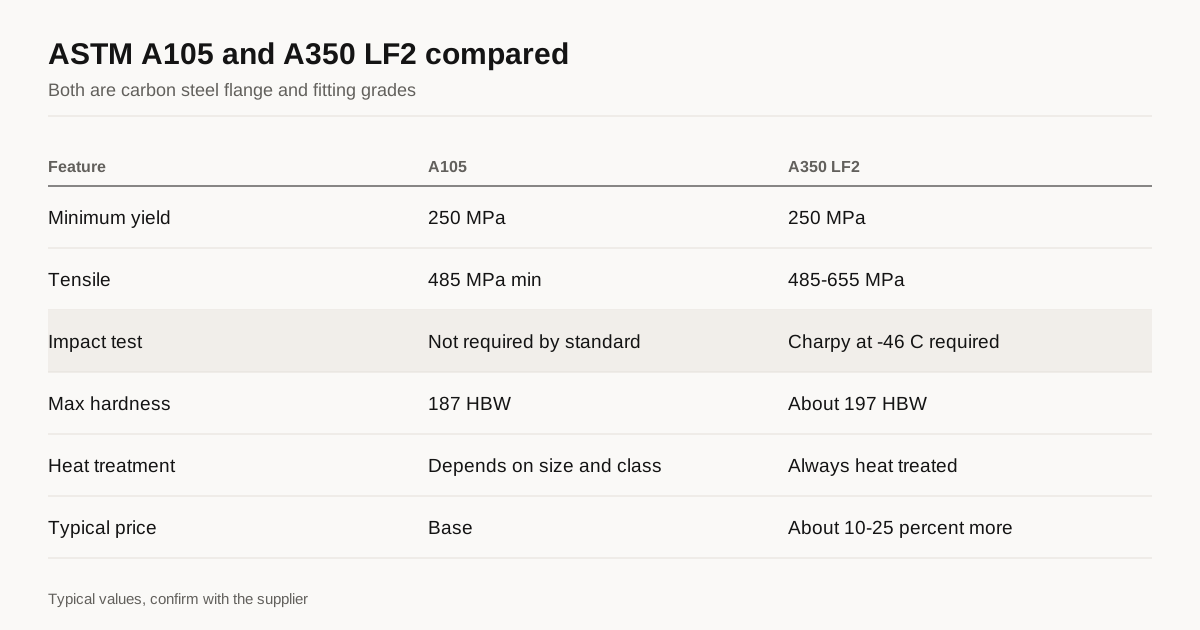
| Feature | A105 | A350 LF2 |
|---|---|---|
| Intended service | Ambient and higher temperature | Low temperature, notch toughness required |
| Typical chemistry | C 0.35 max, Mn 0.60 to 1.05 | C 0.30 max, Mn 0.60 to 1.35 |
| Minimum yield | 250 MPa | 250 MPa |
| Tensile range | 485 MPa min | 485 to 655 MPa |
| Maximum hardness | 187 HBW | About 197 HBW |
| Impact test | Not required by the standard | Required, Charpy at -46 °C |
| Heat treatment | Depends on size and class, often normalized | Normalized or Q&T, always heat treated |
| Typical price | Base | About 10 to 25 percent more |
Check the current edition of each standard before quoting, because limits and rules change between editions, and dimensions of flanges follow separate standards.
Impact testing, in plain words
A Charpy test breaks a small notched bar with a swinging hammer and measures the energy absorbed. Steel that is tough at room temperature can turn brittle at low temperatures, so impact energy drops sharply below a transition temperature. A brittle break in a pressure part can be sudden and large, so piping codes require tested toughness whenever the minimum design metal temperature is low enough.
LF2 must show minimum Charpy energy at minus 46 degrees Celsius. A typical requirement is an average of about 20 J across three specimens, with no single value below about 16 J, for full size specimens. Heavy parts and smaller specimens have adjusted limits. A105 has no such requirement in its own standard, but a buyer can add impact testing as a supplementary requirement, and normalized A105 often passes at moderate cold temperatures.
The choice between the two is set by the design code, not by preference. Codes such as ASME B31.3 give rules for when impact testing is needed, based on the minimum design temperature, the material and the thickness. Ask the design engineer for the minimum metal temperature, and write the grade that matches.
Heat treatment
Heat treatment is another difference. In A105 the rules depend on size and pressure class. Smaller, lower class parts may be supplied as forged, while larger or higher class parts must be heat treated, usually by normalizing. Many suppliers normalize all A105 and mark it A105N to remove doubt. In LF2 heat treatment is always required. Class 1 parts are normalized, or air cooled from the forging temperature and tempered, which refines the grain and gives the toughness the impact test needs. Class 2 is quenched and tempered. Our guide to heat treatment of forgings explains what each treatment does.
Heat treatment explains most of the price difference. LF2 needs a full furnace cycle on every part, plus impact test coupons, plus extra paperwork. A105 can often skip some of that on small sizes.
Where each is used
| Application | Typical grade |
|---|---|
| Water, steam and general process piping, ambient climate | A105 |
| Oil and gas flowlines in moderate climates | A105 |
| Pipelines and process in cold regions, below about minus 29 °C design temperature | LF2 |
| Cryogenic service below minus 46 °C | LF3 or austenitic stainless steel |
| Subsea and offshore with low sea temperature | LF2 or project specification |
| Sour service with hardness limits | A105 with added hardness limit, per NACE rules |
A third grade is worth knowing. A350 LF3 has 3.5 percent nickel and is tested at minus 101 degrees Celsius. For colder service, austenitic stainless steels such as F304L or F316L, as covered in our guide to stainless steel forgings, keep their toughness at very low temperatures.
Flanges and fittings in practice
Most A105 and LF2 forgings are flanges, fittings and valve bodies, and the shape follows dimensional standards. Flanges are forged to ASME B16.5 sizes and pressure classes. Weld neck, slip-on, blind and socket weld types each have a standard profile, which keeps tooling and tolerance simple. Our guide to forged flanges covers the types. Valve bodies are covered in forged valve bodies.
Because these parts are standard, price pressure is high and quality varies. Marking is a good first check. A compliant flange has the manufacturer name or mark, the standard, the grade, the size, the pressure class and the heat number stamped on the rim. A missing or unclear marking is a reason to ask questions before the order, not after it ships.
Documents to ask for
For any pressure forging, ask for a material test report that links the heat number to chemistry, mechanical test results and heat treatment. For LF2, the report must show impact energy values, test temperature and specimen size. EN 10204 type 3.1 is the common certificate form, issued by the manufacturer’s authorized inspector, and type 3.2 adds a third party witness. Our note on forging certifications and specs explains the difference, and the cost of each.
Test frequency and who witnesses
How many parts are tested matters as much as the test limits. The standards set the frequency in terms of heat treatment lots. For A105, tensile and hardness tests are taken from each heat-treated lot, and the lot size depends on part size. For LF2, impact tests are taken from each lot as well, with three specimens per set. A lot is a group of parts of the same heat, the same heat treatment cycle and a similar size, so a large order may contain several lots, each with its own test results. Ask how the supplier defines a lot and check that the test report lists every lot in your shipment. A report that covers only one lot of a ten-lot order tells you little about the rest.
If the project needs independent proof, a third party inspector can witness the tests and sign the certificate. That adds cost and time, so agree it at the quote stage and say which tests are witnessed. Our guide to forging certifications and specs shows how certificate levels differ.
Sour service and hardness
Oil and gas systems that handle hydrogen sulfide are called sour service. In them, high hardness makes steel liable to sulfide stress cracking, so standards such as NACE MR0175 and ISO 15156 limit hardness and sometimes chemistry. A105 for sour service is normally supplied with a maximum hardness of about 22 HRC and often with limits on carbon equivalent and residual elements. These are extra requirements on top of A105, and they need to be written on the order. An ordinary A105 flange that happens to be under the hardness limit is not the same as one tested and certified to the sour service rules, and the certificate should say which one you are buying.
Mistakes buyers make
The most common mistake is to order the lower cost grade to save money and then find that the project specification needed impact testing. Replacing a shipment of flanges is far more expensive than paying the difference at the start. A second mistake is to specify only the material and not the flange standard, pressure class and facing, which leaves the supplier guessing about dimensions. A third is to accept a certificate that does not show the heat number on the part. A fourth is to compare quotes where one includes normalizing and impact tests and another does not, which makes the cheaper one look better than it is.
The fix for all of these is the same. Write the complete designation, name the standards and editions, and ask every supplier to list what is included in the price, including heat treatment, tests and certificates. Quotes then line up, and the differences that remain are real.
Stock, lead time and traceability
Standard sizes of A105 flanges are stocked widely, and large orders of common sizes can ship quickly. LF2 is stocked less widely, and special sizes or higher classes often need to be forged to order. Forging to order takes longer, because the steel must be bought or cut, the part forged and heat treated, tests completed and certificates issued. For project work, plan the schedule around the test and certificate steps, not just the forging step. Traceability from the steel heat to the finished part is part of what you pay for, so insist that the heat number is stamped on the part and appears on the certificate. A forging that cannot be traced to a heat is not suitable for pressure service, regardless of how it looks.
What to put in the RFQ
Write the full designation, for example ASTM A350 LF2 Class 1 flange to ASME B16.5, with edition and pressure class. Give the minimum design metal temperature if you have it, the testing and certificate type, the marking requirements and any supplementary requirements. State the quantity per size. If you will accept either grade for a mild climate, say that you want both prices. Ask for dimensions to be checked against the flange standard.
Next step
Send an RFQ with the flange or fitting list. We match you with up to 3 forging suppliers who make these grades in your sizes, and we reply within 24 business hours. For the wider checklist, read how to choose a forging supplier.
See also: ASTM A105 carbon steel forgings, the reference page on the standard itself.
See also: ASTM A266 and A181 carbon steel forgings, for pressure vessel parts and non-standard fittings.
Frequently asked questions
Can I use A105 flanges instead of LF2 in cold service?
Only if the design code and your engineer agree. LF2 is impact tested at minus 46 degrees Celsius, which A105 is not required to be. A105 can be used in cold service when the design code allows an impact test exemption or when you order extra impact testing, but that decision belongs to the design engineer.
Is LF2 stronger than A105?
Not by much. Both have a minimum yield of 250 MPa and a minimum tensile of 485 MPa. LF2 has a maximum tensile strength as well and tighter heat treatment, with a required impact test. The reason to choose LF2 is toughness at low temperature, not strength.
Can the same forging meet both A105 and LF2?
Sometimes. A normalized forging with suitable chemistry may meet both, and some suppliers sell dual certified parts. Dual certification needs both sets of tests, so confirm it before you quote on that basis.
Need a quote for this part?
Send the drawing. We match you with up to 3 forging suppliers and reply within 24 business hours.
Send my RFQ