Guides / Process
Forged Valve Bodies for Oil, Gas and Water Service: Materials, Standards and Sourcing
October 22, 2026
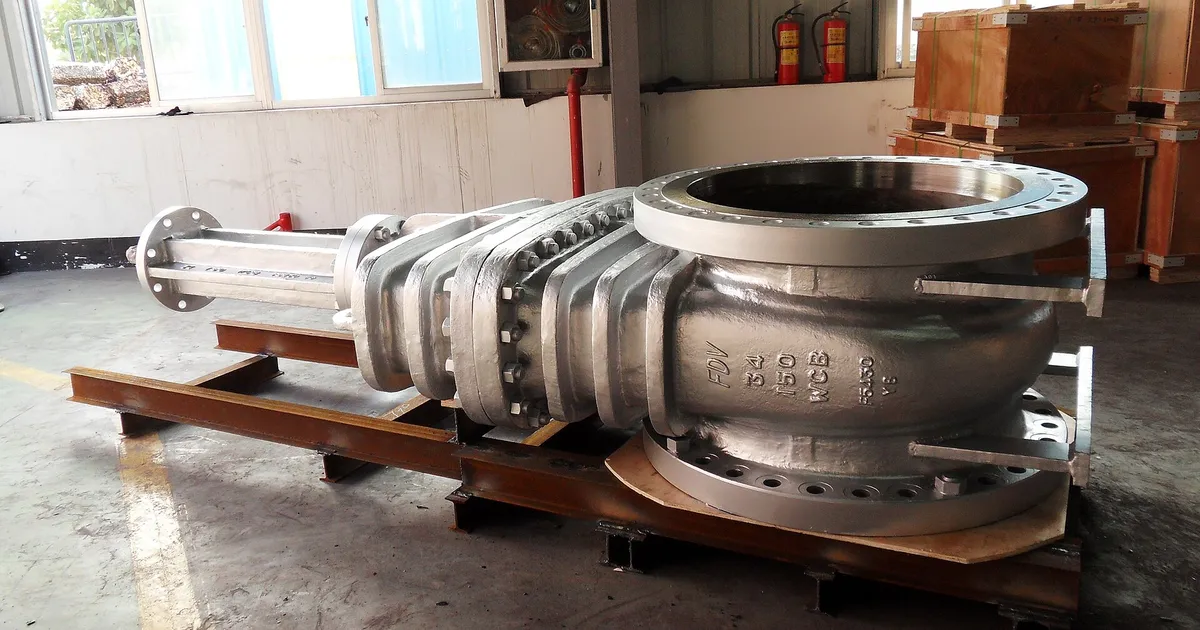
A valve body is a pressure vessel with a hole through it. It holds fluid at pressure, takes pipe loads and carries the seat and stem. Oil, gas and water systems use millions of them, and a large share are forged. A valve maker buys forged bodies as blanks that it machines, so the quality of the forging decides the pressure test pass rate and the field life. This guide covers when forging is chosen, which materials and standards apply, how bodies are made and what to put in an RFQ.
Forged or cast
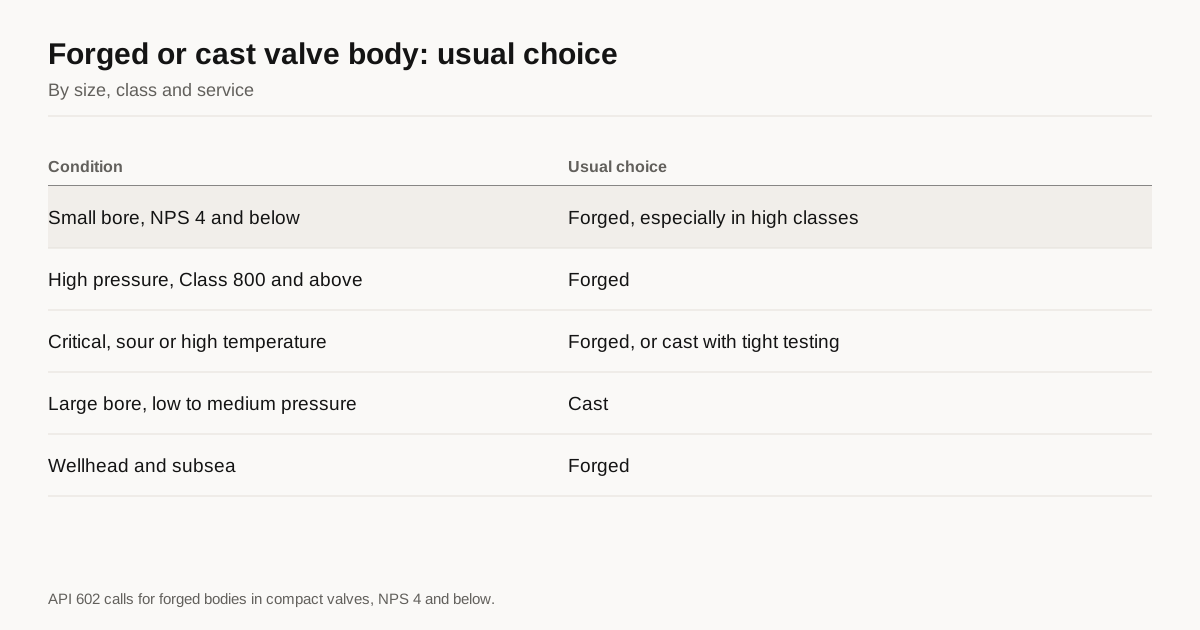
Valve bodies are either cast or forged, and each has a place. Casting suits large sizes and complex internal shapes, and it is cheaper at moderate pressure. Forging gives denser metal with no shrinkage porosity, higher strength for the section and better consistency. The usual split is:
| Condition | Typical choice |
|---|---|
| Small bore, NPS 4 and below | Forged, especially in high pressure classes |
| High pressure, Class 800 and above | Forged |
| Critical, sour or high temperature service | Forged, or cast with tight testing |
| Large bore, low to medium pressure | Cast |
| Complex shapes with internal passages | Cast, or forged and machined in pieces |
| Wellhead and subsea equipment | Forged |
Many specifications require forgings in the smaller sizes. API 602, for compact steel gate, globe and check valves in NPS 4 and below, calls for forged bodies. Our guide to forging against casting and machining sets out the general comparison.
Standards
| Standard | Covers |
|---|---|
| ASME B16.34 | Pressure and temperature ratings, dimensions and testing for flanged, threaded and welding-end valves |
| API 602 | Compact steel gate, globe and check valves, NPS 4 and smaller |
| API 600 | Bolted bonnet steel gate valves for petroleum and gas |
| API 6D | Pipeline and piping valves |
| API 6A | Wellhead and Christmas tree equipment |
| API 598 and ISO 5208 | Valve inspection and pressure testing |
| ASTM A105, A182, A350 | Forged materials for valve bodies and parts |
Check current editions, since material groups and ratings are revised from time to time.
Materials by service
Material depends on fluid, temperature, pressure and corrosion.
| Service | Typical forged material |
|---|---|
| Oil, gas and general process, moderate temperature | ASTM A105 carbon steel |
| Low temperature, cold regions | ASTM A350 LF2 |
| High temperature steam and hydrocarbons | ASTM A182 F11, F22 |
| Corrosive chemicals, food, marine | ASTM A182 F304, F316, F51 duplex |
| Sour service | A105 or low alloy with hardness limits per NACE MR0175 |
| Water and gas, small sizes | Forged brass, CW617N or lead-free alloys |
| Seawater and aggressive service | Duplex, super duplex, nickel alloys |
Our guides to A105 against LF2, stainless steel forgings and brass forging alloys cover the grades in detail.
How bodies are forged
Small valve bodies, up to about NPS 4, are forged in closed dies from round bar. A slug is heated, formed in a press or hammer into a shape with flanged or threaded ends, a bonnet pad and a boss for the stem, then trimmed and heat treated. The bore is not forged in, because the forging would need a core. The valve maker drills and bores it. For larger bodies, forgings may be made as blocks with machining allowance, and for very large bodies, rings or open die blocks are used. Seamless rolled rings are also used for flanged bodies, as in our guide to seamless rolled ring forging.
Brass bodies are hot forged at lower temperature in presses, and the part can leave the die with a fine finish and detailed shape, needing only the bore and threads to be cut.
Machining stock and tolerances
A valve maker machines the bores, seats, flange faces, threads and bonnet mating faces, so the forging only needs a good shape and enough stock. Typical stock per side on a closed die steel body is about 2 to 4 mm on small bodies and 4 to 8 mm on larger ones, with more on open die blanks. Wall thickness at the thinnest section after machining must meet the minimum in the standard, so the forged wall must be thick enough with allowance for mismatch and distortion. Our guide to forging tolerances and draft angles explains how stock and tolerance combine.
Consistent shape matters for machining. If bodies vary in size or are bent, the valve maker’s fixtures and cutting programs cannot hold them reliably. For high volume, ask for process capability data on key dimensions.
Testing
Valve bodies carry pressure, so testing is thorough. For forgings, typical tests include chemical analysis, tensile and hardness tests, impact tests for low temperature grades and a visual and dimensional inspection. Surface testing by magnetic particle or penetrant inspection finds cracks and laps. For higher classes and critical service, ultrasonic testing checks internal soundness, as in our guide to ultrasonic testing of forgings. ASME B16.34 has a special class with extended examination requirements. After machining and assembly, the valve maker does the pressure tests. The shell test is a hydrostatic test at 1.5 times the rating, and the seat tests follow API 598 or ISO 5208.
Material certificates in EN 10204 type 3.1 tie the forging to heat number, chemistry and test results. Positive material identification is common on alloy bodies. Sour service parts need hardness records.
Common problems
Valve makers see a few repeat problems on forged bodies. Laps and cracks near the bore or flange show up after machining and cause pressure test failures, which is expensive when the body has already been machined. Porosity or inclusions at the centre of a thick section can open into the bore. Distortion and mismatch lead to thin walls on one side. Wrong material or missing heat treatment shows up at the test lab or in the field. Ask suppliers how they prevent each: billet inspection, die maintenance, controlled heat treatment, PMI on every heat, and an agreed sampling plan for ultrasonic or surface inspection.
Body styles and forged shapes
Each valve type calls for a different forged shape. A gate valve body is a long block with a straight bore, flanged or threaded ends and a neck for the bonnet, and the forging includes the bonnet pad. A globe valve body has an S-shaped flow path with a seat between the inlet and outlet, which the forger approximates with bulges that the valve maker machines. A swing check body has a cap opening for the disc. A ball valve body is often made in two or three pieces, a main body and one or two end pieces, and each piece is forged or cut from bar. Forged shapes are simplified compared to the finished valve, because the dies cannot form internal passages, so passages are drilled. This is why a valve maker’s drawing of the forging looks different from the valve, and why you should agree the forging drawing with the maker.
Pressure classes and wall thickness
Valve rating classes follow the same pattern as flanges, such as Class 150, 300, 600, 800, 900, 1500 and 2500. ASME B16.34 sets the minimum wall thickness for each size and class, and the forged body must have enough wall after machining. A pressure class is not a pressure value. Allowed pressure falls as temperature rises, in tables by material group. For small forged valves, Class 800 is common, with socket weld or threaded ends, and Class 1500 is common for high pressure service. For a high class, wall thickness and structure at the body neck are critical, so ultrasonic testing is common. If you are redesigning a valve for a different class, tell the forger early, because wall thickness changes the forging shape and the die.
Forged against bar stock
Very small valves, such as instrument valves and some ball valves below about NPS 1, may be machined from bar instead of forged. Bar stock gives a clean, consistent material with no die cost, and small quantities are easy to supply. Forging pays back when volume rises, because it saves metal and cutting time, and because the grain follows the shape. For brass ball valves in water and gas, forging is the standard route, as the material is cheap to forge and the volumes are large. For stainless steel and alloy bodies in small runs, bar stock is common. Run the numbers for your volume, as in forging die cost, and ask suppliers to quote both when you are near the crossover.
Tooling for valve bodies
Valve body dies are costly because the shapes are complex, with bosses, pads and uneven sections. Valve makers often use family dies, in which one die serves several sizes with inserts, to cut cost. Check who owns the die, where it is stored and what happens if you move supply. The ownership of dies and of the forging drawing should be written into the purchase terms. Die life depends on material, with stainless steel and alloys wearing dies faster than carbon steel and brass. For a size range, ask suppliers to propose a die family and the volume at which it pays back.
Project documentation
Valve orders for projects need paperwork as well as parts. A manufacturing data record, or MDR, collects material certificates, heat treatment charts, test reports, drawings and inspection results for each valve or lot. Forging suppliers contribute their part, which is the material test report, the heat treatment record and the test results for the forging. For a valve maker with project customers, ask the forging supplier whether it can provide the records in the format your customers need and by when. A forging without records cannot be used on a documented order, so agree this before the order, not after delivery. Our guide to forging certifications and specs explains the certificate levels.
Lead time
Lead time for forged valve bodies depends on whether the die exists. For existing dies and standard grades, delivery takes a few weeks to a few months, depending on the supplier’s schedule. A new die adds several weeks for tooling and first articles. Steel with special requirements, such as sour service or impact tests, takes longer because of the extra testing. Plan for first article approval and a trial machining run before releasing a large order, since a body that looks right can still prove hard to machine or test.
Fugitive emissions and fire tests
Some valve specifications go beyond pressure strength. Fugitive emission tests, such as ISO 15848, check stem and body leakage in service and place demands on bore finish and stem sealing. Fire-safe tests, such as API 607 and ISO 10497, check that a soft seated valve holds under fire. These tests belong to the valve design, not the body forging, but the forging has to be sound and dimensionally stable for the valve to pass. If you are a valve maker, share these requirements with the forging supplier so that they understand what the body must do.
What to put in the RFQ
Give the forging drawing with machining allowance, the material and standard with edition, the heat treatment and the test requirements. State the pressure class, the size, the service conditions, NACE or low temperature needs, and the certificate type. Add the yearly quantity, batch size, tooling ownership and first article requirements. If you want the supplier to propose a forging shape from your finished drawing, say so and give the volume.
Next step
Send an RFQ with the drawing or valve list. We match you with up to 3 forging suppliers who make valve body forgings in your size and grade, and we reply within 24 business hours. For the wider checklist, read how to choose a forging supplier.
See also the reference pages on ASTM A105 and ASTM A182.
See also: ASME B16.5 and B16.34 for forged flanges and valve bodies, on pressure classes and material groups, and NACE MR0175 / ISO 15156 for sour service forgings.
Frequently asked questions
When should a valve body be forged instead of cast?
Forged bodies are typical for small valves, high pressure classes and critical service, such as API 602 compact valves, API 6A wellhead equipment and Class 800 and higher valves. Casting is more common for larger sizes and complex shapes at lower pressure, where a casting is cheaper.
Which standards cover forged valve bodies?
Common ones are ASME B16.34 for pressure and temperature ratings, API 602 for compact steel valves, API 600 and API 6D for gate valves and pipeline valves, and ASTM A105, A182 and A350 for the forged material. Testing follows API 598 or ISO 5208.
Do forged brass valve bodies work for gas and water?
Yes, forged brass is common for small ball and gate valves in water, gas and heating, within the pressure and temperature limits of the valve standard. Potable water uses dezincification resistant or lead-free brass where local rules require.
Need a quote for this part?
Send the drawing. We match you with up to 3 forging suppliers and reply within 24 business hours.
Send my RFQ