Guides / Process
Forging Lead Time: What to Expect From Die to Delivery
November 3, 2026
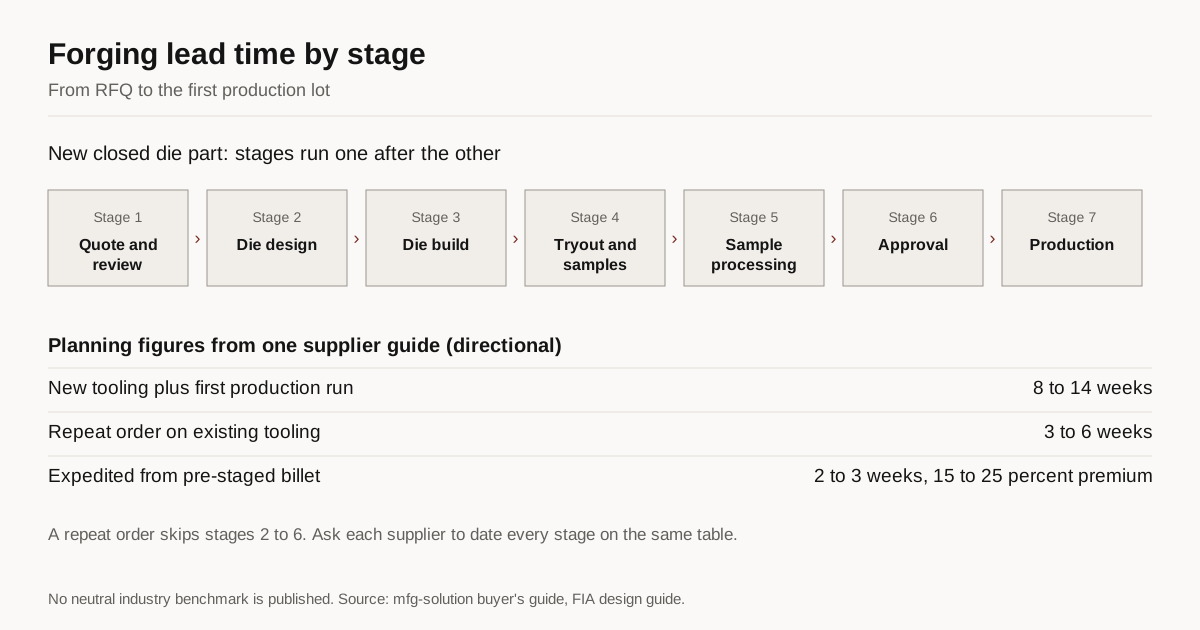
Forging lead time for a new closed die part is the sum of several clocks that run one after the other: die design and build, first samples, buyer approval and then production. A repeat order on existing tooling is far shorter. There is no neutral industry benchmark for the weeks, so any single figure you hear is a supplier’s planning number. This guide breaks the schedule into stages, gives the ranges that published supplier sources do offer, flags how far to trust them and lists what to ask so that two quotes can be compared.
The stages of a new closed die part
Closed die forging needs tooling that is built for your part. Those dies come first, and nothing else starts until they exist. A typical program has these stages:
| Stage | What happens | What you should ask |
|---|---|---|
| Quote and review | Supplier reviews the drawing, proposes parting line, draft and allowances | Which drawing changes are needed before the die is cut |
| Die design | Blocker and finisher impressions, flash gutter, trim die | Who approves the die design and how long you have to respond |
| Die build | Steel is bought, machined, heat treated, finished and fitted | Start date, and whether steel is in stock |
| Tryout and first samples | Dies are run, parts are forged and measured | How many samples, and in which heat treated state |
| Sample processing | Heat treatment, machining, testing and layout inspection of the samples | Whether this is inside the quoted lead time |
| Approval | You check the samples, usually with a first article report | How many days you have to approve, and what happens if a die needs correction |
| Production release | First production lot, then regular deliveries | Lot size and shipping terms |
This matches how suppliers describe a full program. One US forging sourcing page lists sample forgings, tool approval, heat treatment, shot blast, rough machining, final machining and hardness checks among the items of a full program, advises that samples, heat treatment, machining and inspection be quoted together and says tooling cost, ownership, sample timing and expected tool life should be clarified before launch. The Forging Industry Association makes the same point from the other side: the cost and lead time of forging tools can be too high for prototyping, which is why other processes are often used for early parts.
Planning ranges, and how far to trust them
Published numbers come from suppliers, not from a survey, so treat them as directional:
- A buyer’s guide from a forging supplier puts quoted lead times at 6 to 14 weeks for custom tooled parts, 8 to 14 weeks for new tooling plus the first production run and 3 to 6 weeks for repeat orders with existing tooling.
- The same guide says expedited programs from pre-staged billets can compress to 2 to 3 weeks, typically at a 15 to 25 percent premium.
- A US forger describes a case where the traditional lead time for a set of parts was around two months, and where it made tooling at a fraction of closed die cost to turn parts around in four weeks. When the closed die supplier ran short, lead times for the same forgings stretched to between eight months and a year.
The last point matters. Lead time is a range, and it moves with capacity, steel supply and rework. A quote that says “6 weeks” is a promise only for the day it was written.
What lengthens the schedule
Delays in forging rarely come from the press. They come from the stages around it:
- Die correction. If samples miss dimensions or show a fill problem, the die is corrected and tried again. Each loop adds a tryout and a measurement round. Our guide to forging defects explains the usual causes.
- Outside processes. Heat treatment, machining or non-destructive testing done at another shop adds transport and queue time.
- Alloy supply. Special alloys may need a mill order. Ask for the material lead time separately for nickel alloy or titanium parts.
- Incomplete RFQs. The same supplier guide says missing information can add 1 to 2 weeks to the quote cycle.
- Slow approval on your side. The clock keeps running while samples sit on a desk.
What shortens it
- Existing tooling. A supplier that already has a die close to your shape can sometimes adapt it. One forger says it holds more than 10,000 tools in its hammer shop, which is a claim you can ask about for your own part.
- Open die for the first lots. Open die forging uses standard dies, so the FIA describes tooling cost as not significant, and a supplier can start without a die build. Our comparison of open die vs closed die forging shows when that is a reasonable bridge.
- A complete RFQ. Drawing, specification, quantity and finished state in one message save the questions-and-answers loop.
- Early sign-off on die design. Approve the parting line and draft quickly. Changes after the die is cut cost time and money.
- Planned samples. Say which tests you need on the first samples, so the supplier schedules them in one pass.
- Pre-agreed approval. Agree on the first article format in advance. See forging tolerances and draft angles for what the drawing must state.
How to compare two lead time quotes
A lead time figure only means something when you know what it counts. Ask both suppliers to fill in the same table:
| Milestone | Supplier A | Supplier B |
|---|---|---|
| Die design approved by you | week | week |
| Die finished | week | week |
| First samples forged | week | week |
| Samples heat treated, machined and tested | week | week |
| Samples at your door | week | week |
| First production lot shipped | week | week |
| Repeat order lead time | weeks | weeks |
Count from the day the purchase order and the approved drawing are in the supplier’s hands. State the finished state (as-forged, heat treated, machined) and the Incoterm. A supplier who quotes to the forging only and another who quotes to a finished, tested part are not offering the same lead time.
Put it in the RFQ
Ask each supplier to list the dates above, to say whether steel is in stock and to name the stage where your approval is needed. Send an RFQ with the drawing, the alloy and specification, the yearly quantity and the date you need first samples. We match you with up to 3 forging suppliers that fit the process, alloy and weight, and we reply within 24 business hours. For the cost side of the first order, read forging die cost.
Lead time is also a cost line; our guide to forging cost shows how it fits the rest of the quote.
Sources
- Forging Industry Association, Product Design Guide for Forging: prototyping and tooling lead time, open die tooling.
- Closed die forging buyer’s guide, mfg-solution: supplier lead time ranges (directional).
- Scot Forge, closed die alternatives case study: two month, four week and eight month to one year lead times in one case.
- SanCo Sales, closed die forgings: stages that may be quoted together and sample timing.
Frequently asked questions
How long does a new closed die forging take from order to delivery?
No neutral benchmark is published. One supplier guide gives 8 to 14 weeks for new tooling plus the first production run, and 3 to 6 weeks for repeat orders on existing tooling. Treat these as planning figures and ask each supplier to date every stage.
Why is the first order so much slower than repeat orders?
A new part needs a die set designed, built and tried out, then samples measured and approved before production starts. A repeat order skips all of that, so only material, forging, heat treatment and shipping remain.
Can forging lead time be shortened?
Sometimes. Using an existing die, accepting a different process for the first lots, sending a complete RFQ and approving samples quickly all save time. Expedited runs from pre-staged billet are offered by some suppliers at a premium, which one guide puts at 15 to 25 percent.
Does the quoted lead time include heat treatment and machining?
Not always. One supplier may mean forging only, another includes heat treatment, machining and testing. Ask for the lead time to the finished state you will receive, and for the stages listed separately.
Need a quote for this part?
Send the drawing. We match you with up to 3 forging suppliers and reply within 24 business hours.
Send my RFQ