Guides / Materials
Titanium Forgings: Grade 5 Billet, Die Cost and Material Yield Explained
October 29, 2026
Titanium forgings go into aircraft structures, jet engines, medical implants, marine hardware, chemical equipment and high performance vehicles. The metal is light, strong and corrosion resistant, and it is also expensive and awkward to forge. Buyers who treat it like steel are surprised by the quote. This guide explains Grade 5 billet, the forging window, why die cost and material yield matter so much, and how to write an RFQ that gets comparable answers.
Grade 5 and the other grades
Titanium comes in commercially pure grades and alloys. Grades 1 to 4 are unalloyed, with strength rising from Grade 1 to Grade 4 as oxygen and iron content go up. They are used for corrosion resistance in chemical and marine equipment. Grade 5, the alloy Ti-6Al-4V, has about 6 percent aluminum and 4 percent vanadium and is the standard choice for strength. Grade 23, also called Ti-6Al-4V ELI, has lower oxygen and iron for better toughness and is used in implants and cryogenic parts. Other forged alloys include Ti-6Al-2Sn-4Zr-2Mo for higher temperature use in engines and beta alloys such as Ti-5553 for very high strength.
Density is about 4.43 g/cm3, around 57 percent that of steel. Annealed Grade 5 has a typical tensile strength of about 900 to 1,000 MPa and yield of about 830 to 900 MPa, similar to a medium strength alloy steel at much lower weight. Grades 1 to 4 are weaker and more ductile.
Standards
Common specifications for titanium forgings are:
| Standard | Covers |
|---|---|
| ASTM B381 | Titanium and titanium alloy forgings, by grade |
| AMS 4928 | Ti-6Al-4V bars, wire, forgings and rings, annealed |
| AMS 4965 | Ti-6Al-4V bars, forgings and rings, solution treated and aged |
| ASTM F136 | Ti-6Al-4V ELI for surgical implants |
| MIL-T-9047 and customer specifications | Aerospace bar and forgings |
Check the current edition on your drawing. Aerospace and medical parts usually add customer approvals and specific test requirements, such as microstructure limits and ultrasonic testing, on top of the base standards.
The forging window
Titanium has a narrow forging window and is sensitive to how it is handled. Ti-6Al-4V has a beta transus of about 995 degrees Celsius, the temperature above which the structure changes to a single phase called beta. Most forging is done just below it, in the alpha-beta range of about 900 to 950 degrees, which gives a fine equiaxed structure with a good balance of strength and ductility. Forging above the beta transus gives a coarser lamellar structure that has better fracture toughness and creep resistance but lower ductility and fatigue strength. The choice is a design decision for critical parts, and it appears in specifications as alpha-beta or beta processed.
Titanium loses heat quickly to cold dies, so the surface cools and becomes harder to deform. For that reason many shops use heated dies, often 250 to 450 degrees Celsius, and slow deformation in presses rather than hammers. Isothermal forging, where the dies are held at close to the workpiece temperature, usually in a protective atmosphere, gives near-net shapes with thin webs. It needs expensive tooling made of nickel superalloy or molybdenum alloy, and is used for high value aerospace parts.
Alpha case
Hot titanium reacts with oxygen in air and forms a hard, brittle surface layer called alpha case. The layer is a few tenths of a millimetre deep and can reach a millimetre after long exposure. It cracks easily and ruins fatigue life, so it has to be removed after forging by machining or chemical milling. This is a main reason that machining allowance on titanium forgings is larger than on steel, and it is one reason that material yield is low. Lubricants and coatings, usually glass based, reduce oxidation during heating and forging.
Billet and yield
Titanium forging starts from billet produced by a mill that melts the alloy two or three times in vacuum, and then forges and rolls it. Billet cost is a large part of the part price and varies with the market. The price per kilogram is several times that of alloy steel and also moves with demand from aerospace.
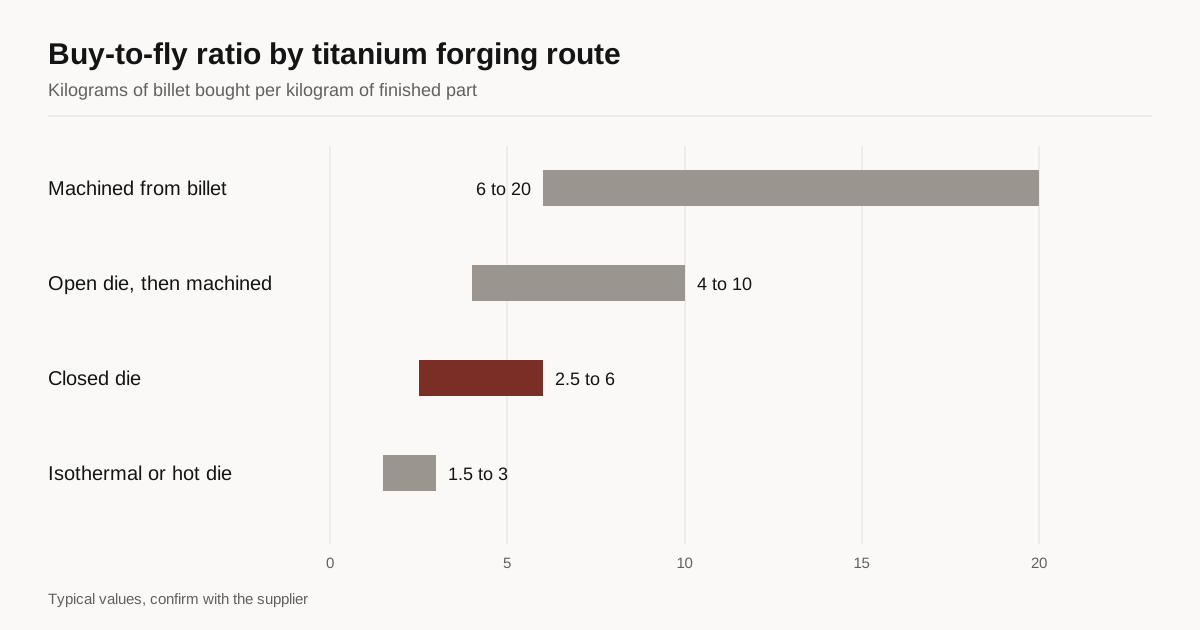
Material yield is the other half of the cost. In aerospace, buy-to-fly ratio is the weight of the billet divided by the weight of the finished part. Machining a part from billet can have a buy-to-fly ratio of 10 or more for complex shapes. A near-net forging cuts it to about 3 to 6, and isothermal forging can go lower. At the price of titanium, each kilogram saved pays a lot of tooling cost.
| Route | Typical buy-to-fly ratio | Notes |
|---|---|---|
| Machined from billet | 6 to 20 | Cheapest for one or two parts |
| Open die forging then machining | 4 to 10 | Simple shapes, low tooling cost |
| Closed die forging | 2.5 to 6 | Typical for volume parts |
| Isothermal or hot-die forging | 1.5 to 3 | Highest tooling cost, near-net |
These ranges vary with shape and size. The point is that the extra tooling cost for a closer forged shape is paid back through lower metal use. Our guide to forging die cost explains how to work out the payback.
Die cost and life
Titanium dies cost more than steel dies of the same size for three reasons. They need more complex shapes to control flow, they are made of tougher and more expensive hot work tool steel or superalloy, and they wear faster because titanium is strong at forging temperature and sticks to the die. Die life is lower than for steel, and re-sinking or repair is common. A supplier will quote the die cost and the expected number of parts per die. Ask for both, since a cheap die with a short life can cost more per part.
Many titanium parts are made in small runs, so the die cost is often split over a few hundred parts. That makes open die forging with machining the economical choice for low volumes, and closed die forging the choice when volume or yield justifies it. Our guide to open die and closed die forging helps with that choice.
Heat treatment and properties
After forging, Grade 5 is usually annealed at about 700 to 785 degrees Celsius for strength and toughness, or solution treated at about 925 to 955 and aged at about 480 to 595 for higher strength. Section size limits how well the solution treated and aged condition develops, because large parts do not quench fast enough. The control of hydrogen, oxygen and nitrogen is also part of the specification, since they embrittle the metal. Hydrogen is typically limited to 150 ppm or less.
Testing
Typical tests include tensile, hardness, microstructure and, for critical parts, ultrasonic inspection of the billet and the forging. Microstructure checks look for alpha case, beta flecks and other structure defects that damage fatigue life. Our guide to ultrasonic testing of forgings covers the method. Titanium needs special calibration, because its grain structure scatters sound differently from steel.
Machining titanium
Titanium is hard to machine. It conducts heat badly, so heat concentrates at the cutting edge, and it tends to gall and stick to tools. Cutting speeds are a fraction of those for steel, tools wear faster and tool life is shorter. Machining often costs as much as the forging itself, so any metal removed in the forge is a saving twice. This is why near-net forging is common in titanium, and why a supplier may suggest a shape change to remove metal.
A worked example of yield
Take a bracket with a finished weight of 1.2 kg. Machined from billet at a buy-to-fly ratio of 8, it needs 9.6 kg of billet, and 8.4 kg of that becomes chips. Forged to a near-net shape at a ratio of 3, it needs 3.6 kg, and 2.4 kg becomes chips. The difference is 6 kg of titanium per part. At a billet price of P per kilogram, the forged route saves 6 times P per part in metal alone, and it also cuts machining time because there is less to remove. If the closed die costs D, the break-even quantity is roughly D divided by the saving per part, once the extra forging charge is included. For a part this size the break-even is often a few hundred pieces, and fewer for a more complex shape or a pricier alloy.
Run the same sum with your own numbers, using the supplier’s billet price and die quote. If the break-even is higher than your expected order, open die forging or machining from billet is the better route. If it is lower, ask for a closed die quote. Our guide to forging against casting and machining sets out the same type of comparison for other metals.
Typical titanium forged parts
Titanium forgings fall into a few families. Aerospace structures use forged bulkheads, landing gear parts, wing fittings and engine mounts, where weight saving justifies the cost. Jet engines use forged fan and compressor discs, blades and rings in titanium alloys, with strict microstructure control. Medical use includes hip stems, knee components and bone plates made of the ELI grade or other implant alloys under specific standards. Industrial use includes valve bodies, pump parts and heat exchanger parts for seawater and chemical service, usually in the unalloyed grades or in Grade 5 where strength is needed. Marine and motorsport parts use titanium for connecting rods, fasteners and suspension parts where strength and weight both count.
Each family has its own approvals and testing. If your part is for aerospace or medical use, ask early about the approvals the supplier holds. We do not rate suppliers, and no approval can be assumed, so ask for the certificate and check its scope, date and the part families it covers.
Traceability and counterfeit risk
Titanium is expensive enough that substitution and mislabelling are real risks. A mill test report should show the heat number, the chemistry, the mechanical properties and the melt practice. The heat number should be marked on the forging and carried through to the final part, so that the part can be traced back to the billet. For critical parts, buyers ask for the report from the billet mill as well as from the forger, and some check chemistry with a handheld analyzer on receipt. The cost of that check is small against the cost of a failure. Hydrogen and oxygen content need laboratory analysis, not a handheld device, so they come from the report.
Lead time
Titanium lead times are long. Billet may need to be ordered from the mill, and mill lead time can run several months when aerospace demand is high. Dies for closed die work take weeks to make, and the first articles need inspection before the full order starts. Ask suppliers whether they hold billet in your alloy and size, and whether the quote assumes mill delivery. Parts needed in a few weeks are only feasible when billet is in stock and the part can be made from open die forging or machined, not from a new closed die.
What to put in the RFQ
State the alloy, the standard and the condition, such as ASTM B381 Grade 5 annealed. Give the specification for microstructure and ultrasonic testing, the yearly quantity and the finished weight and drawing. Say if you want alpha-beta or beta processing. Ask suppliers to quote the billet source and the expected material yield, since a low yield may signal a conservative design. Ask about alpha case removal and who does it.
Next step
Send an RFQ with the drawing and volume. We match you with up to 3 forging suppliers who forge titanium in your size range, and we reply within 24 business hours. For the wider checklist, read how to choose a forging supplier.
Frequently asked questions
What is Grade 5 titanium?
Grade 5 is the common name for the alloy Ti-6Al-4V, which contains about 6 percent aluminum and 4 percent vanadium. It is the most widely used titanium alloy and makes up roughly half of all titanium produced. It combines high strength, low density and good corrosion resistance.
Why is titanium forging so much more expensive than steel?
Titanium sponge and billet cost several times more than steel per kilogram, forging needs tight temperature control and strong equipment, dies wear faster and the surface must be machined to remove a brittle layer. A low material yield adds to the cost.
What does buy-to-fly ratio mean?
It is the weight of the starting material divided by the weight of the finished part. A ratio of 5 means you buy 5 kg of titanium for every 1 kg that ends up in the part. Near-net forging lowers the ratio compared with machining from billet.
Need a quote for this part?
Send the drawing. We match you with up to 3 forging suppliers and reply within 24 business hours.
Send my RFQ