Guides / Materials
Nickel Alloy Forgings: Inconel 718 and 625 Explained for Buyers
October 26, 2026
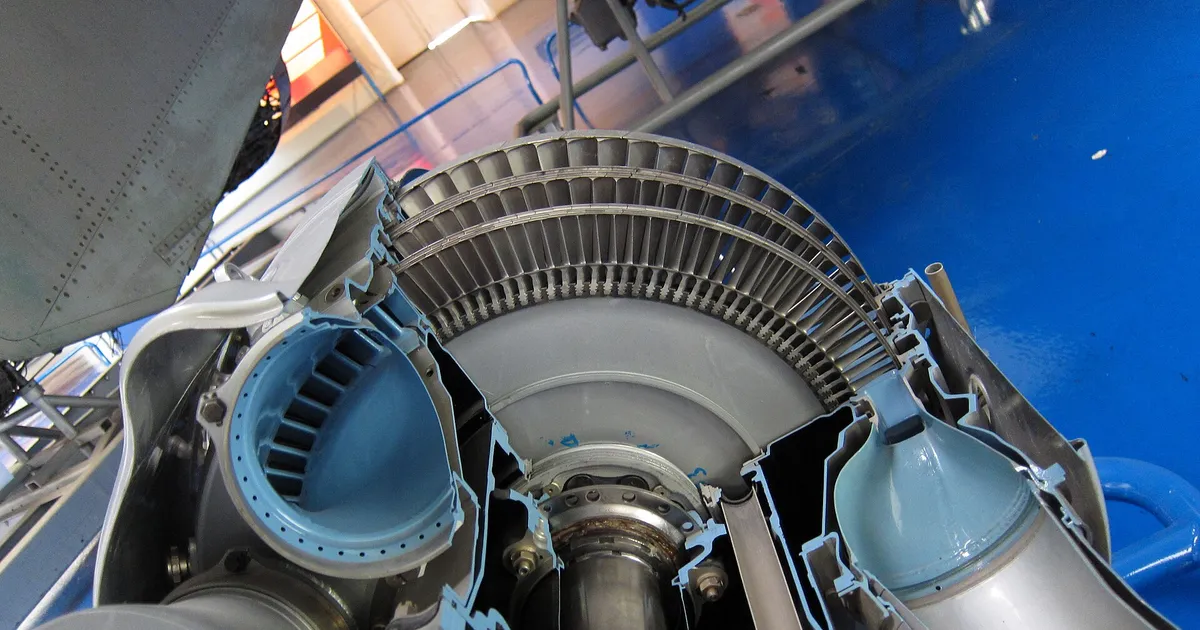
Nickel alloy forgings are the parts that keep working where steel would soften, rust or crack: gas turbine discs, subsea wellhead parts, chemical reactors, aerospace fasteners and high temperature shafts. Inconel 718 and 625 are the two grades buyers see most. They are expensive, slow to make and tightly specified, so a clear RFQ saves a lot of time. This guide explains what each grade is good for, what makes them hard to forge, which standards apply and what to ask suppliers.
What Inconel means
Inconel is a trade name for a family of nickel-chromium alloys. Buyers often use it as a generic term, but the alloys differ, and a drawing should name the alloy by UNS number or standard designation. Alloy 718 is UNS N07718. Alloy 625 is UNS N06625. Other names for them in the market include Nickelvac 718, Haynes 625 and Nicrofer 5219 for 718 or 6020 for 625, depending on the maker.
Alloy 718
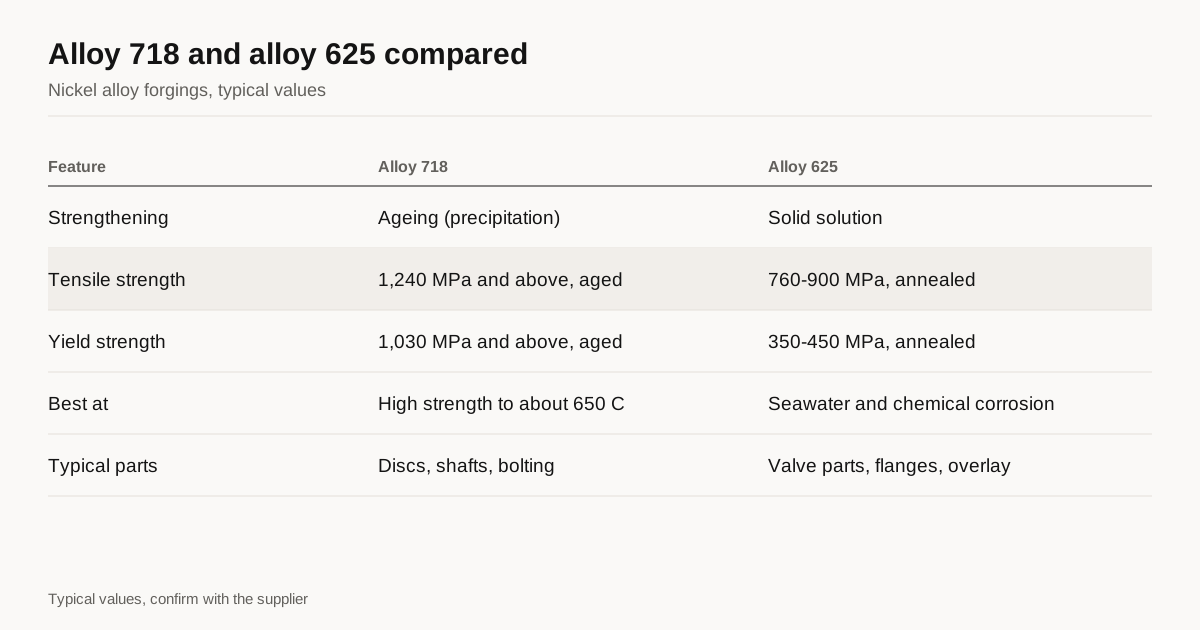
Alloy 718 contains roughly 50 to 55 percent nickel, 17 to 21 percent chromium, about 18 percent iron, 4.75 to 5.5 percent niobium and 2.8 to 3.3 percent molybdenum. The niobium forms a fine precipitate during ageing that gives very high strength. 718 is the workhorse alloy for strong parts at temperatures up to about 650 degrees Celsius. It weld repairs well compared to other precipitation hardened alloys.
Typical aged properties are tensile strength above 1,240 MPa and yield strength above 1,030 MPa, with elongation of about 12 percent. Aerospace standards set minimums near those values.
Alloy 625
Alloy 625 contains at least 58 percent nickel, 20 to 23 percent chromium, 8 to 10 percent molybdenum and 3.15 to 4.15 percent niobium. The molybdenum and niobium strengthen the alloy by solid solution, without ageing. Strength is lower than 718, with annealed tensile strength typically around 760 to 900 MPa and yield around 350 to 450 MPa. What 625 offers is outstanding resistance to pitting, crevice corrosion and chloride stress corrosion cracking, along with good strength and toughness from cryogenic temperatures to about 980 degrees. It is used in seawater, chemical and oil and gas parts and as a weld overlay on steel.
| Feature | Alloy 718 | Alloy 625 |
|---|---|---|
| UNS number | N07718 | N06625 |
| Strengthening | Precipitation hardening by ageing | Solid solution, no ageing |
| Typical tensile strength | 1,240 MPa and above (aged) | 760 to 900 MPa (annealed) |
| Typical yield strength | 1,030 MPa and above (aged) | 350 to 450 MPa (annealed) |
| Best for | High strength up to about 650 °C | Corrosion resistance, seawater, chemical |
| Typical forged parts | Discs, shafts, rings, bolting, wellhead parts | Valve and pump parts, flanges, fittings, transition rings |
| Relative price | High | High, similar to 718 |
Check actual minimum values in the standard on your drawing.
Standards
Common specifications for nickel alloy forgings include:
| Standard | Covers |
|---|---|
| ASTM B564 | Nickel alloy forgings, including 625 and 718 |
| ASTM B637 | Precipitation hardening nickel alloy bars, forgings and forging stock for high temperature service |
| AMS 5662 and 5663 | Alloy 718 bars, forgings and rings, solution treated and aged |
| AMS 5666 | Alloy 625 bars, forgings and rings |
| API 6A and 6ACRA | Oil field wellhead equipment, including 718 and 625 variants |
Check the current edition and the class or grade. Aerospace parts add customer specifications for structure, cleanliness and testing.
Forging nickel alloys
Nickel alloys are demanding to forge. They stay strong at high temperature, so the force to deform them is several times that for steel. The working range is narrow. For 718 it runs from about 1,100 degrees Celsius at the start down to about 925 at the finish, and the alloy cracks if it is worked colder or overheated. Heat and reduction in the last steps also set the grain size and the amount of a brittle delta phase, which controls fatigue strength.
Shops use powerful presses, heated dies and slow strain rates. Dies are often heated to several hundred degrees to reduce chill, and for critical parts isothermal forging in a protective atmosphere is used. Reheating between steps is frequent, because the part loses heat quickly. These factors raise the cost of tooling and of each hour of press time. Not many forges can make large nickel alloy parts, which narrows the supplier list, and it is useful to ask for experience on similar alloys and sizes.
Heat treatment
718 is solution annealed at about 955 to 980 degrees Celsius and then aged in two steps, typically 720 degrees for 8 hours, furnace cooled to 620 degrees and held another 8 hours, then air cooled. The ageing cycle builds the strength. Time and temperature are controlled tightly, and furnace records are part of the certificate. 625 is annealed, typically between 870 and 1,100 degrees depending on the grade of anneal, and then cooled quickly. It does not age harden in the normal sense. Our guide to heat treatment of forgings covers the principles for other metals.
Melt route and cleanliness
For critical rotating parts, cleanliness matters. Inclusions and segregation start fatigue cracks. Aerospace discs and similar parts are made from billet that is melted in vacuum, then remelted by electroslag or vacuum arc, or both, known as double or triple melt. The extra melting steps cost more and are required by some specifications. For static parts such as flanges and valve bodies, a single or double melt route is usually enough. If your specification does not name the melt route, ask for the route the supplier will use, because it changes the price a lot.
Grain size and delta phase in 718
Two structure features decide whether a 718 forging performs in fatigue and creep. The first is grain size, which is controlled by temperature and reduction in the last forging steps. Fine grain gives better fatigue strength and easier ultrasonic inspection, while coarse grain helps creep resistance. The second is delta phase, a needle-like phase of niobium and nickel that forms between about 800 and 1,000 degrees Celsius. A small amount of delta phase at the grain boundaries restrains grain growth and improves notch behaviour. Too much, or the wrong shape, lowers strength and ductility. Specifications for critical parts set limits on both, checked by cutting a sample section, polishing and etching it. If your part needs a structure grade, write it on the drawing and ask the supplier how they control it, because a forging that meets tensile strength can still fail on structure.
Typical nickel alloy forged parts
The parts fall into a few groups. In power and aerospace, forged discs, shafts, casings and rings for gas turbines use 718 and related alloys at high temperature. In oil and gas, wellhead components, valve bodies, hangers and connectors use 718 and 625 for strength and corrosion resistance in sour and subsea service. In chemical and marine plants, valve parts, pump shafts, flanges and tube sheets use 625 against chlorides and acids. In fasteners, bolts and studs for hot or corrosive joints use 718. For flanges and valve bodies in lower grades of steel, see our guides to forged flanges and forged valve bodies, which explain the shapes that carry over to nickel alloys.
Welding, repair and overlay
Weldability differs between the two. 625 welds easily and is often used as filler metal and as overlay on steel parts, giving a corrosion resistant surface over a cheaper base. 718 is much less prone to strain-age cracking than older precipitation hardened alloys, but it still needs a controlled welding procedure and a post-weld heat treatment. Repair of forgings by welding is often restricted or forbidden by aerospace specifications and may need purchaser approval in others. If your part may need weld repair, or if it will be welded into a larger assembly, say so in the RFQ so that the supplier can quote the right chemistry and condition.
Lead time and supply
Nickel alloy billet is made by a limited number of mills, and lead time can stretch to months when aerospace and energy demand is high. Forgers that work with nickel alloys often hold stock of common sizes of 718 and 625, which shortens delivery for standard parts. Large or special sizes, or specifications with a triple melt requirement, are made to order. Plan the schedule around billet delivery, forging, heat treatment, testing and certificates. A first article approval adds more time, so tell the supplier early if it is required. Our note on forging die cost explains why tooling lead time also needs to be in the plan for closed die parts.
Testing
Typical tests include tensile and hardness tests, stress rupture or creep tests for high temperature parts, microstructure and grain size checks and ultrasonic testing. Ultrasonic testing of nickel alloys is harder than steel because coarse grain scatters sound, so the procedure is set up with reference blocks of the same alloy. Our guide to ultrasonic testing of forgings explains the method. For corrosion service, tests such as ASTM G28 for intergranular attack are used on 625.
Machining
Nickel alloys work harden and hold strength at the heat of cutting, so tools wear fast. Machining uses carbide or ceramic tools at slow speeds with firm setups and heavy coolant, and cutting cost per part is high. Machining in the solution annealed state is easier than aged, so many parts are rough machined first, aged and then finish machined for tight dimensions. Allowance on forgings should leave room for any surface layer lost in heating and heat treatment.
Cost
Nickel alloy forgings cost many times more than steel forgings of the same size. Nickel and niobium prices make up much of the raw material cost, melt route and yield add to it, and the forging step needs more force and more care. A low yield from billet to finished part adds further. Because of these factors, near-net forging pays back quickly, as in titanium. Our guide to titanium forgings explains how to work out the payback, and the same sum applies to nickel alloys.
What to put in the RFQ
Name the alloy by UNS number and standard, with edition, such as UNS N07718 to AMS 5663. Give the heat treatment condition, the melt route if specified, the mechanical and creep testing, the microstructure and grain size requirements and the ultrasonic standard and class. Include the finished drawing, weight and yearly quantity. Ask suppliers to state their billet source and their experience on similar alloys and sizes.
Next step
Send an RFQ with the drawing and specification. We match you with up to 3 forging suppliers who forge nickel alloys in your size range, and we reply within 24 business hours. For the wider checklist, read how to choose a forging supplier.
See also: ASTM B564 nickel alloy forgings, the reference page on the UNS alloy list and annealing notes.
Frequently asked questions
What is the difference between Inconel 718 and 625?
718 is precipitation hardened and reaches very high strength after ageing, so it suits discs, shafts and bolting up to about 650 degrees Celsius. 625 is solid solution strengthened, has lower strength and outstanding corrosion resistance, so it suits seawater, chemical and cladding use.
Why is Inconel so hard to forge?
Nickel alloys stay strong at high temperature, so they resist deformation and need far more force than steel. The working range is narrow, and the metal cracks if worked too cold or overheated. Heated dies and slow presses are normal.
Do I need triple melted material?
Only for critical rotating parts such as engine discs, where the specification calls for it. Triple melting through vacuum induction, electroslag and vacuum arc remelting gives the cleanest structure. Many industrial parts are made from double melted or single melted material at lower cost.
Need a quote for this part?
Send the drawing. We match you with up to 3 forging suppliers and reply within 24 business hours.
Send my RFQ