Guides / Process
Heat Treatment of Forgings: Normalize, Quench and Temper Compared
October 24, 2026
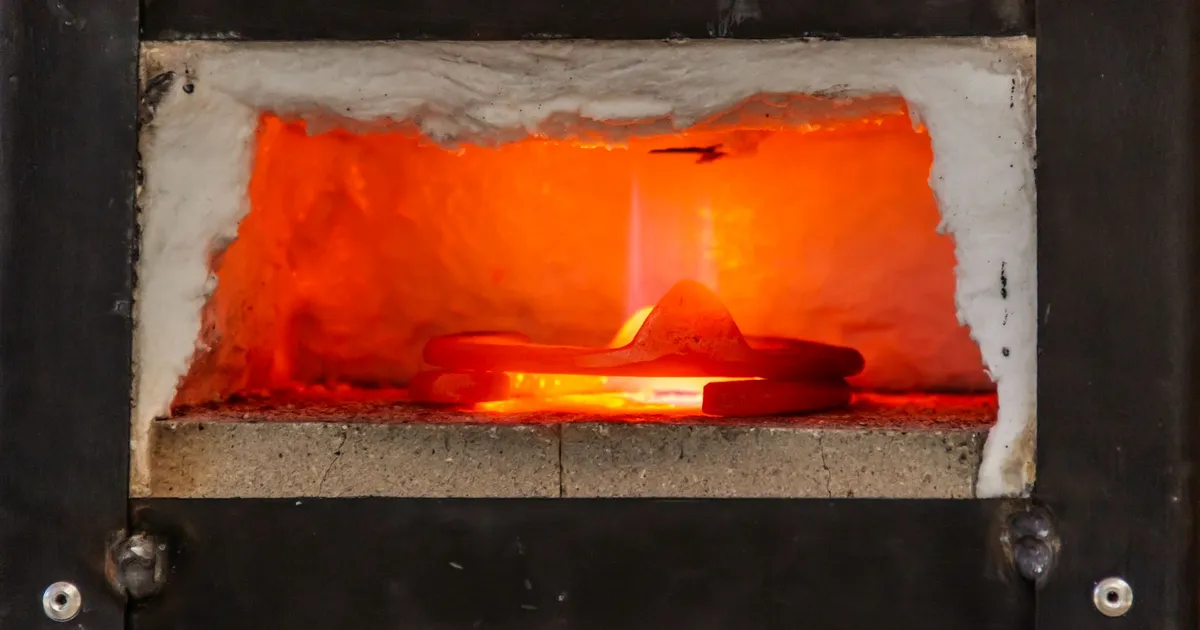
Heat treatment decides most of the mechanical properties of a forging after the shape is made. Two forgings of the same steel and the same shape can have very different strength, hardness and toughness depending on how they were heated and cooled. Buyers see terms like normalized, annealed, quenched and tempered on drawings and quotes, and they matter for both performance and price. This guide explains what each treatment does, what temperatures and times are typical, and how to specify the result.
Why forgings are heat treated
A forging leaves the press with a coarse and uneven structure. The metal was hot at the end of forging, cooled at different rates in thick and thin sections and holds internal stress. Heat treatment resets that structure. It refines the grain, makes the structure uniform from surface to centre and sets the balance between strength and toughness. It also relieves stress that would otherwise cause the part to move during machining.
The treatment is chosen to meet the material specification and the drawing. For example, a carbon steel flange may be required to be normalized to meet its specification, while an alloy steel shaft may be required to be quenched and tempered to a given hardness. Our note on ASTM A105 against A350 LF2 shows how the heat treatment differs between two common flange grades.
Normalizing
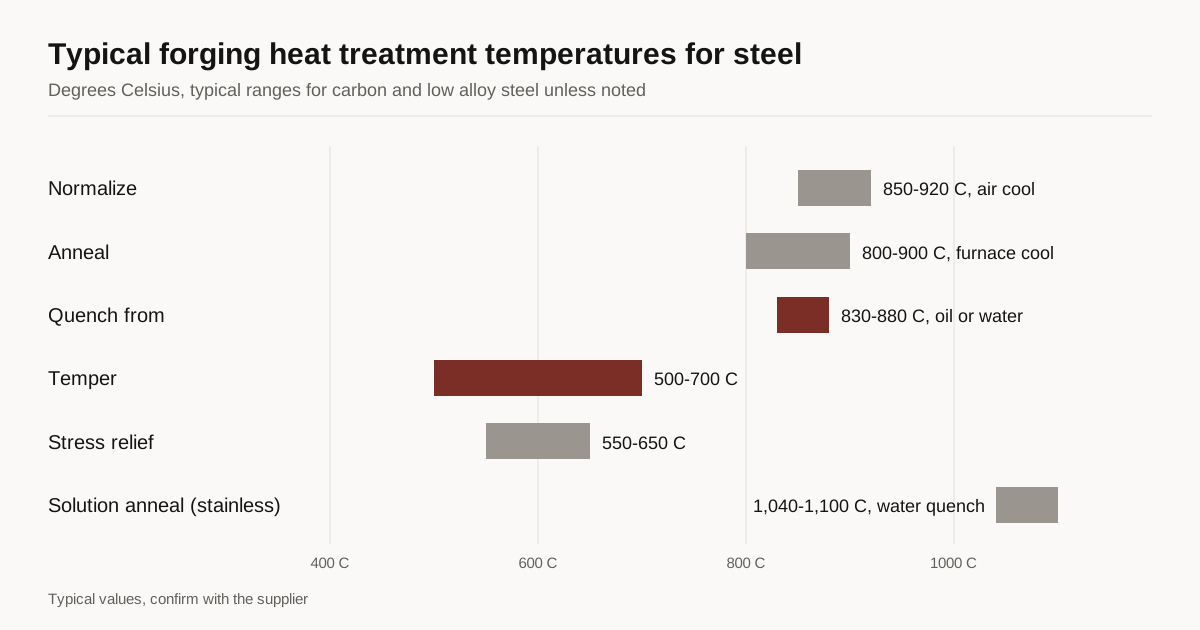
Normalizing heats steel to above its upper transformation temperature, typically about 850 to 920 degrees Celsius for carbon and low alloy steels, holds it long enough to be uniform and cools it in still air. The air cool is faster than a furnace cool, so the structure is finer and the strength is a little higher than in the annealed state. Normalizing is the standard treatment for carbon steel forgings that do not need to be hardened, and it is often used before quench and temper to refine grain.
A rough rule for hold time is about one hour per 25 mm of section thickness, with a minimum of about one hour. The actual time depends on the furnace, the load and the specification.
Annealing
Annealing also heats above the transformation range, but cools the part very slowly, usually in the furnace, over many hours. The result is the softest state the steel can reach. It is used when machining or cold forming needs a soft part. A variation is spheroidize annealing, which holds the steel just under or around the transformation temperature to turn hard carbide plates into round particles. Cold forged parts and high carbon steels are often supplied spheroidized. Our guide to cold, warm and hot forging explains why cold forming needs this starting condition.
Quench and temper
Quench and temper is the standard treatment for forgings that need high strength and toughness. It has two steps.
First the part is heated to austenitizing temperature, about 830 to 880 degrees Celsius for common alloy steels such as 4140 and 4340, held until uniform and then quenched in oil, polymer or water. Quenching cools the steel fast enough to form martensite, which is very hard but also brittle. Second, the part is tempered by reheating to a lower temperature, usually between about 500 and 700 degrees, and held. Tempering softens the martensite a little and gives back toughness. A higher tempering temperature gives lower strength and higher toughness. The tempering temperature is the main lever the supplier uses to hit a hardness or tensile target.
| Treatment | Typical temperature | Cooling | What it gives |
|---|---|---|---|
| Normalize | 850 to 920 °C | Still air | Fine, uniform structure, moderate strength |
| Anneal | 800 to 900 °C | Slow, in the furnace | Soft, easy to machine |
| Quench and temper | Quench from 830 to 880 °C, temper at 500 to 700 °C | Oil, polymer or water, then air | High strength with toughness |
| Stress relief | 550 to 650 °C | Slow | Lower residual stress, little change in strength |
| Solution anneal (austenitic stainless) | 1,040 to 1,100 °C | Fast water quench | Dissolved carbides, corrosion resistance |
These are typical ranges for steels. The correct values come from the specification and the grade.
Section size and hardenability
Heavy sections cool slower in the middle than at the surface. That is the reason section size limits how hard a steel can be through the full thickness. Steels differ in how deep the hardening reaches, which is called hardenability. A steel with high hardenability, such as 4340, hardens through thick sections. One with lower hardenability, such as 1045, hardens only near the surface in thick sections. When the part is thick, this is a main reason to choose an alloy steel. Our comparison of 4140 and 4340 forgings shows how that works in practice.
Test coupons are used to check the result. A coupon is a piece of the same heat that is treated with the part, or a prolongation cut from the forging, and tested for tensile strength, yield strength, elongation and impact energy. The specification says where the coupon comes from, for example a quarter thickness position, because the properties differ between surface and centre.
Before or after rough machining
The order of machining and heat treatment changes both the result and the cost. If a thick forging is quenched before it is rough machined, the centre cools slowly and may not harden as deeply as the surface. If it is rough machined to a smaller section first, the whole part cools faster and the properties are more even, but there is less metal left to remove decarburization and distortion after the treatment. Many specifications require the heat treatment to be done in the rough machined condition for exactly this reason, and some call for a test section as large as the final part.
A common route for shafts and gear blanks is to forge, normalize, rough machine, quench and temper, and then finish machine. Each step leaves a little more allowance for the next. If your drawing allows only a few millimetres of stock, tell the supplier early, because it may limit the quench method or the steel grade they can use. Distortion on a long slender shaft can exceed a small allowance, so straightening may be needed. Straightening is itself a risk on hardened steel, so it belongs on the drawing as an allowed or forbidden step.
Tempering range and embrittlement
Tempering is not a free choice. Some steels lose toughness if they are tempered or cooled slowly in certain temperature ranges. Tempered martensite embrittlement appears when alloy steels are tempered around 250 to 400 degrees, which is why high strength parts are rarely tempered in that range. Temper embrittlement can appear in some alloy steels that are held or cooled slowly between about 375 and 575 degrees, and it is controlled by cooling quickly after tempering or by choosing steels low in certain trace elements. The supplier takes care of this in practice, but a buyer who specifies a strength level near the top of a grade can force a tempering temperature in a poor range. If a drawing asks for both very high strength and high impact energy, ask the supplier whether the combination is practical.
Records and traceability
Heat treatment records are the evidence that the right process was applied. A good set includes the furnace chart showing time and temperature for each load, the quench medium and temperature, the tempering chart, the hardness results and the tensile and impact results from the test coupons. Each record should tie to the heat number of the steel and the part or lot number. Ask whether you receive the charts or only a summary. Many standard mill test reports carry only a summary, which is fine for general parts but may not be enough for critical parts. If your specification requires full charts, say so before the order, because retrieving them later is slow.
Stress relief
Stress relief is a lower temperature treatment, around 550 to 650 degrees for steels, that reduces internal stress without changing the structure much. It is used on parts that will be machined heavily or welded, because stress release can cause movement or distortion. It is also used after repair welding of forgings. It does not replace normalizing or quench and temper.
Other alloys
Heat treatment is not only for steel. Austenitic stainless steels are solution annealed and water quenched to dissolve carbides, which gives corrosion resistance. Duplex stainless steels are also solution annealed, with careful control of temperature and cooling to hold the correct balance of phases. Aluminum alloys such as 6061 and 7075 are solution treated, quenched and aged to temper designations such as T6. Titanium is annealed or solution treated and aged. Each alloy has its own specification, and our guides on stainless steel forgings and aluminum forgings show the typical conditions.
Problems to ask about
The main risks in heat treatment are distortion, cracking and decarburization. Distortion comes from uneven cooling in a quench and is controlled by how the part is racked and quenched, and by machining allowance. Quench cracks appear when a part cools too fast or has sharp changes in section, and are controlled by the quench medium and by tempering soon after quenching. Decarburization is the loss of carbon from the surface in the furnace, which softens the skin. A machining allowance removes it.
Ask the supplier what furnace they use and how it is controlled. A furnace with recorded temperature charts, regular temperature surveys and a calibration program is a good sign. Aerospace and many industrial customers refer to AMS 2750 for furnace control, but the standard needed for your part depends on your specification.
What to specify
Write the heat treatment condition on the drawing in plain terms, such as quenched and tempered to a hardness range or to minimum tensile and yield strength, not just a letter code. Give the specification and grade, the section where properties are measured and the test requirements. If you need a time-temperature chart with the shipment, say so.
What to put in the RFQ
Include the grade, the specification and edition, the required condition, the property targets and the test locations. State whether you will rough machine before heat treatment or after, because that changes the section size at the time of treatment. Add the yearly quantity and the weight of the part, because those determine furnace loading and the cost per piece.
Next step
Send an RFQ with the drawing. We match you with up to 3 forging suppliers who heat treat in house or work with approved treaters, and we reply within 24 business hours. For the full list of checks, read how to choose a forging supplier.
Frequently asked questions
Is normalizing the same as annealing?
No. Both heat steel above its transformation range, but normalizing cools the part in still air while annealing cools it very slowly in the furnace. Normalizing gives a finer and slightly harder structure and is faster. Annealing gives a softer structure that is easier to machine or cold form.
Why is quench and temper specified for shafts and gears?
Quenching hardens the steel and tempering trades some of that hardness for toughness. The result is a combination of strength and toughness that normalizing alone cannot reach in alloy steels. It is the usual condition for shafts, gears and highly loaded parts.
Who sets the heat treatment, the buyer or the supplier?
The buyer sets the required condition and properties on the drawing or in the specification. The supplier chooses temperatures and times to reach them. If the properties are not met, the supplier re-treats within the limits of the specification.
Need a quote for this part?
Send the drawing. We match you with up to 3 forging suppliers and reply within 24 business hours.
Send my RFQ