Guides / Materials
Aluminum Forgings: 6061, 6082 and 7075 Compared for Strength, Cost and Use
October 14, 2026
Aluminum forgings are common in vehicles, aircraft, bicycles, machinery and marine hardware, wherever a part needs to be light and strong. Three alloys cover most industrial orders: 6061, 6082 and 7075. They differ in strength, corrosion behaviour, weldability and price, and they behave differently in the forge. This guide compares them in plain terms and shows what to tell a supplier when you need a part made.
Why forge aluminum
Cast aluminum is cheap and flexible in shape, but it contains tiny pores and a coarse structure that limit strength and fatigue life. Machining from bar gives a clean structure but wastes metal and cuts through the flow lines. Forging works the metal into shape between dies, closes porosity and aligns the grain with the contour. The result is higher strength and fatigue life than a casting, and for shaped parts less waste than machining. Our guide to forging against casting and machining sets out the full comparison.
Aluminum is also forged at much lower temperature than steel, usually about 350 to 500 degrees Celsius, so tools last longer and parts hold tighter tolerances. Dies are often heated to a few hundred degrees, because cold dies chill the part and cause cracks and laps. Aluminum flows readily, so draft angles can be smaller and thin webs are practical.
The three alloys
6061 is the general purpose structural alloy. It contains magnesium and silicon, which form a hardening phase during ageing. It has good corrosion resistance, welds well and takes an anodized finish. Strength is moderate. It is the cheapest of the three and the easiest to source.
6082 is the European counterpart, with more manganese and silicon than 6061. It gives somewhat higher strength than 6061 in the T6 temper and is the usual choice for forged structural parts in Europe, including chassis and suspension parts. It shares the good corrosion resistance and weldability of the 6000 series.
7075 is a zinc-magnesium-copper alloy and the strongest of the three. It reaches strengths close to many steels per unit weight, which is why it appears in aircraft fittings, high load bicycle parts and tooling. It is harder to forge because of a narrower temperature window, is sensitive to stress corrosion in some tempers and cannot be welded by normal methods.
Typical properties
| Property | 6061-T6 | 6082-T6 | 7075-T6 | 7075-T73 |
|---|---|---|---|---|
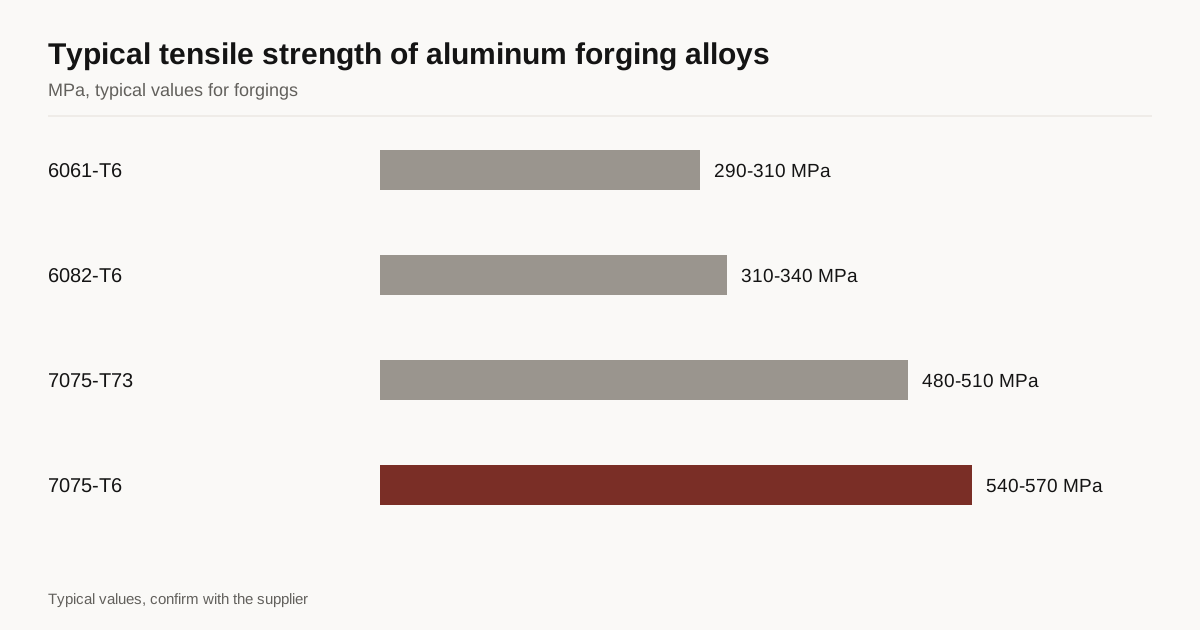
| Typical tensile strength | About 290 to 310 MPa | About 310 to 340 MPa | About 540 to 570 MPa | About 480 to 510 MPa |
| Typical yield strength | About 240 to 275 MPa | About 260 to 300 MPa | About 470 to 500 MPa | About 410 to 435 MPa |
| Typical elongation | 8 to 12 % | 8 to 10 % | 7 to 11 % | 8 to 11 % |
| Corrosion resistance | Good | Good | Fair | Better than T6 |
| Stress corrosion resistance | Good | Good | Low in T6 | Good |
| Weldability | Good | Good | Not for fusion welding | Not for fusion welding |
| Relative price | Base | Similar to 6061 | About 1.3 to 2 times | About 1.4 to 2.2 times |
These are typical values for forgings. Minimum values for acceptance come from the specification, such as ASTM B247 for aluminum die forgings, hand forgings and rolled ring forgings, or EN 586-2 in Europe, and they are lower than typical numbers.
Tempers
The temper letters and numbers describe the heat treatment. T6 means solution treated, quenched and artificially aged for maximum strength. T4 means solution treated and naturally aged at room temperature, which gives lower strength and higher ductility. T73 and T7352 are overaged tempers of 7075 that give up some strength in exchange for much better stress corrosion resistance. Stress corrosion cracking is a problem for 7075-T6 when the part holds sustained tensile stress in the short transverse direction, meaning through the thickness at the parting line or across the flow lines. For a forging with machined faces that expose end grain, that is a real risk, and it is the reason aerospace specifications call for T73 temper.
Heat treatment is done at temperatures set by the alloy. For 6061 solution treatment is around 530 degrees Celsius, for 7075 around 470. Control is tight, because aluminum alloys are close to melting at these temperatures. Quenching in water gives the best properties but can distort parts, and some suppliers use hot water or polymer quenches to reduce distortion at a small cost in strength. Ageing is done at about 120 to 175 degrees for several hours. Our guide to heat treatment of forgings covers the same principles for steel.
Forging aluminum
All three alloys are forged hot. 6061 and 6082 have a wide working range, roughly 430 to 500 degrees Celsius, and are forged in hammers and presses. 7075 has a narrow window of roughly 380 to 440 degrees, and needs careful control, because it cracks when it is too cold and loses strength when it is too hot. Most aluminum forging is done in presses, since slow deformation gives better flow than hammer blows and reduces cracking.
Parts are forged in several steps, often a blocker and a finisher, with the billet cut from extruded or cast bar. Flash is trimmed, the part is heat treated, and it is machined where needed. Surface finish is better than steel because there is little scale. Typical tolerances are close to those for hot steel closed die forging, with about ±0.4 to ±1.0 mm on small parts.
Cost
Alloy price is the first difference. 6061 and 6082 cost about the same per kilogram. 7075 costs more because of the alloying elements and the tight process control that it needs. Tooling cost is similar across the alloys, but 7075 dies tend to wear a little faster because the alloy is stronger. Die cost is covered in forging die cost. For all three, aluminum is light, so the weight of metal per part is small, and tooling and machining usually drive the price more than material does.
Section thickness and quench sensitivity
Aluminum alloys differ in how fast they must be cooled in the quench to reach full strength. The 6000 series are forgiving, so even thick sections reach close to their rated strength. 7075 is more sensitive, and strength drops in thick sections where the centre cannot cool fast enough. Specifications therefore give lower minimum strength for thick sections of 7075 than for thin ones. If your part has a section over about 75 mm, ask the supplier what strength they can guarantee at the centre, rather than assuming the figure for thin sections. Where a thick section matters, a different 7000 alloy such as 7050 is often used in aerospace for its better through-thickness strength, though it costs more and is less common in general industry.
Distortion and straightening
Aluminum parts move during quenching, and long, thin or asymmetric forgings can bend or twist. The common fixes are a hot water or polymer quench, which cools more slowly and moves the part less, and cold straightening or a cold stretch after quenching for some shapes. Each has a trade-off. A slower quench lowers strength a little, and straightening adds a step and can leave residual stress. Parts that will be machined heavily after heat treatment often need a stress relief condition such as T652 or T7352, which uses a controlled compression after quenching to reduce residual stress and prevent movement in machining. If your part has thin walls or long ribs, ask whether a stress relieved temper is available, and what it costs.
Typical forged aluminum parts
Aluminum forgings fit parts that need low weight and high strength:
- Suspension arms, knuckles and control arms for road vehicles.
- Wheels for cars, trucks and motorcycles.
- Bicycle cranks, stems and brake parts.
- Aircraft fittings, brackets and landing gear parts.
- Pistons for engines and compressors.
- Marine and offshore fittings, pulleys and hardware.
- Tooling and fixtures where weight matters.
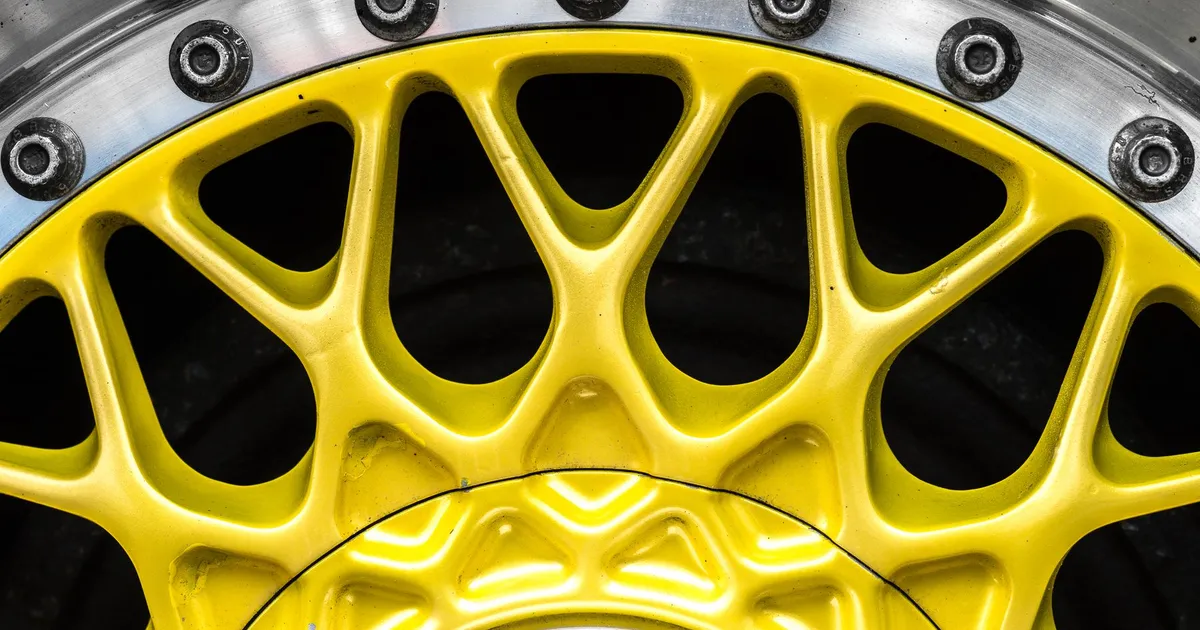
Wheels are the most familiar example. A forged aluminum wheel is stronger and lighter than a cast one of the same size, since the structure is denser and the grain follows the spokes. Some wheels are forged as a disc and then spun or rolled to form the barrel, and the forging step sets the strength.
Machining aluminum forgings
Aluminum machines fast, which keeps machining cost low per part. Cutting speeds are several times those for steel, and tool wear is modest if the right inserts are used. Parts are rough machined, heat treated if needed, then finish machined, and the order depends on distortion. 7075 is harder and less gummy than 6061, so it gives a cleaner finish. 6061 can build up on the tool, which is solved with sharp tools and good coolant.
Remember to allow for the anodize layer in the finished dimensions. A normal anodize adds a few micrometres on each surface and hard anodize adds more, so tight fits need the layer on the drawing.
Surface finish and anodizing
Aluminum parts are often anodized for corrosion resistance and appearance. 6061 and 6082 anodize cleanly with an even colour. 7075 anodizes well too, though the colour can be slightly different, and hard anodizing is common on 7075 for wear. If cosmetic quality matters, say so, because the forging flow lines and parting line can show after anodizing. A supplier can place the parting line where it is least visible, and a machined surface hides the flow lines.
How to choose
| Need | Likely choice |
|---|---|
| General structural part, welding allowed, moderate load | 6061-T6 |
| European specification, suspension or chassis part | 6082-T6 |
| Highest strength for weight, no welding | 7075-T6 or T73 |
| Stress corrosion risk or thick sections with short transverse load | 7075-T73 |
| Cosmetic anodized part | 6061 or 6082 |
If the part is for aerospace, the specification will name the alloy, the temper and the testing, and the supplier needs the approvals that go with it. Our guide to forging certifications and specs lists what to ask.
What to put in the RFQ
State the alloy, the temper and the specification with edition. Give the mechanical test requirements and the direction of the test coupons, and state whether stress corrosion testing is needed. Add the finished weight, the yearly quantity and the surface requirement, including anodizing. If you are open to 6061 or 6082, say so, since both are easy to source and the cost is similar.
Next step
Send an RFQ with the drawing and the load case if you have one. We match you with up to 3 forging suppliers who forge aluminum in your size range, and we reply within 24 business hours. For the wider checklist, read how to choose a forging supplier.
Frequently asked questions
Why forge aluminum instead of casting or machining it?
Forging gives aluminum a refined grain and flow lines that follow the shape, which raises strength and fatigue life compared with a casting of the same alloy. Against machining from bar, forging wastes less metal on shaped parts and gives better properties at the stress points.
Which aluminum alloy is strongest for forging?
7075 in the T6 temper has the highest strength of the three, with tensile strength around 570 MPa. It is also the most sensitive to stress corrosion and the hardest to weld. 6061 and 6082 are lower in strength but resist corrosion better and weld well.
What does T6 mean?
T6 is a heat treatment temper. The part is solution treated at high temperature, quenched and then artificially aged at a lower temperature. It gives high strength in the heat-treatable alloys. Other tempers such as T73 trade some strength for better stress corrosion resistance.
Need a quote for this part?
Send the drawing. We match you with up to 3 forging suppliers and reply within 24 business hours.
Send my RFQ