Guides / Materials
Stainless Steel Forgings: Choosing Between F304, F316 and F51 Duplex
October 28, 2026
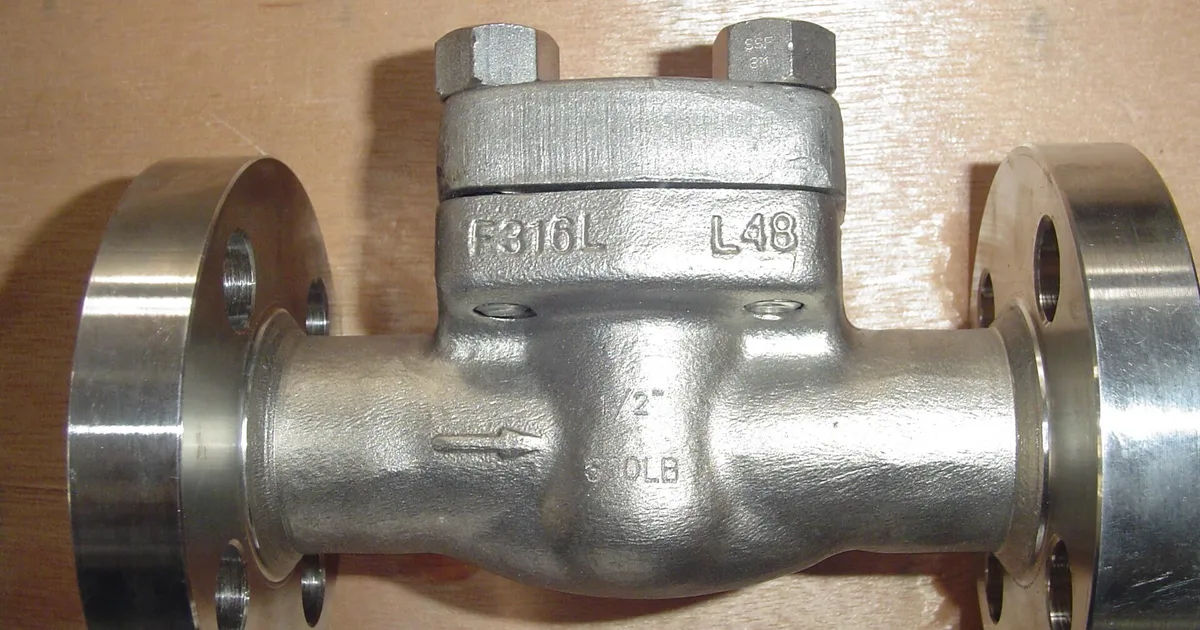
Stainless steel forgings turn up in valves, pumps, flanges, food and chemical equipment, marine hardware and process pipework. Most orders come down to three families: austenitic 304, austenitic 316 with molybdenum and duplex such as F51. They look similar on a quote, but they behave differently in the forge, in heat treatment and in service. This guide compares them in plain terms and sets out what to write on an RFQ.
The three grades
F304 is the basic austenitic stainless steel, with about 18 to 20 percent chromium and 8 to 10.5 percent nickel. It resists general corrosion and many food and mild chemical environments. It is not suited to chloride service such as seawater, because chlorides cause pitting and stress corrosion cracking.
F316 adds about 2 to 3 percent molybdenum to a similar base. Molybdenum improves resistance to pitting in chloride solutions, which makes 316 the usual choice for marine, chemical and pharmaceutical parts. The low carbon versions, F304L and F316L, limit carbon to 0.03 percent so that welding does not leave the weld zone prone to corrosion.
F51 is a duplex stainless steel, usually the 22 percent chromium, 5 percent nickel, 3 percent molybdenum grade known as 2205, with added nitrogen. Its structure is a mix of austenite and ferrite, about half each. The mix gives higher strength than the austenitic grades and better resistance to chloride stress corrosion cracking. Super duplex F53 and F55 go further, and are used for seawater and aggressive chemical service.
These are named in ASTM A182, the specification for forged or rolled alloy and stainless steel flanges, fittings, valves and parts for high temperature service. For general stainless steel forgings, ASTM A473 covers austenitic grades and ASTM A182 is also commonly cited for valve parts. EN 10222-5 covers martensitic, austenitic and austenitic-ferritic stainless steel for pressure purposes in Europe.
Typical properties
| Property | F304 | F316 | F51 duplex |
|---|---|---|---|
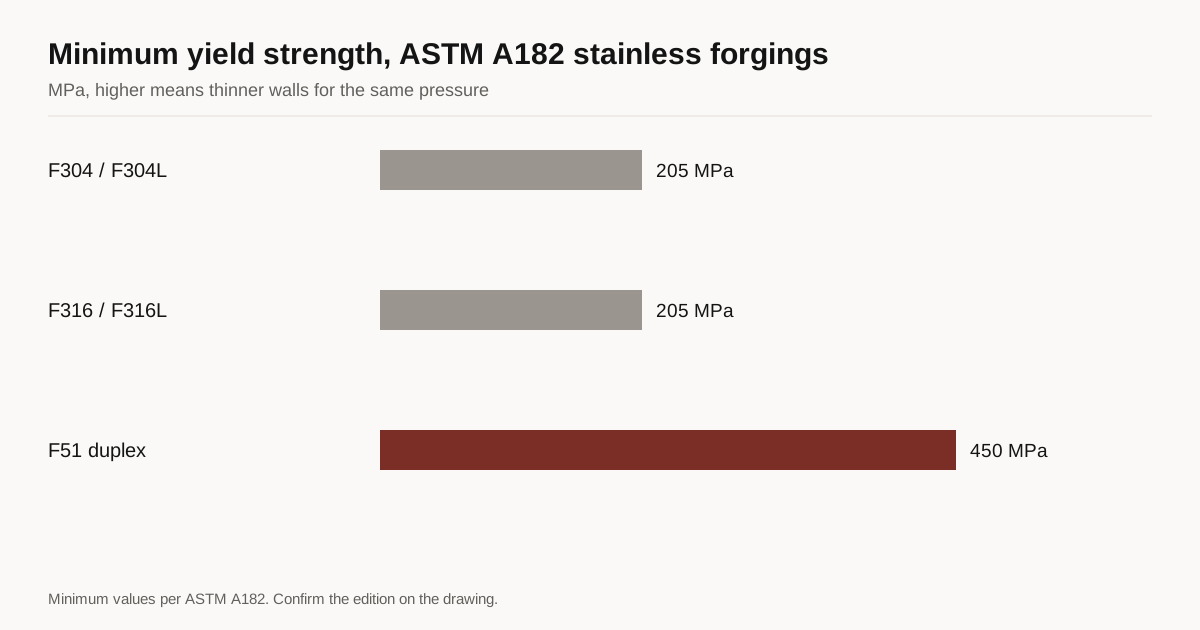
| Minimum yield strength (A182) | 205 MPa | 205 MPa | 450 MPa |
| Minimum tensile strength (A182) | 515 MPa | 515 MPa | 620 MPa |
| Chromium, typical | 18 to 20 % | 16 to 18 % | 21 to 23 % |
| Nickel, typical | 8 to 10.5 % | 10 to 14 % | 4.5 to 6.5 % |
| Molybdenum, typical | None | 2 to 3 % | 2.5 to 3.5 % |
| Pitting resistance (PREN, typical) | About 18 to 20 | About 24 | About 34 to 36 |
| Magnetic | No | No | Yes, weakly |
| Typical upper service limit | About 400 °C and more | About 400 °C and more | About 280 to 300 °C |
The strength figures are the minimums in ASTM A182, and real parts often exceed them. PREN is the pitting resistance equivalent number, a simple index where higher is better. Check the exact values for your edition, because they differ between standards and between grades.
Forging stainless steel
Stainless steels are harder to forge than carbon steel. They are stronger at forging temperature, so they need more force and heavier equipment. They also have a narrower temperature window and a tendency to crack if they are forged too cold or heated unevenly.
Austenitic grades are forged from about 1,150 to 1,200 degrees Celsius down to a finishing temperature of about 900 to 950. They stay austenitic through the range, so there is no hardening by cooling, and the final properties come from the solution anneal. Duplex grades are less forgiving. The working range is narrower, and the steel has to be kept out of the 600 to 1,000 degree zone in which brittle phases form, so reheating and rapid cooling after forging are needed. This is why only some shops forge duplex grades in size.
Heat treatment
Stainless steel forgings are almost always solution annealed. The part is heated to a temperature at which carbides and other phases dissolve, then quenched fast. For austenitic grades the minimum is typically about 1,040 degrees Celsius with a water quench, and for F51 about 1,020 to 1,100 degrees with a water quench. The quench has to be quick enough to keep the dissolved phases from forming again. This is a case where section size matters, since the centre of a heavy part cools slowly and can form unwanted phases. Our guide to heat treatment of forgings covers how heavy sections are managed.
Stainless steel cannot be hardened by heat treatment, except for martensitic grades such as 410 and 17-4 precipitation hardening. Austenitic and duplex grades gain strength only from cold work or from alloy chemistry.
Corrosion and testing
Stainless steel forgings are often bought for corrosion resistance, so tests that check it are common. Intergranular corrosion tests under ASTM A262 check that the solution anneal has dissolved carbides in austenitic grades. For duplex grades, ASTM A923 tests for detrimental intermetallic phases by etching, impact testing or a corrosion test. Ferrite content is measured in duplex grades and is normally required between about 35 and 55 percent. Ask which tests are in the price. Duplex forgings in particular often need impact testing at low temperature to show that no harmful phases formed.
Ultrasonic testing of stainless forgings is harder than for carbon steel because coarse grain scatters sound, particularly in heavy austenitic sections. This is covered in our guide to ultrasonic testing of forgings.
Machining stainless forgings
Austenitic stainless steels work harden quickly, which means the surface gets harder under the cutting tool. A tool that rubs instead of cutting hardens the layer ahead of it and then wears out. The usual practice is to use sharp tools, a positive feed, steady cutting speed and plenty of coolant, and not to stop the tool in the cut. 316 machines a little worse than 304 because of the molybdenum. Duplex grades are stronger and need slower speeds and more rigid setups. These facts affect your cost even though machining happens after forging, so they matter when you compare a quote for a rough forging with one for a finished part.
Machining allowance on stainless forgings is often a little larger than on carbon steel, because scale from forging and solution annealing is hard and abrasive and has to be removed completely. Our guide to forging tolerances and draft angles shows typical allowances.
Surface condition and cleaning
A stainless steel forging leaves heat treatment with an oxide scale that is not corrosion resistant. Scale and the chromium-depleted layer under it are removed by pickling in an acid bath, by shot or grit blasting, or by machining. If the part is left in the as-forged condition for a non-critical surface, it should still be cleaned of iron particles and scale, since embedded iron will rust and spoil the surface. For parts in food, pharmaceutical or marine service, a passivation step after machining restores the protective chromium oxide film. Passivation is usually done to ASTM A967 or a similar standard. Say what surface condition you need on the drawing, because pickling and passivation are separate steps with separate prices.
Duplex service limits
Duplex grades have a service temperature ceiling that buyers sometimes miss. Above about 280 to 300 degrees Celsius, long exposure can cause the ferrite phase to embrittle, an effect known as 475 degree embrittlement. For that reason pressure vessel codes limit duplex to lower temperatures than austenitic grades. Duplex is also welded with more care, since heat input and filler metal decide the phase balance in the weld. If your part will be welded into pipework, tell the supplier so that it can supply the forging in a condition and with a chemistry that suit the weld procedure. Where service temperature exceeds the limit, or where the fabricator has no duplex welding procedure, an austenitic grade is the safer pick even though it is weaker.
Material identification and traceability
Stainless grades look alike, and a mix-up between 304 and 316 is easy to make in a stockroom and impossible to see by eye. For that reason buyers often ask for positive material identification on each finished forging, done with a handheld X-ray fluorescence analyzer, and a mill test report that ties the heat number to the chemistry. The heat number should be stamped or marked on the part where the design allows. Ask for the test report with the shipment, and check that the chemistry matches the grade limits in the standard, especially molybdenum in 316 and nitrogen in duplex. A part that fails on molybdenum looks perfect and fails in service.
Cost
Stainless steel costs several times more than carbon steel per kilogram. Nickel and molybdenum drive the price, so 316 costs more than 304, and the gap moves with the metal market. F51 duplex has less nickel than 316, so its raw material price is often similar to 316 or a little higher, but the forging and heat treatment are more demanding and add cost. A duplex part can still be cheaper overall than a 316 part, because higher yield strength allows a thinner wall and a lower part weight. This is a reason that duplex is common in pressure parts and large pipework.
Choosing between them
| Service condition | Usual choice |
|---|---|
| Food and mild chemicals, indoor | F304 or F304L |
| Seawater splash, chlorides, pharmaceutical | F316 or F316L |
| Chloride stress corrosion risk, high pressure, thin walls | F51 duplex |
| Seawater service with heavy chlorides | Super duplex or higher grades |
| Heated service above about 300 °C | Austenitic grades |
| Parts that will be welded | L grades or stabilized grades |
The right choice depends on the actual fluid, temperature and stress. When a part has a known corrosion issue, ask a materials engineer or the supplier to review it, since this table is only a starting point.
Parts typically forged in stainless
Valve bodies and bonnets, flanges, pump shafts and impellers, fittings and fasteners are the usual stainless forgings. Valve bodies are covered in more detail in our guide to forged valve bodies, and flanges in the guide to forged flanges. Large shafts and rings are also made from stainless in food, marine and chemical plants.
What to put in the RFQ
Give the grade with the standard and edition, such as ASTM A182 F316L. Add the heat treatment condition, the corrosion tests you need, the mechanical tests and ultrasonic requirements. State whether the part will be welded, the environment and the temperature, because they decide whether an L grade or duplex is needed. Add the quantity, the weight and the finished drawing.
Next step
Send an RFQ with the drawing and service conditions. We match you with up to 3 forging suppliers who forge stainless steel in your size range, and we reply within 24 business hours. For the wider checklist, read how to choose a forging supplier.
See also: ASTM A182 forgings, the reference page with grades, heat treatment and tests.
Frequently asked questions
What does the F in F316 stand for?
It marks a forging grade in ASTM A182, the specification for forged or rolled alloy and stainless steel pipe flanges, fittings and valves. F316 is the forged version of the 316 alloy, with composition and test requirements written for forgings.
Is duplex stainless steel better than 316?
It depends on the job. Duplex F51 has about twice the yield strength of 316 and better resistance to chloride stress corrosion cracking, which allows thinner walls. 316 is easier to forge, weld and machine, and works to higher temperatures. Choose by service conditions and fabrication.
Why is F316L specified instead of F316?
The L means low carbon, which lowers the risk of carbide precipitation at grain boundaries during welding and heat exposure. That risk makes the weld zone susceptible to corrosion. L grades are the usual choice for welded parts.
Need a quote for this part?
Send the drawing. We match you with up to 3 forging suppliers and reply within 24 business hours.
Send my RFQ