Guides / Process
Forged Flanges: Weld Neck, Blind and Custom Profiles Explained for Buyers
October 18, 2026
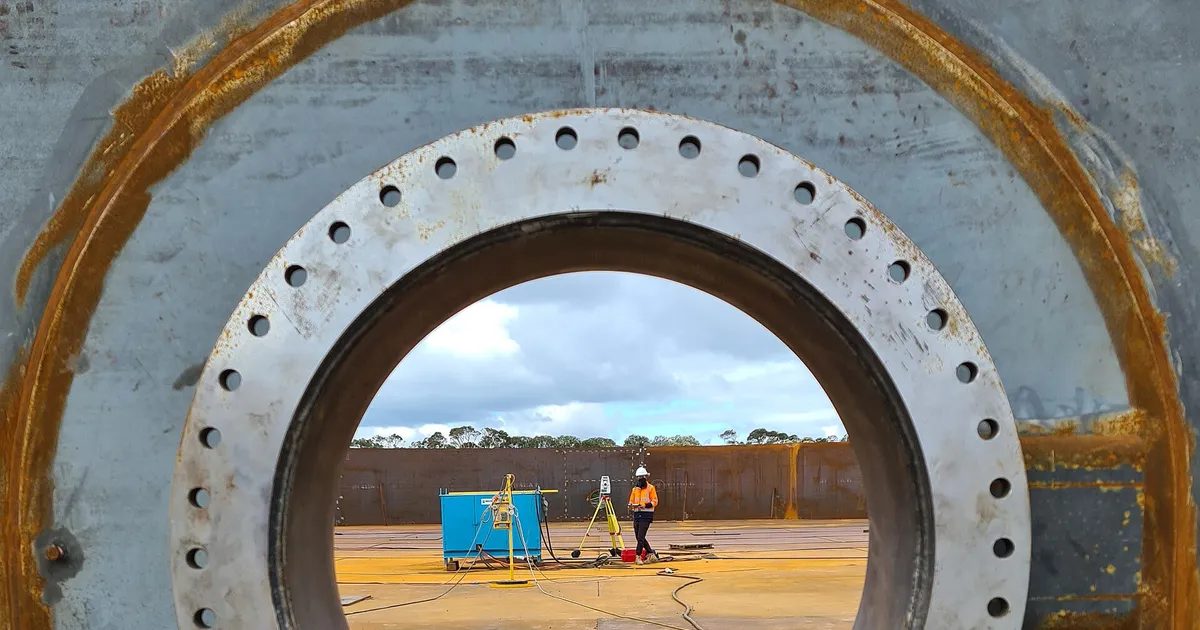
Flanges join pipes, valves, pumps and vessels, and most pressure-rated flanges are forged. A buyer who orders flanges meets a lot of abbreviations at once: WN, SO, BL, RF, RTJ, class 150, PN 16. The good news is that standard flanges are well defined, so an RFQ that names the standard and the grade gets comparable quotes. This guide sets out the types, the standards, the facings and the materials, and covers what changes when a flange is not standard.
Why flanges are forged
A flange sees bolt load, pipe load and pressure all at once, and the hub and neck carry stress where the section changes. A forged flange has dense metal and a grain structure that follows the shape. A flange cut from plate has flat grain and exposed edges, and a cast flange can have porosity. For steel pressure piping, standards such as ASME B16.5 expect forged material, listed in specifications such as ASTM A105, A350 and A182. Our guide to grain flow in forgings explains the benefit in more detail.
Types of flange
| Type | Description | Typical use |
|---|---|---|
| Weld neck (WN) | Long tapered hub, butt welded to pipe | High pressure, high temperature, cyclic service |
| Slip-on (SO) | Slides over pipe, two fillet welds | Low pressure, water, utilities |
| Blind (BL) | Solid disc with no bore | Closing a line end or a nozzle |
| Socket weld (SW) | Pipe fits into a recess, one fillet weld | Small bore, high pressure |
| Threaded (TH) | Internal thread | Small bore, where welding is not allowed |
| Lap joint (LJ) | Used with a stub end, rotates freely | Systems that need easy alignment |
| Orifice | Taps for flow measurement | Flow metering |
Weld neck flanges are the most common in process piping, because the smooth transition from hub to pipe lowers stress and allows full radiography of the weld. Blind flanges are plain discs and the simplest forgings. They are easy to make but can be heavy at large sizes.
Standards and sizes
Dimensions come from standards, which keep flanges from different makers interchangeable.
| Standard | Covers | Rating system |
|---|---|---|
| ASME B16.5 | Pipe flanges and flanged fittings, NPS 1/2 to 24 | Class 150, 300, 600, 900, 1500, 2500 |
| ASME B16.47 | Large diameter flanges, NPS 26 to 60 | Class 75 to 900, Series A and B |
| EN 1092-1 | Steel flanges for European piping | PN 2.5 to PN 400 |
| MSS SP-44 and API 605 | Large flanges, as Series A and Series B | Used with B16.47 |
| MSS SP-25 | Marking of flanges and fittings | Marking content |
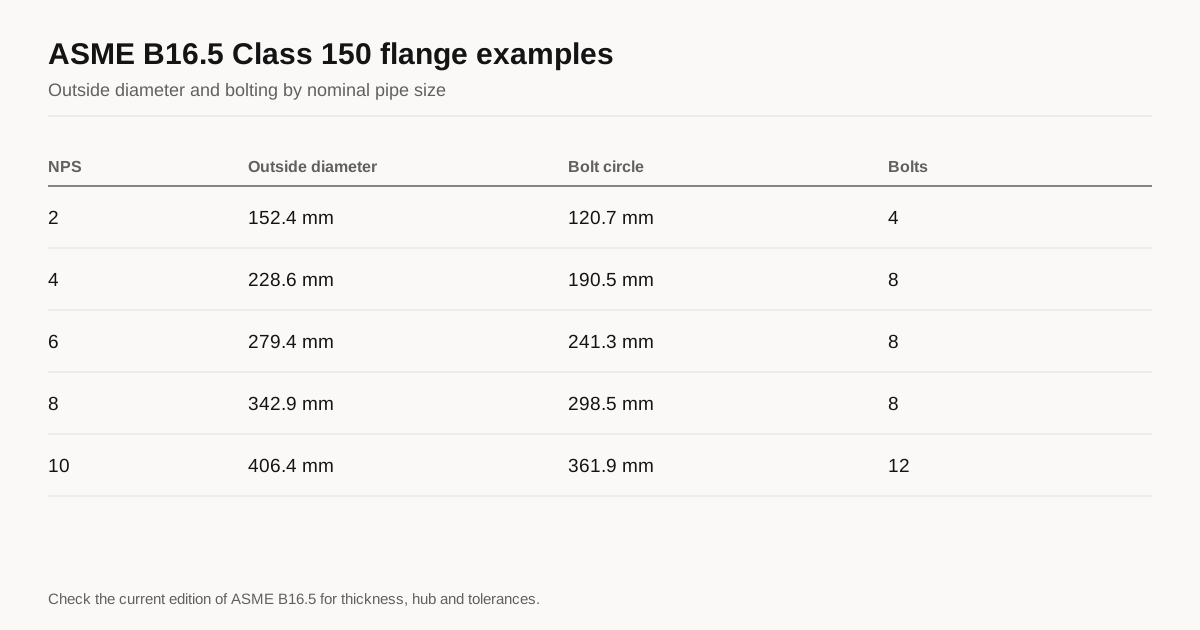
As an example, a Class 150 flange in NPS 4 has an outside diameter of 228.6 mm, eight bolt holes on a 190.5 mm bolt circle. A Class 150 flange in NPS 8 has a 342.9 mm outside diameter and eight bolts on a 298.5 mm circle. Check the current edition of the standard for exact numbers, since thickness, hub size and tolerance depend on the class and type.
Facings
The face is where the gasket sits. The standard types are:
- Raised face (RF). A raised ring around the bore holds the gasket. Most common in process piping.
- Flat face (FF). The whole face is flat, used with cast iron and some low pressure joints.
- Ring type joint (RTJ). A machined groove holds a metal ring gasket for high pressure and temperature.
- Tongue and groove, male and female. Used in special services where the gasket must be confined.
Facing finish is also specified. A serrated finish with 125 to 250 microinch roughness is typical for gasketed raised faces. Ask the supplier for the finish and check it on arrival.
Materials
Carbon steel flanges in ASTM A105 are the default, with A350 LF2 for low temperature, both covered in our guide to A105 against A350 LF2. Alloy steels such as A182 F11 and F22 serve for high temperature steam, and stainless steels F304, F316 and F51 for corrosion, as set out in stainless steel forgings. Nickel alloys and titanium are used in aggressive and offshore service. Material choice follows the fluid, temperature and design code.
How flanges are forged
Small and medium flanges are usually forged in closed dies from a round billet, using a press or hammer. The billet is upset and formed into the flange shape with a hub, and the part is trimmed, heat treated and machined to size. Large flanges are often made from seamless rolled rings, which are rolled to near the flange diameter and then machined, as in our guide to seamless rolled ring forging. The biggest flanges and special ones come from open die forged discs or rings. After forging, the flange is heat treated, machined to the standard dimensions, bored and drilled, marked and inspected.
Custom flanges
A custom flange does not follow a standard, for example a special bolt circle, a larger outside diameter, an unusual thickness, a stepped bore or a profile for a machine housing. These are not made from standard tooling, so the route is different. For small quantities the usual answer is an open die forged disc or a rolled ring machined to the drawing. For larger quantities a closed die may pay back. The price is driven by the weight of the starting forging, the machining time and the tests. Our guide to open die and closed die forging helps decide the route.
A custom flange drawing needs more detail than a standard one. Give the outside diameter, bore, thickness, bolt circle, number and size of bolt holes, facing, any hub shape and the tolerances and finish. Mark critical features and say what the flange will mate with.
Marking, testing and documents
A flange to a standard has marks on the rim: manufacturer, standard, size, class, material grade, heat number and sometimes the schedule. Marking is checked on receipt, and it is the first sign of a compliant part. Testing depends on the grade and the project. It may include chemical analysis, tensile and hardness tests, impact tests for low temperature grades, positive material identification and surface tests. A material test report to EN 10204 type 3.1 is typical, and type 3.2 with a third party is used on larger projects. Our guide to forging certifications and specs explains the levels.
Weld neck bore and pipe schedule
A weld neck flange has to match the pipe it will be welded to. The bore of the flange and the wall thickness at the weld end must fit the pipe schedule, which is the wall thickness class of the pipe, such as schedule 40, schedule 80 or standard weight. If the bore is too small, the flow is restricted and the welder has to grind the pipe. If it is too large, the weld end is too thin and the joint is weak. The order must therefore say the schedule or the exact bore, not only the nominal size. Many delays come from flanges delivered with a standard bore when the pipe was a heavier wall, so check this on every line of the order.
Pressure and temperature ratings
A flange class is a rating, not a pressure. Class 150 does not mean 150 psi. The allowed pressure depends on the material group and the temperature, and falls as temperature rises. For example, a Class 150 flange in carbon steel is rated for about 19.6 bar at ambient temperature and falls to about 13.8 bar at 260 degrees Celsius. A Class 300 flange in the same material is rated for about 51 bar at ambient. Tables in ASME B16.5 give the exact values by material group. A105 and LF2 sit in the same group, which is one reason the two can often be swapped on rating, though not on the impact test requirement.
The design engineer picks the class from the maximum pressure and temperature, and the buyer writes it on the order. If you are replacing flanges on an existing line, copy the class and facing from the old ones, and check the mating flange.
Bolting and gaskets
A flange does not work alone. The bolts, nuts and gasket complete the joint, and a mismatch can cause leaks even when the flange is correct. Bolt size and number follow the standard for each class and size. Gasket type depends on the facing: spiral wound or sheet for raised face, ring joint gaskets for RTJ. If you buy flanges through us, check with the supplier whether the quote covers bolts and gaskets or just the flange. For critical service, bolting has its own specifications, such as ASTM A193 for studs and A194 for nuts, and the joint is assembled with a controlled torque procedure.
What to check on receipt
A short list of checks on delivery saves trouble later. Check the marking against the order: grade, class, size and heat number. Check the outside diameter, bolt circle and bore with a caliper or gauge on a sample. Check the facing finish and look for damage on the sealing surface, because scratches across the face cause leaks. Check that the weld bevel is clean and at the angle required, usually 37.5 degrees for weld neck flanges. Check the material test report against the heat number on the flange. If the order needs positive material identification, run it on a sample from each heat. A flange that fails any of these should be set aside, and the supplier told before it is fitted.
What drives price
The price of a standard flange comes from the weight, the material, the size of the lot and the extras. Weight is the main driver, since a flange is a block of steel, and a Class 600 flange weighs several times more than a Class 150 flange of the same size. Material comes next, with stainless steel and alloy grades far above carbon steel. Lot size matters because dies and setups are shared across a batch. Extras include impact tests, PMI, third party inspection, special marking and painting or coating for transport. Ask each supplier to itemize these, and compare the same list. A bargain on the flange can disappear once the missing tests are added.
Standard flanges are traded in large volumes, and delivery from stock is common. Custom and large flanges are made to order, and lead time depends on forging, heat treatment, machining and testing. For project work, ask for a schedule with milestones, and confirm the supplier can meet the document package as well as the material delivery.
What to put in the RFQ
For standard flanges, write the type, size, class and standard, the facing and finish, the material grade and specification, the bore or pipe schedule for weld neck types, the quantity per line and the documents and tests. For custom flanges, send the drawing and say whether you will accept a forging from a rolled ring or a disc. State if marking differs from the standard, and give the destination and delivery terms. Group items by material and size, so suppliers can see which ones fit their tooling.
Next step
Send an RFQ with your flange list or drawing. We match you with up to 3 forging suppliers who make flanges in your size and grade, and we reply within 24 business hours. For the wider checklist, read how to choose a forging supplier.
See also: ASTM A105 carbon steel forgings, the material standard behind most carbon steel flanges.
Frequently asked questions
What is the difference between a weld neck and a slip-on flange?
A weld neck flange has a long tapered hub that is butt welded to the pipe, which gives a smooth transition and better fatigue and pressure performance. A slip-on flange slides over the pipe and is fillet welded inside and outside. It costs less and is easier to fit, but it is weaker in high pressure and cyclic service.
Are all flanges forged?
No. Some flanges are cut from plate, and some are cast. For pressure piping, forged flanges are the common choice because of their dense structure. Plate flanges are used for large diameters and low pressure, and cast flanges come as part of cast valves and fittings.
What is a custom flange?
It is a flange whose dimensions do not follow a standard, for example a special bolt circle, thickness, bore or profile for a machine or vessel. Custom flanges are typically made as open die forged discs or rolled rings and machined to the drawing.
Need a quote for this part?
Send the drawing. We match you with up to 3 forging suppliers and reply within 24 business hours.
Send my RFQ