Guides / Process
Seamless Rolled Ring Forging: Sizes, Profiles and Tolerances Buyers Should Know
October 27, 2026
A seamless rolled ring is a ring with no weld, made by punching a hole in a forged billet and then rolling it out to a larger diameter. It is the standard way to make bearing races, gear rings, flanges, pressure vessel nozzles and turbine casing rings. This guide covers the size range buyers can plan around, the profiles that are practical, the tolerances to expect and what to write in the RFQ.
How a seamless rolled ring is made
The process has four stages. A billet is cut to weight and heated. It is upset under a press or hammer so it becomes a thick pancake, and the press then punches a hole through the middle to make a preform. The preform goes onto a ring rolling mill, where a driven main roll presses the ring wall against an idler mandrel that passes through the hole. As the wall gets thinner the ring grows in diameter. Axial rolls hold the height. Sensors track the diameter and the mill stops when the ring reaches the programmed size.
Because the metal flows around the ring, the grain follows the circumference. That is the main reason a rolled ring holds up in rotating and pressure service better than a ring cut from plate or a welded ring made from rolled strip. There is no weld seam and no flat end grain at the cut edges. For a closer look at why that matters, see our guide to grain flow in forgings.
After rolling, the ring is normally heat treated, tested and machined to final size. The rolled shape is a near-net blank, not a finished part.
Typical size range
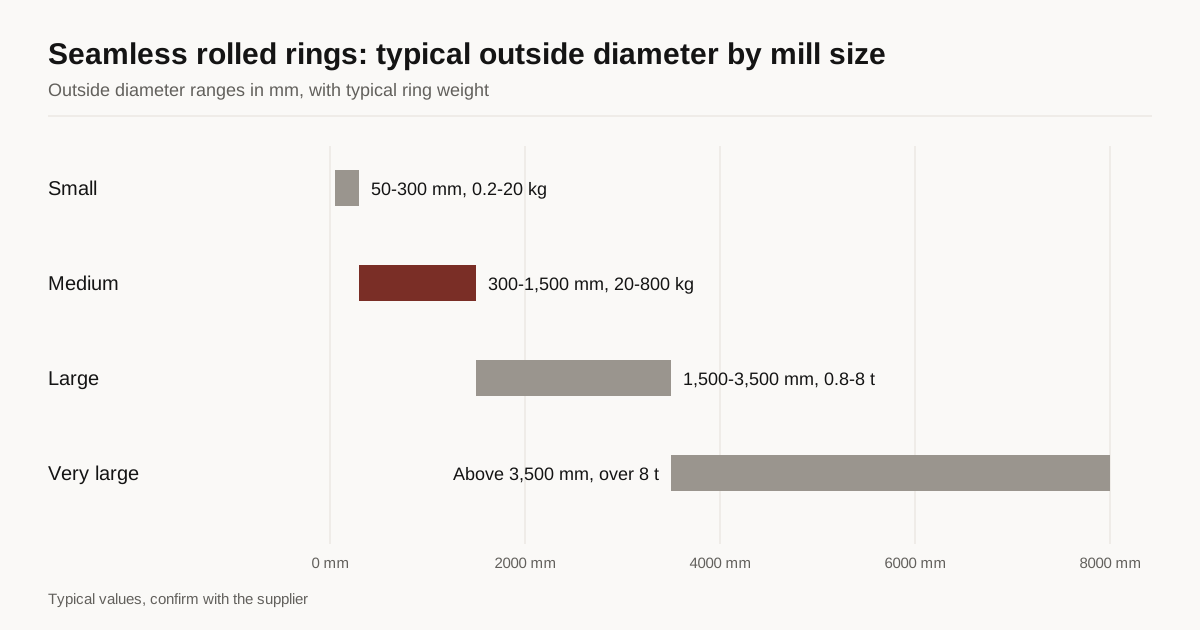
Ring rolling mills come in a wide range of capacities, so the useful question is which mill the supplier plans to use for your part. As a planning guide:
| Size class | Outside diameter | Typical ring weight | Typical use |
|---|---|---|---|
| Small | 50 to 300 mm | 0.2 to 20 kg | Bearing races, small gear rings, couplings |
| Medium | 300 to 1,500 mm | 20 to 800 kg | Flanges, gear rings, valve and pump parts |
| Large | 1,500 to 3,500 mm | 0.8 to 8 tonnes | Wind turbine bearings, vessel rings, slewing rings |
| Very large | Above 3,500 mm | Above 8 tonnes | Turbine casings, nuclear and offshore rings |
These bands are typical, not limits. A few mills in the world make rings above 8 metres in diameter, and every shop has its own minimum and maximum. If your part sits near the edge of a band, say so in the RFQ. The supplier shortlist changes with size more than with any other single factor.
Ring height and wall thickness also matter. Tall, thin-walled rings are harder to roll than short, thick ones because the wall can buckle. A drawing with an unusual proportion should be sent early so the supplier can say whether it can be rolled or needs a different route.
Profiles
The simplest ring has a rectangular cross-section. Rolling mills can also shape the cross-section directly by using profiled rolls, which saves material and machining.
Common profiles are:
- Rectangular, the default and the lowest cost.
- L-shaped or flanged, used for bearing seats and turbine casings.
- T-shaped or with a rib, used for slewing and gear rings.
- Stepped or contoured, where the rolled shape follows the final shape closely.
Profiled rings use less metal, but profiled rolls cost money. A plain rectangular ring is often cheaper unless the volume is high or the metal is expensive. The same trade-off applies to any shaped tooling, which we cover in forging die cost.
Tolerances and machining allowance
A rolled ring leaves the mill with a diameter held to a tolerance that grows with size, and with a surface that is scaled and rough. Machining allowance covers both. Typical numbers, to be confirmed with the supplier:
| Ring size | As-rolled diameter tolerance | Machining allowance per side |
|---|---|---|
| Up to 500 mm OD | About ±2 to ±4 mm | 3 to 6 mm |
| 500 to 2,000 mm OD | About ±4 to ±10 mm | 6 to 12 mm |
| Above 2,000 mm OD | Larger, set by quote | 10 to 25 mm |
Ovality, taper and height variation also apply, so allowances on large rings are set by agreement rather than from a table. A rolled ring that is rolled close to final shape will need less machining, but it also leaves less margin for scale and decarburization on the surface. A safe approach is to ask the supplier what allowance they plan and check it against your finished dimensions.
Materials
Rings are rolled from carbon and alloy steels, stainless steels, nickel alloys, titanium and aluminum. The alloy changes the process window. Stainless and nickel alloys need tighter temperature control and often more power. Titanium and aluminum are more sensitive again. Material specifications you will see on drawings include ASTM A182 for flanges and fittings, A336 for alloy steel forgings in pressure and high temperature service, A508 for vessel parts, and AMS or customer specifications for aerospace rings. Check the exact edition and grade on your drawing.
Testing
Ring forgings are commonly tested by ultrasonic inspection, hardness, tensile and impact tests on test coupons taken from a prolongation or from the ring itself, and dimensional inspection. Ring shapes are well suited to ultrasonic testing because the geometry is simple. The accept limits and the test method are set by the specification on the drawing, not by the supplier, so name them in the RFQ. Our note on ultrasonic testing of forgings explains how the common standard is applied.
When a rolled ring is the wrong choice
A rolled ring is not always the answer. Very small rings may be cheaper to cut from tube. Rings with unusual shapes, such as a bell or a ring with long internal ribs, may be better made as a closed die forging. If you need only one or two rings of an uncommon size, a supplier may suggest a ring cut from an open die forged cylinder instead, which avoids rolling setup. When you compare processes for your part, our overview of open die and closed die forging is a useful start.
What drives the price
Ring price is built from four parts: the metal, the forging and rolling, heat treatment and testing, and any machining the supplier does before shipping. For most grades the metal is the largest part, which is why a profiled blank that saves weight can pay for its tooling on a repeat order.
Rolling cost depends on the mill and the setup. A mill that is a good size match for your ring runs quickly and wastes little. A ring that is small for a large mill, or large for a small one, costs more per kilogram because the mill runs below its sweet spot or the shop has to improvise. That is the practical reason to share the diameter and weight early. Setup changes between ring sizes also take time, so batch size matters. A run of ten identical rings costs less per ring than ten different rings.
Heat treatment can add more than buyers expect on large rings. Quench and temper of a ring several metres across needs a large furnace and a large quench tank, and fewer shops have them. Testing adds cost when the specification calls for coupons at several positions or full-volume ultrasonic inspection. Check the specification before you compare quotes, because a supplier who priced less testing will look cheaper for the wrong reason.
Defects worth asking about
Rolled rings are reliable parts, but a few things go wrong often enough that buyers should know them. Laps and cracks on the surface come from poor billet preparation or from rolling too cold. Internal flaws such as porosity left from the ingot or inclusions are found by ultrasonic inspection, which is why that test is so common on ring forgings. Out-of-round rings result from uneven rolling or cooling, and are corrected with a sizing pass or by machining allowance. Scale and decarburization on the surface are normal and are removed by machining, but they set the minimum allowance.
You do not need to inspect for any of this yourself. You do need to ask what the supplier checks and what the report will show. A good answer names the test method, the standard and the acceptance limit, and says whether you will get the report with the shipment.
Lead time and planning
Lead time for rolled rings depends on three things: whether the billet material is in stock, how busy the mill is, and how long heat treatment and testing take. Common grades in standard sizes ship faster than special alloys, which may need a melt ordered from a steel mill. If your alloy is uncommon, ask early whether the supplier holds stock or has to order, because that single question can move delivery by weeks.
Plan for the machining step as well. If the supplier machines the ring, the lead time includes it. If you machine it yourself, make sure your shop receives the ring with enough notice and with the heat treatment certificate, since the machining plan often depends on the hardness. When a ring is for a critical rotating part, ask whether the supplier can send a test ring or a sample coupon before the full order, so that your own inspection can confirm the structure and hardness before the whole batch is committed.
What to put in the RFQ
A ring quote is only as good as the drawing and the notes. Send:
- Finished drawing with outside diameter, inside diameter and height.
- Material grade and specification, with edition.
- Heat treatment condition and any mechanical test requirements.
- Test method and acceptance limits for ultrasonic inspection.
- Quantity per order and per year.
- Required certificates and traceability.
- Delivery terms and destination.
Say if you are open to a profiled blank. Suppliers will often quote both, which shows the real cost difference for your part.
Next step
If you have a ring drawing, send an RFQ. We match you with up to 3 forging suppliers whose mills fit your diameter, height and material, and we reply within 24 business hours. For the wider checklist, read how to choose a forging supplier.
For the diameter ranges at which a ring is rolled, forged over a mandrel or made in impression dies, see types of forging.
See also: open die forging, the reference page on presses, reduction ratio and allowances.
Frequently asked questions
What is the difference between a rolled ring and a ring cut from plate?
A rolled ring is formed from a pierced forged billet, so the grain runs around the circumference. A ring cut from plate has grain running in one flat direction, and the cut faces expose end grain. For rotating or pressure parts the rolled ring is usually the stronger and more consistent choice.
What is the smallest ring a ring rolling mill can make?
Small mills work down to roughly 50 to 100 mm outside diameter. Below that, rings are usually cut from tube or bar. Ask the supplier for the minimum and maximum size on the mill they plan to use for your part.
Do I pay for tooling on a rolled ring?
Usually not for plain rectangular rings. Profiled rings that need shaped mandrel and main rolls may carry a tooling charge. Your RFQ should say whether you expect a profile so quotes show it clearly.
Need a quote for this part?
Send the drawing. We match you with up to 3 forging suppliers and reply within 24 business hours.
Send my RFQ