Guides / Process
Upset Forging for Shafts, Flanges and Bolt Heads: What Buyers Need to Know
October 31, 2026
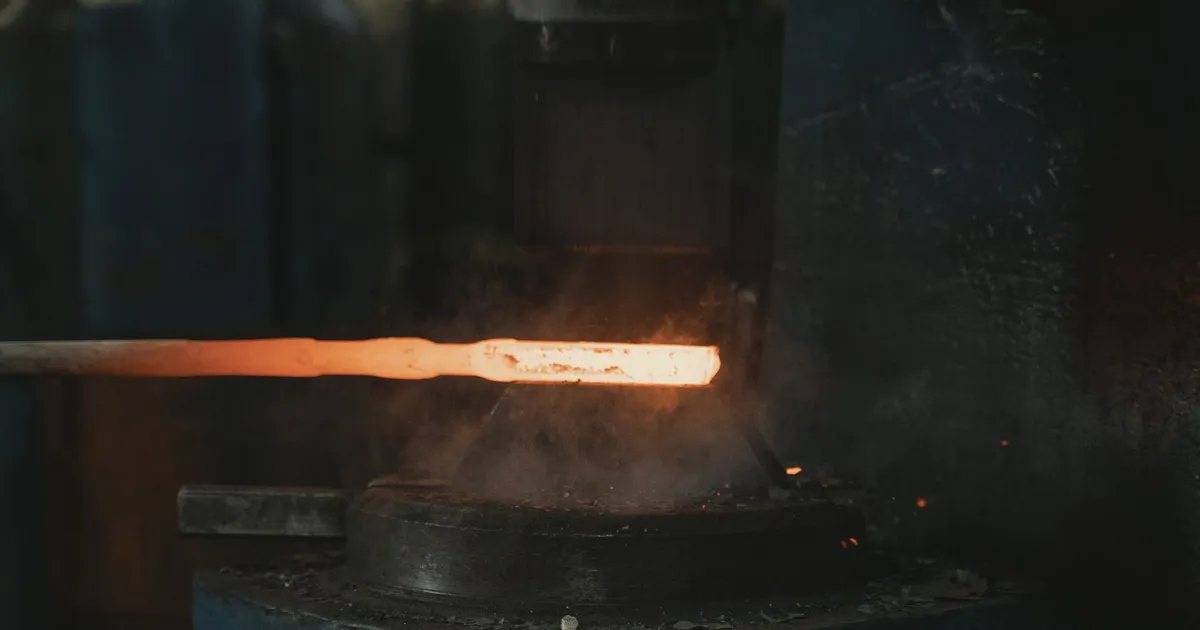
Upset forging, also called upsetting or heading, makes one end of a bar thicker by pushing it along its own axis. The bar is held in grip dies, a heated end is struck or pressed by a punch, and the metal bulges outward into a head, a flange or a collar. It is the standard way to make bolt heads on large bolts, flanged shafts, valve stems, axle ends and many gear blanks. This guide explains how it works, where its limits are and what to tell a supplier when you need a part made this way.
How upset forging works
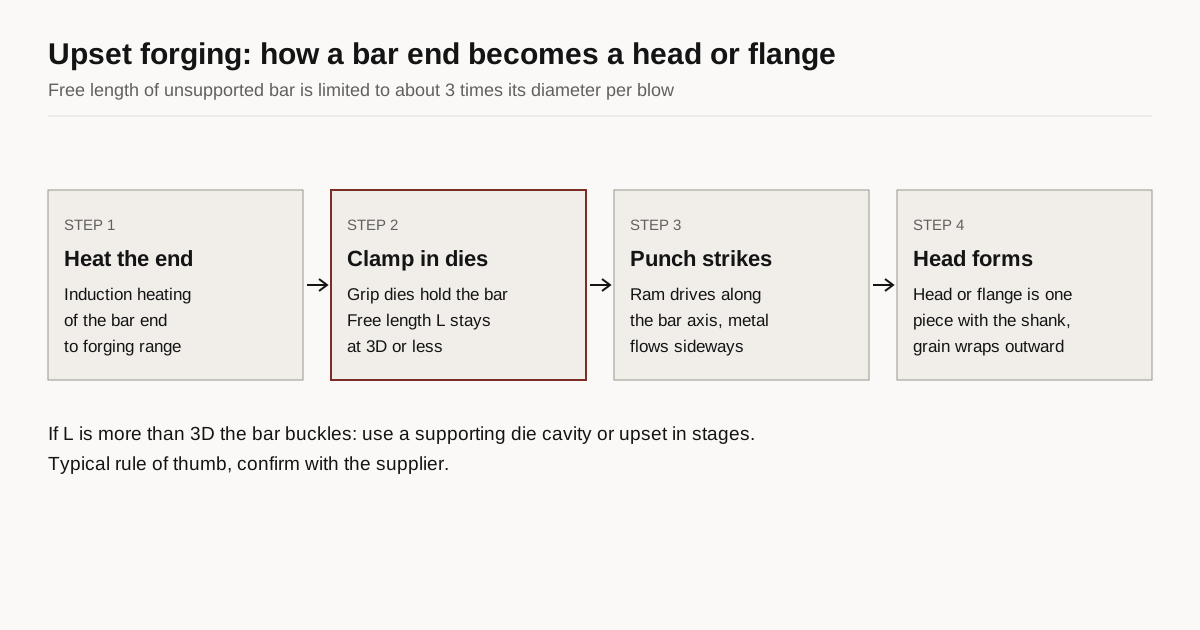
A bar is cut to length and heated at the end that will be upset. The bar goes into a pair of grip dies that clamp it, leaving a set length sticking out. A punch or ram then drives against the free end. Because the bar cannot move backward, the heated metal flows sideways and fills the cavity in the die or the shape of the punch. The result is a bar with a thickened end that is part of the same piece of metal, with no weld and no joint.
Two machine types do most of this work. A horizontal forging machine, also called an upsetter or header, holds the bar in a horizontal grip and strikes it with a ram that runs along the bar axis. It makes several stages in one machine by moving the bar between die stations, which suits volume parts. A vertical press or hammer can also upset, and does so when the part is large or made in small quantity. Open die shops upset ingots and billets in press forging for the same reason, to refine the structure and change the shape before further work.
The 3D rule
The key design limit is the length of unsupported bar. If too much bar sticks out of the grip dies, the end buckles sideways instead of bulging evenly, and the part folds over on itself. The common guide is that the unsupported length in a single blow should not exceed about three times the bar diameter. This is the 3D rule.
There are two ways around it. A die cavity can support the bar as it thickens. A cavity diameter of up to about one and a half times the bar diameter lets a longer length be upset safely, and some processes allow more with multiple stages. The other way is to upset in steps: a short upset first, then another on a larger cavity. Each step adds tooling and time, so every extra stage raises the price.
| Condition | Typical free length limit | Notes |
|---|---|---|
| One blow, no cavity support | About 3 times bar diameter | Buckles beyond this |
| One blow, supported by die cavity | Longer, set by cavity and ratio | Cavity usually up to about 1.5 times bar diameter |
| Two or more stages | Large total upset ratio | More tooling, more cost |
These are typical guides. The supplier sets the actual limit from the alloy, the temperature and the machine.
What parts suit upsetting
Upset forging fits parts with a head or flange that is larger than the shank and that sits at the end of the bar:
- Large bolts, studs with heads and tie rods.
- Flanged shafts, axle shafts and wheel studs.
- Valve stems and engine valves.
- Pump shafts with a collar or a coupling flange.
- Rail and chain parts such as spikes and clevis pins.
- Gear blanks with a hub on a shaft.
If your part has a large flange but a short shank, upsetting may not be the most economical route. A short bar with a large disc is often better made by closed die forging, covered in our overview of open die and closed die forging. If your part is a plain shaft with no head, upsetting adds nothing.
Typical sizes
Horizontal upsetters cover a wide range. As a planning guide:
| Class | Bar diameter | Typical part | Typical weight |
|---|---|---|---|
| Small | 10 to 40 mm | Bolts, wheel studs, valve stems | 0.05 to 3 kg |
| Medium | 40 to 100 mm | Axle shafts, flanged shafts, pump shafts | 3 to 40 kg |
| Large | 100 to 250 mm | Large shafts and flanged bars | 40 to 400 kg |
| Very large | Above 250 mm | Press upset ingots and billets | Above 400 kg |
Shop machine sizes decide the real limits. Send diameter, length and weight when you ask for quotes so suppliers with the right machines respond.
Grain flow and strength
When a bar is upset, the grain lines turn outward into the head and flange. A bolt head upset from bar has grain that wraps around the shank-to-head transition. A bolt head machined from a larger bar, with the shank cut away, has grain that is cut at the same transition. That is why upset heads handle fatigue and impact loads better, and why forged bolts are specified in critical joints. Our guide to grain flow in forgings shows how to check this on a sample.
The same logic applies to flanged shafts. A flange upset from the shaft end is a single piece of metal with grain following its shape. A flange welded to a shaft has a weld, a heat-affected zone and a joint to inspect.
Heat, temperature and alloys
Upsetting is usually done hot, with the end heated to the alloy’s forging range. For carbon and alloy steels that is generally between about 1,100 and 1,250 degrees Celsius at the start. Stainless steels, nickel alloys and titanium each have their own range, and the allowable upset per blow is smaller because the alloys are stronger at temperature. Heating is often done by induction at the bar end, which heats only the part to be upset and keeps scale down.
Some parts are warm or cold headed instead. Fasteners from wire and small rod are often cold headed because it is fast and gives a good surface and close tolerances. Our note on cold, warm and hot forging explains how to choose the range.
Tolerances and machining
Upset forgings leave the machine with a head or flange that is close to final shape, but not finished. The shank usually keeps the as-rolled bar tolerance, and the upset end follows the die. Typical planning numbers are about ±0.5 to ±1.5 mm on small parts and larger on big ones, plus draft where the die needs it. Faces that mate with anything are normally machined, and bearing seats and threads are always machined. Ask the supplier what stock they leave on each surface and compare that with your final drawing before you accept a quote. If you want to read tolerance callouts on a forging drawing, see forging tolerances and draft angles.
Tooling cost
Upsetting needs grip dies and a punch or cavity die for each part. The dies are smaller and cheaper than a full closed die set, but they are still a one-time cost that is spread over the run. For a few parts, a supplier may suggest open die work with machining instead. For hundreds or thousands, tooling cost per piece is small. Details on how to compare are in our piece on forging die cost.
Upsetting against machining from bar
The alternative to upsetting a flanged shaft is to start from a bar as large as the flange and machine the shank down. For a flange that is much larger than the shank this wastes a lot of metal. A shaft with a 150 mm flange and a 60 mm shank, for example, would start from 150 mm bar and cut away most of it as chips. Upsetting starts from 60 mm bar and moves the metal where it is needed. The saving grows with the flange-to-shank ratio and with the price of the alloy, and it is largest for stainless steel, alloy steel and nickel alloys, where chips are expensive to throw away.
Machining from bar still wins for single parts and very small runs. Setting up a heating station, grip dies and a punch costs more than a few hours on a lathe, so a one-off prototype is usually machined. The crossover is a few dozen pieces for most shaft sizes, lower for expensive alloys. If you are unsure, ask suppliers to quote both routes. Our guide on forging against casting and machining sets out the same trade-off in more detail.
Problems worth asking about
Three defects show up often enough in upset parts that a buyer should know their names. A fold or lap happens when the bar buckles or when metal folds over itself as it fills the die, and it leaves a hidden seam that can start a crack. Off-center heads happen when the bar is not held square in the grip dies, so the head is shifted from the shank axis. Cracks in the head come from upsetting too cold or too fast, or from an alloy that has little ductility in the working range.
Suppliers prevent these with the right bar length, die design and temperature. You can check for them with magnetic particle inspection on steel parts, which finds surface folds and cracks, and with a macro-etch of a sample section, which shows whether the grain lines follow the head. If your part is safety critical, put the inspection method and sample frequency on the drawing or in the purchase order so that it is part of the price from the start.
What to put in the RFQ
A good upset forging RFQ includes:
- Drawing showing the head or flange dimensions, shank diameter and total length.
- Material grade and specification.
- Heat treatment and hardness or strength requirements.
- Yearly quantity and order size.
- Surface and tolerance requirements, and which faces are machined.
- Testing, such as magnetic particle inspection on bolt heads or ultrasonic testing on shafts.
- Certificates required.
State if you can accept a slightly different head shape. Small changes, like a larger radius where the head meets the shank, can lower cost and improve fatigue life.
Next step
If you have a drawing for a headed or flanged bar, send an RFQ. We match you with up to 3 forging suppliers whose machines fit your bar size and alloy, and we reply within 24 business hours. For the wider checklist, read how to choose a forging supplier.
For how upsetting sits next to open die, closed die, ring and cold forging, read types of forging.
See also the reference pages on cold forging and forged shafts and axles.
Frequently asked questions
What is the 3D rule in upset forging?
It says the unsupported length of the bar that you upset in one blow should not be more than about three times its diameter. A longer free length buckles instead of thickening. Longer upsets are possible when a die cavity supports the bar, or when the upset is done in several steps.
Can any alloy be upset forged?
Most carbon, alloy and stainless steels can be, as can aluminum, titanium and nickel alloys, but each has its own temperature window and force requirement. The harder the alloy at forging temperature, the larger the machine needed and the smaller the practical upset ratio.
Is upset forging the same as cold heading?
They share the same idea, thickening one end of a bar. Cold heading is done at room temperature on small wire or rod for fasteners and is fast and cheap per piece. Hot upset forging is done on heated bar and covers larger sizes and higher upsets.
Need a quote for this part?
Send the drawing. We match you with up to 3 forging suppliers and reply within 24 business hours.
Send my RFQ