Guides / Process
Cold vs Warm vs Hot Forging: How to Choose the Temperature Range for Your Part
October 16, 2026
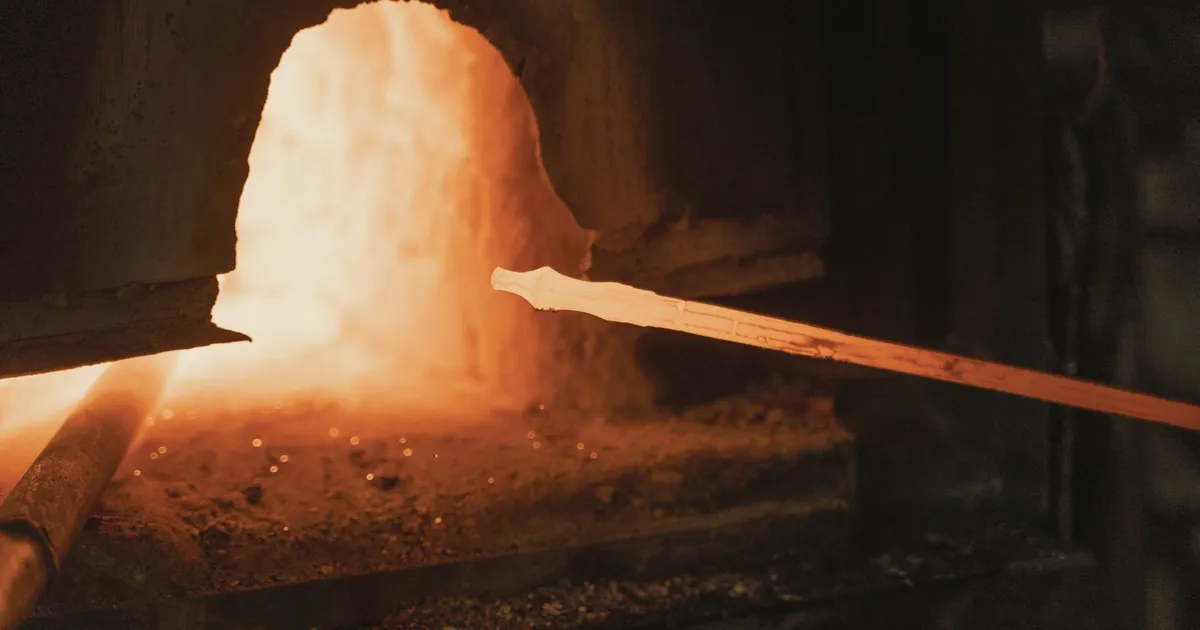
Whether a part is forged cold, warm or hot decides its tolerance, its surface, its maximum size, the alloys that can be used and the tooling cost. It is also one of the first questions a supplier asks, because only some suppliers have all three types of equipment. This guide explains the three ranges in plain terms, compares them in a table and gives a simple way to decide which fits your part.
What the three ranges mean
The ranges are set by what happens to the metal at temperature, not by a single number.
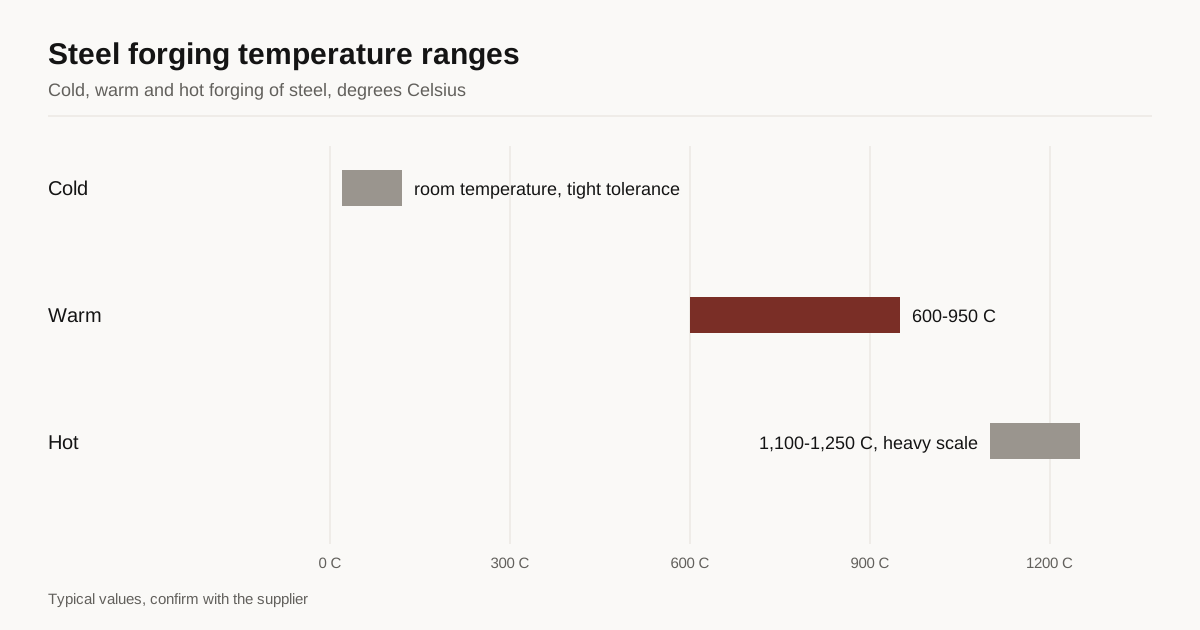
Hot forging is done above the recrystallization temperature of the alloy. At that temperature the metal softens and its structure renews itself as it is deformed, so it takes shape with relatively low force and does not work harden. For carbon and alloy steels the starting temperature is about 1,100 to 1,250 degrees Celsius. Aluminum is forged at about 350 to 500 degrees, copper alloys such as brass at about 650 to 800, and titanium at about 850 to 1,000 depending on the alloy.
Cold forging is done at or near room temperature. Metal is stiffer, so the forces are large and the tooling carries high stress. The metal work hardens as it deforms, which raises the strength of the part. Surfaces stay clean because there is no scale.
Warm forging sits between the two. For steel it is about 600 to 950 degrees Celsius, high enough to lower the force a lot compared with cold, and low enough to avoid heavy scale and to keep tolerances close.
Side by side
| Feature | Cold | Warm | Hot |
|---|---|---|---|
| Steel temperature | Room temperature | About 600 to 950 °C | About 1,100 to 1,250 °C |
| Typical tolerance | About ±0.05 to ±0.2 mm | About ±0.1 to ±0.4 mm | About ±0.5 to ±1.5 mm |
| Surface finish | Smooth, bright | Smooth with light oxide | Rough with scale |
| Typical part weight | Up to a few kg | Up to about 20 kg | Grams to many tonnes |
| Forming force | Highest | Medium | Lowest |
| Tooling life | Limited by high stress | Shorter than cold in some cases | Limited by heat and wear |
| Machining after forging | Little or none on some faces | Light | Light to heavy |
| Typical alloys | Low carbon steels, aluminum, copper | Medium carbon and alloy steels, stainless | Almost all alloys |
These values are typical. Individual shops differ, and the limits keep moving as equipment improves.
Tolerance and surface
Cold forging gives the tightest tolerances and the best surface, because there is no thermal shrinkage and no scale. Parts can come off the press close to final size, with only critical faces cut or ground. That is why fasteners, small shafts, splined shafts and gear blanks for automotive parts are often cold formed. Warm forging gives a slightly wider tolerance and a light oxide surface but covers larger sizes and stronger alloys. Hot forging gives wider tolerances and a rough scaled surface that is removed by machining, as we explain in forging tolerances and draft angles.
Size and force
The forming force needed grows quickly as metal gets colder. Cold forging a part from a hard alloy can need several times the force of forging it hot, and press capacity and die strength limit the part size. Cold forged parts are usually small, from a few grams to a few kilograms. Warm forging pushes the weight to tens of kilograms for some parts. Hot forging has no practical upper limit: ingots weighing hundreds of tonnes are forged in open die presses. When a part is large, the temperature choice is easy.
Alloys
Alloy choice interacts with temperature. Cold forging works best with soft, ductile materials such as low carbon steels, aluminum alloys and copper. Higher carbon and alloy steels can crack unless they are annealed and often spheroidized first, which adds cost. Warm forging suits medium carbon steels, alloy steels and some stainless steels that are too strong to form cold. Hot forging is used for the widest group, including high alloy steels, nickel alloys and titanium. Our guides on nickel alloy forgings and titanium forgings show how narrow the temperature window becomes for these alloys.
Cost
Cost has three parts. The first is tooling. Cold and warm forging use hardened dies that must resist very high pressure, often with prestressed die inserts, so tooling is expensive and has a defined life. Hot forging dies are made of hot work tool steel, and the cost depends on size and complexity, as we cover in forging die cost. The second is material use. Cold and warm forging make parts close to final shape and waste little metal, while hot forging loses 1 to 3 percent of the metal as scale and leaves more to machine away. The third is processing. Cold forging may need annealing, surface coating and a lubricant step, while hot forging needs furnace heating and cleaning.
For high volumes of small parts, cold forging usually gives the lowest piece price. For medium volumes of larger parts, warm forging or hot closed die forging is common. For low volumes or very large parts, hot open die forging is the standard choice.
Grain flow and properties
All three ranges produce grain flow that follows the shape of the part, as covered in our guide to grain flow in forgings. Cold forging adds strength by work hardening, which can raise the strength of a steel part without heat treatment. Hot forging refines the grain by recrystallization, and strength then comes from the heat treatment applied after forging. A warm forged part falls between the two, and it often needs less heat treatment than a hot forged part to reach the same strength.
How to choose
A simple way to decide:
- Is the part small, simple and made in high volume? Ask for cold forging first.
- Does it need tight tolerance and a good surface in a stronger steel or a more complex shape? Ask for warm forging.
- Is the part large, complex or made from a hard or heat resistant alloy? It is a hot forging.
- Is the volume low, or does the part change often? Hot open die forging with machining keeps tooling cost low.
If two routes seem possible, ask for quotes on both. The price comparison tells you how much the tolerance is worth. Our guide to open die and closed die forging helps with the hot part of the decision.
What the cold forging route involves
Cold forging looks simple from the outside, but the route has more steps than hot forging. Wire or bar is cut to a slug of exact weight, because the die cannot spill excess metal as a hot closed die does. Steel slugs are often annealed or spheroidized to soften them, then cleaned and given a phosphate and soap or other lubricant coating. The coating carries the lubricant through the very high pressure of the stroke. The slug is formed in several stations in sequence, with extrusion, upsetting and heading, and the part may be annealed between stations on difficult shapes. The yield of metal is high, but the line is tied to specific shapes and sizes, so changeovers take time. That is why cold forging prices well for high volume and badly for short runs.
Dimensional control also depends on process stability. Die wear, lubricant condition and slug weight all move the result by tenths of a millimetre, and suppliers watch them with statistical process control. If you need a tight tolerance on a cold forged feature, ask what capability the supplier has shown on similar parts.
Parts by range
Looking at familiar parts makes the ranges easier to grasp. Fasteners such as bolts, screws and rivets are cold headed from wire in huge numbers. Splined and stepped shafts for steering and transmissions are cold or warm extruded. Constant velocity joint parts and gear blanks for passenger cars are warm forged. Connecting rods, crankshafts, flanges, valve bodies and hand tools are hot closed die forged. Large shafts, rings, discs and pressure vessel parts are hot open die forged. Parts for mining and earthmoving machinery, which are heavy and see impact, are almost always hot forged, as we show in our guide to forged parts for mining and earthmoving equipment.
Mistakes buyers make
The first mistake is to ask for cold forging because the tolerance is tight, without checking that the part size and alloy suit it. A part of 8 kg in 4140 steel is not a cold forging job in most shops, however tight the tolerance. The second is to ask for hot forging on a tiny part in a large volume, where cold heading would cost a fraction. The third is to assume the supplier will pick the right route. A supplier will usually quote the route that suits its own equipment, which may not be the cheapest for you. The fix for all three is to describe the part, the volume and the key tolerances, and to ask for the route that gives the best price at that volume.
Heat treatment after forging
The temperature route also decides what heat treatment follows. Cold forged parts may be stress relieved or annealed to restore ductility, or hardened afterward if they are made of a hardenable steel. Warm forged parts are often quenched and tempered directly from machining. Hot forged parts almost always get normalized or quenched and tempered, as described in our guide to heat treatment of forgings. If you plan to specify a final condition, make sure the supplier has the equipment or a treater they trust.
What to put in the RFQ
Give the supplier the drawing, the material, the yearly quantity, the weight and the tolerances on critical faces. Say if you are open to more than one forging route. A supplier who offers only hot forging may suggest machining the tight faces. A supplier with cold forging may ask to change a corner radius or a wall thickness to make the part formable. These small changes are part of the design discussion, and they are easier before tooling is ordered.
Next step
Send an RFQ with the drawing and quantity. We match you with up to 3 forging suppliers whose equipment suits your part, and we reply within 24 business hours. For the wider checklist, read how to choose a forging supplier.
The temperature class is one of several process choices; see them together in our guide to types of forging.
See also: cold forging, the reference page on extrusion, steels, tolerances and tooling.
Frequently asked questions
At what temperature does hot forging start?
Hot forging is done above the recrystallization temperature of the metal. For steel that means roughly 1,100 to 1,250 degrees Celsius at the start of forging. For aluminum alloys it is lower, about 350 to 500 degrees, and for titanium about 850 to 1,000 degrees depending on the alloy.
Is warm forging a compromise between cold and hot?
Yes. Warm forging works the metal below the temperature where heavy scale forms but above room temperature, where it is softer than cold. For steel that is roughly 600 to 950 degrees. It gives tolerances and surface closer to cold forging with force and material limits closer to hot forging.
Why are most large forgings made hot?
Hot metal is soft and takes shape under much less force. A large part cold would need a press far bigger than any shop owns and might crack. Hot forging also works alloys that are too hard or too brittle to deform at room temperature.
Need a quote for this part?
Send the drawing. We match you with up to 3 forging suppliers and reply within 24 business hours.
Send my RFQ