Guides / Choosing a Supplier
Forged Parts for Mining and Earthmoving Equipment: What to Specify and How to Buy
October 21, 2026
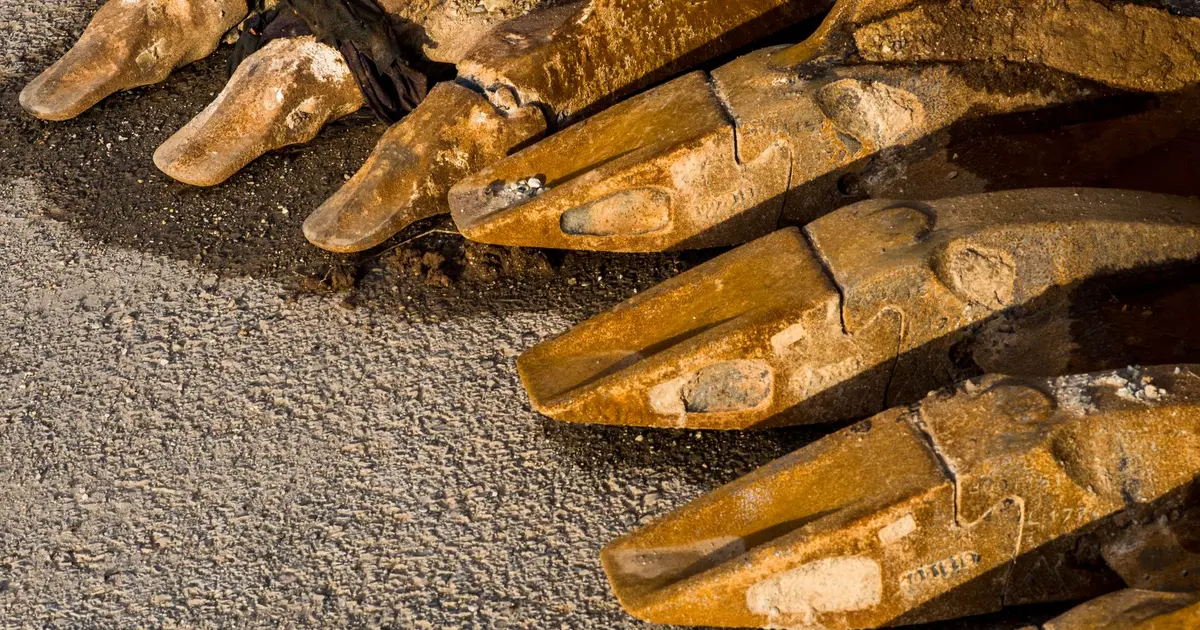
Mining and earthmoving machines break and wear metal faster than almost any other equipment. Teeth, track links, pins, rollers, chains and grinding balls are replaced on a schedule, and the spare parts market is large. Many of these parts are forged because impact and abrasion together are hard on cast shapes. For a buyer, the questions are which steel, which hardness, how the part is heat treated and how to check that a new supplier’s part will last as long as the old one. This guide covers those points and a practical checklist.
Why forging suits this duty
Earthmoving parts face two kinds of damage. Abrasion removes metal from the surface, which wants hard steel. Impact tries to crack the part, which wants tough steel. Hard steel is usually less tough, so the design is a compromise, set by heat treatment. A forged part gives the heat treater a good starting point. The metal is dense, with no shrinkage cavities, and the grain follows the shape, so cracks do not find easy paths. Forged parts are also more consistent from piece to piece than castings, which matters when hundreds of teeth or links are replaced in a set. Our guide to forging against casting and machining explains the trade-offs.
Typical forged parts
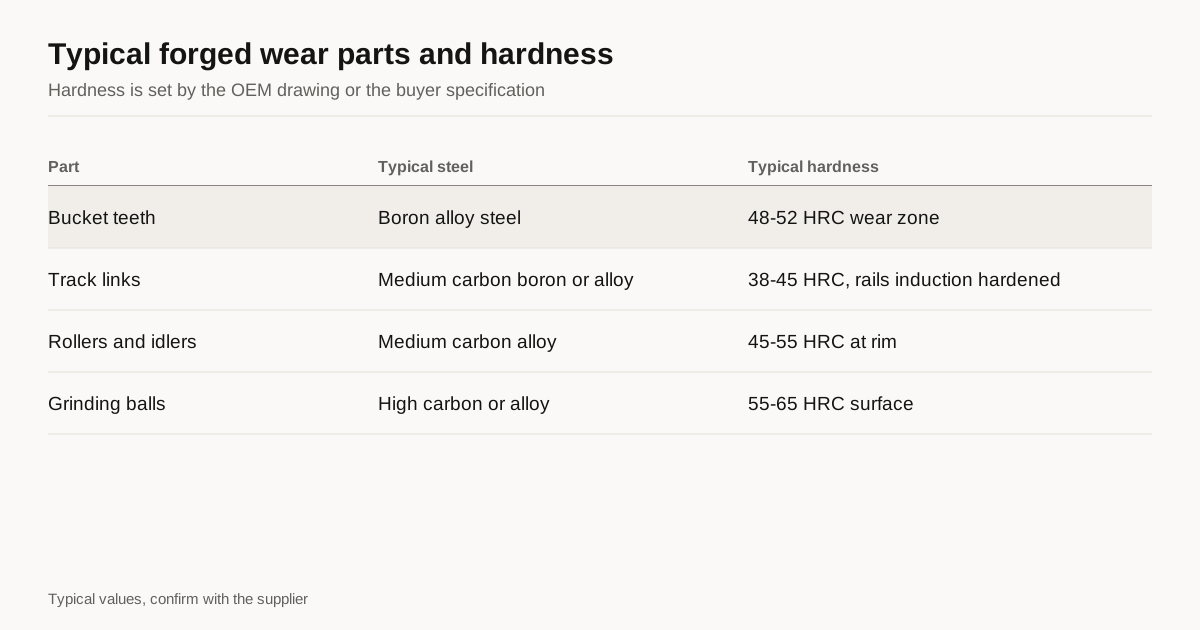
| Part | Typical steel | Typical hardness | Typical process |
|---|---|---|---|
| Bucket teeth and adapters (smaller machines) | Boron alloy steel, 30MnB5 or similar | About 48 to 52 HRC on wear zone | Closed die, Q&T |
| Track links | Medium carbon boron or alloy steel | Through hardened, about 38 to 45 HRC, rails induction hardened | Closed die, Q&T, induction |
| Track pins and bushings | Alloy steel such as 40Cr, 42CrMo4 | Case or through hardened | Forged or bar, heat treated |
| Rollers, idlers and sprocket segments | Medium carbon alloy steel | About 45 to 55 HRC at rim | Closed die, induction hardened |
| Chain links and shackles | Alloy steel to chain standards | Per chain grade | Forged or welded, Q&T |
| Hooks, pins and clevises | Alloy steel | Per load rating | Open or closed die, Q&T |
| Crusher hammers and pick bodies | Alloy steel | About 45 to 55 HRC | Forged, Q&T |
| Grinding balls | High carbon or alloy steel | About 55 to 65 HRC on surface | Forged, rolled or cast |
The table is a general map. Actual hardness and steel come from the OEM drawing or the buyer’s specification. Large crushers also use cast high manganese steel for liners and jaws, which are not forged and are not covered here.
Steels and hardenability
Wear parts need steels that harden deeply and reliably. Boron steels such as 30MnB5 or 27MnCrB5 reach high hardenability from small amounts of boron and cost less than nickel alloys. Chromium-molybdenum steels such as 4140 and 42CrMo4 are common for pins, rollers and shafts. Nickel-chromium-molybdenum steels such as 4340 are used for large and highly loaded parts. Our guide to 4140 against 4340 compares the two common alloy steels.
For a part with a thick section, the steel must harden through the section, or the core stays soft and the part deforms under load. For a part that is heavy but needs wear only at the surface, induction hardening of the surface over a tough core is common. The drawing should say which approach applies and what the hardness depth is.
Heat treatment
Most mining forgings are quenched and tempered, which brings the steel to a hardness and toughness suited to the duty. Some are also induction hardened at the working surface, to give a hard skin on a tough core. Our guide to heat treatment of forgings explains the steps. Key points for a buyer:
- Hardness is specified as a range, not a minimum, because very hard parts chip and crack. The upper limit matters as much as the lower.
- Case depth on induction hardened parts is specified in millimetres to a stated hardness, and it is checked on a cut section.
- Cold climate service often adds a Charpy impact requirement at minus 20 degrees Celsius or lower.
- Tempering after quenching should happen soon, since a part that waits can crack.
Testing
Testing a wear part is mostly about hardness, structure and soundness. Common checks are surface hardness on each part or a sample, hardness traverses on cut samples, microstructure, magnetic particle inspection for cracks and dimensional checks. Impact tests apply where the specification calls for them. For safety critical parts such as hooks and lifting gear, proof load tests and full traceability are common.
A first article check is a cheap way to protect a first order. Cut one part from the first lot, measure hardness across the section, check the structure and look at the grain flow. Our guide to grain flow in forgings shows what to look for.
Aftermarket and drawings
Much of the market is aftermarket: parts that fit an existing machine but are made by a supplier other than the machine maker. A buyer in this market usually has either an OEM drawing, a worn sample or a part number. Dimensions, material and hardness are the minimum to specify. If you have only a sample, a measuring service or the supplier can produce a drawing, and a material analysis of the sample shows the steel type. Hardness profile on a cut sample shows the heat treatment.
Be careful with markings. OEM trademarks and part numbers are protected, and aftermarket parts should carry the supplier’s own marks. If you order from a supplier, ask for the marking on the part and on the packaging, and keep your own record of the lot.
Grinding balls and mill media
Grinding balls are a special case, because they are consumed in huge numbers. Forged or rolled steel balls from about 20 to 150 mm in diameter break rock in ball mills and SAG mills at mines and cement plants. They are made by forging or rolling a round bar slug into a ball, then quenching and tempering, with a surface hardness of roughly 55 to 65 HRC and a softer core. The main quality concerns are surface and internal cracks, which make balls break into pieces in the mill, and uneven hardness, which makes them wear into flat or oval shapes. Producers test by dropping balls repeatedly from a height until they crack and by cutting sections to check the hardness profile. Cast high chrome balls compete with forged balls in some mills, so the choice often comes down to cost per tonne of ore ground. If you buy balls, ask for the drop test result, the hardness profile and the wear rate in a similar mill.
Reading failure modes
A worn part tells you what the steel and heat treatment need to do better, if you know how to read it. Even wear on the working face with no cracks suggests the hardness is right and the part has simply done its job. Rapid wear, with the surface polished and rounded, suggests the hardness was too low for the abrasive. Chipping at edges and corners suggests the hardness was too high for the impact, or the part was tempered too little. Cracks running through the section suggest a quench crack, a forging flaw or an overload. Spalling, where flakes break off a hardened surface, suggests that the case was too shallow or too hard for the load beneath it.
Send photographs and the hours in service to the supplier when you ask for a revised specification. A supplier that can read these signs is more useful than one that only quotes a price. Our guide to how to choose a forging supplier lists other questions that tell a capable supplier from a trader.
Fits, pins and bushings
Track chains and linkages depend on fits between pins, bushings and links. A pin that is slightly oversize will not press in, and one that is slightly undersize will loosen and wear fast. Tolerances on pins and bores are therefore tight, often within a few hundredths of a millimetre, and they are met by grinding after heat treatment. A forged pin blank has to leave enough stock for that grinding and enough case depth to survive it. Check that the drawing gives the fit tolerance, the surface finish and the hardness after grinding. If you order a set of links, pins and bushings from different suppliers, check that the fits match, because a good part from each can still be a bad assembly.
Corrosion protection and packing
Heavy parts sit in stock and travel by sea, and bare hardened steel rusts. Parts are normally oiled or coated with a rust preventive, and larger ones are painted or packed in wrapped bundles. Hardened parts need care about the coating, since some processes such as pickling or electroplating can cause hydrogen embrittlement in high strength steel. If your parts are above about 40 HRC, ask the supplier which coating they use and whether a baking step follows. Pack weight is high, so check the pallet and crate design against the lifting gear and the container loading plan, and ask for marking that matches your stock system.
Cost per hour, not cost per piece
A wear part’s price matters less than its life. A tooth that costs 20 percent more but lasts 50 percent longer is cheaper per hour of use. Buyers in mining track cost per operating hour or per tonne moved, not price per piece. To compare suppliers, run a field trial on a few machines in the same conditions, record hours to replacement and compare. Take care that conditions match, since ground, load and operator change wear a lot. A supplier who accepts a fair trial and shares its heat treatment data is more likely to be consistent.
Volume and tooling
Most of these parts are made in closed dies, and tooling cost is spread across a long run. Aftermarket volumes for common machines are large, so tooling for popular parts is easy to justify. For low volume parts such as older models, open die forging with machining may be more economical. Our guide to forging die cost helps with that decision.
What to put in the RFQ
Give the drawing or sample, the steel grade or a performance target, the hardness range and the case depth for induction hardened parts. State the heat treatment, the testing, the marking and packaging, the yearly quantity and the batch size. Mention the operating conditions, such as ground type and climate, so that the supplier can propose a steel and hardness. Ask for a first article report and for a trial lot before the full order.
Next step
Send an RFQ with your drawing or sample details. We match you with up to 3 forging suppliers that make heavy equipment parts in your size and volume range, and we reply within 24 business hours. For the wider checklist, read how to choose a forging supplier.
Frequently asked questions
Why are mining and earthmoving parts forged?
They take heavy impact and abrasion, and a forged part has dense metal and flow lines that resist cracking under shock. Forging also allows alloy steels to be hardened and tempered to a combination of hardness and toughness that castings often cannot match in thin sections.
How hard should a bucket tooth or track link be?
It depends on the part. Bucket teeth are often hardened to about 48 to 52 HRC for wear resistance with a tougher core. Track links are commonly through hardened to about 38 to 45 HRC with induction hardened rails. The drawing or OEM specification sets the exact values.
Can I buy aftermarket forgings that fit OEM machines?
Yes, aftermarket parts are common. Specify dimensions, material, hardness and heat treatment from a drawing or a measured sample, and test the first batch in service. Do not ask for OEM trademarks or part numbers to be copied, since those are protected.
Need a quote for this part?
Send the drawing. We match you with up to 3 forging suppliers and reply within 24 business hours.
Send my RFQ