Guides / Choosing a Supplier
Forged Hand Tools: How Wrenches, Hammers and Pliers Are Made at Volume
October 20, 2026
Hand tools are one of the oldest and biggest uses of forging. A single wrench size can be made in millions of pieces, and a supplier may run dozens of sizes on the same line. A buyer who brings a private label range, a distributor spec or a tool for an equipment kit meets a market where price is tight, tolerances are set by standards and the difference between good and poor tools is not obvious from the outside. This guide explains how forged hand tools are made, what steels and hardness apply and how to buy at volume without surprises.
Why hand tools are forged
A tool must be strong where it is thin and hard where it touches. A wrench jaw is a thin section under torque, a hammer face takes impact and a pair of pliers has cutting edges and a pivot that carry high stress. Forged steel has dense metal and a grain pattern that follows the shape, which resists bending and cracking. Forging also lets the maker choose alloy steels, harden them and temper them to a known hardness. Cast tools are brittle in thin sections, and tools stamped from plate lack the thickness and toughness needed for heavy use. For the general reasons, see our guide to forging against casting and machining.
Steels
| Tool | Common steel | Notes |
|---|---|---|
| Combination and open-end wrenches | Chrome vanadium, 6150, 50CrV4, 31CrV3 | Tough, hardens deeply |
| Ratchet wrenches and sockets | Chrome vanadium or chrome molybdenum | Sockets for hand use and impact use differ |
| Impact sockets | Chrome molybdenum, 4140 or similar | Higher toughness for impact guns |
| Hammer heads | Medium carbon steel (1045 or C45) or alloy steel | Face and peen hardened |
| Pliers, cutters | Carbon or chrome vanadium steel | Induction hardened cutting edges |
| Pry bars, chisels | Chrome vanadium, medium carbon | Tempered for toughness |
Chrome vanadium steel is the usual choice for premium wrenches because it hardens well and keeps toughness in thin jaws. Medium carbon steel is cheaper and is acceptable for hammers and for economy ranges. Our guide to 4140 against 4340 compares the common alloy steels that overlap with tool steels.
How tools are forged
Most hand tools follow the same sequence on a high speed forging line.
- Bar or slug. Round or flat bar is cut to a weight that matches the tool plus flash.
- Heating. Induction heating brings the slug to about 1,100 to 1,200 degrees Celsius.
- Forging. A press or a hammer forms the tool in a preform and a finishing die. A combination wrench is forged flat with the open jaw at one end and the ring at the other.
- Trimming and piercing. A trim press cuts away flash and punches out the ring or hole.
- Cooling or normalizing. Parts are cooled in a controlled way to prepare for machining.
- Heat treatment. The tools are hardened and tempered to the target hardness.
- Finishing. Grinding, polishing, plating, marking and inspection finish the product.
Precision forging dies leave the jaw and ring close to final size. A wrench blank may need only light grinding on the jaw faces. Pliers are forged as two halves, then machined at the joint and cutting surfaces, assembled with a rivet and given handles.
Hardness and standards
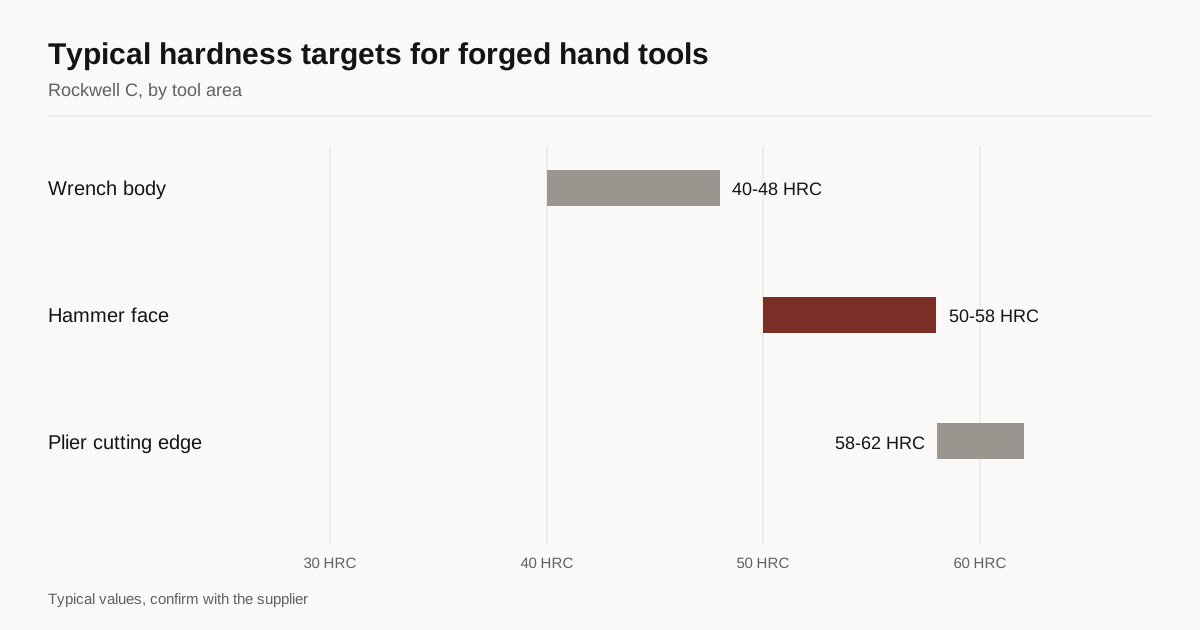
Hardness is the key spec on a tool, because it balances wear against brittleness. Typical targets are about 40 to 48 HRC for wrench bodies, with a lower value for impact sockets that must flex, 50 to 58 HRC on hammer faces and 58 to 62 HRC on the cutting edges of pliers and cutters. Pliers handles are softer. These are typical values and the tool standard or brand specification sets the exact limits.
Standards cover dimensions and performance. Examples are ASME B107.100 for wrenches in the United States, which sets sizes and a minimum torque test, and ISO 691 for open-end wrench head sizes. There are national and industry standards for hammers and pliers too. A buyer should name the standard on the drawing and ask whether the supplier tests to it. A tool that meets the dimensions but not the torque test can look right and fail in service. Our guide to forging certifications and specs explains how to check what a supplier claims.
Heat treatment
Most hand tools are quenched and tempered, which gives hardness with toughness. Our guide to heat treatment of forgings explains how it works. Some tools get selective hardening. Hammer heads are often induction hardened on the face and peen only, leaving the eye and body softer so that the head does not crack at the handle hole. Pliers have induction hardened cutting edges. Selective hardening needs a controlled depth, which is checked by cutting a sample and measuring hardness across the section.
Case depth, hardness and tempering temperature should be stated in the specification. A hammer face hardened too deep can chip and send fragments flying, which is a safety issue. If you buy impact tools, ask about testing for brittleness, such as a drop or bend test.
Finishing and plating
Finish decides how a tool looks on the shelf, and also how it resists rust. Common finishes are nickel and chrome plate, black oxide and phosphate. A polished chrome finish takes high effort on the surface, so the forging has to be clean and smooth. For hardened steel above about 40 HRC, plating can cause hydrogen embrittlement, a delayed cracking from hydrogen absorbed during the process. The usual remedy is to bake the parts soon after plating, to drive hydrogen out, and a good supplier will describe its process. Ask whether baking is done and to what standard.
What separates a good tool from a cheap one
Two wrenches of the same size can look alike and perform very differently. The differences are in the steel, the heat treatment and the geometry, and a buyer can check most of them. Steel chemistry shows in the certificate or in a spectrometer test on a sample, and a premium tool should match the grade named in the specification. Hardness should sit within the target range across the jaw and ring, not only at one point. Geometry matters at the jaw, where the opening must match the nut size within a tight tolerance, and at the ring, where the profile decides how many contact points grip the nut. A 12-point box end can turn a nut from many angles, while a 6-point one grips the flats better and puts less stress on a worn nut. Offset in the neck of a combination wrench gives knuckle clearance, and the head angle, usually 15 degrees, lets you turn a nut in a tight space by flipping the wrench.
Cheap tools save money in the steel and in heat treatment control. A wrench made from low alloy steel and hardened unevenly may spread its jaws under torque, round the nut or crack. A field test is simple: put a sized nut in the jaw and apply torque with a bar, or use a torque tester. A good tool survives the proof torque in the standard without deformation. A poor one shows a permanent set or breaks. Ask suppliers for torque test records on a sample of each lot.
Hammers and safety
Hammer heads are a safety product, because a hard face can chip and send fragments at speed. Standards call for markings such as warnings about striking hardened steel with a hammer, and for hardness limits on the face so that it does not become brittle. Head hardness is controlled by induction hardening and tempering, and eye strength by leaving the eye area softer. The handle fit matters as much as the head. A loose head can fly off, so fit tests, wedges and handle material are part of the specification. If you buy hammers with handles from another supplier, check that the eye shape and the handle match, and run a pull-off test on a sample.
Pliers and cutters
Pliers are the most complex of the three. Each half has a handle, a pivot and a jaw. The jaws may need gripping teeth, a cutting edge or both, and the pivot has to hold tight tolerances. After forging, the halves are milled at the joint, drilled and ground, then the cutting edges are hardened by induction and the whole tool is assembled. Cutter quality depends on edge hardness and alignment, so check that the edges meet cleanly and that a test cut in hardened wire at the rated size leaves the edge intact. If the cutter is rated for hard wire, the supplier should show the test.
Supplier checks for hand tools
Hand tool suppliers range from large plants with their own forge, heat treatment and plating lines to traders who buy from several factories. For a first order, ask where each step is done. A supplier who forges and heat treats in house can show you charts and records. A trader may be reliable too, but you rely on its own checks. A factory visit or a third party inspection of the first lot reduces risk. Our guide to how to choose a forging supplier lists the questions that apply here.
Tooling and volume
Hand tool dies are built for long runs, and a die set for a single wrench size can make tens of thousands of pieces before rework, sometimes more. Die cost is spread over the run, so the economics work for ranges sold in volume. A buyer who wants a custom shape in small quantities will find tooling a barrier. The shortcut is to start from a supplier’s existing designs, which already have dies, and to add your own marking and finish. Our guide to forging die cost shows how to work out payback for a custom shape.
Private label buyers should keep control of their brand marks. The marking die, which stamps the brand on the tool, is a separate small tool. State who owns the marking tool and who can use it, and keep that in writing.
Testing
Typical tests for hand tools are hardness checks on samples, torque or proof load tests for wrenches, impact or drop tests for hammers and sockets, dimension checks with go and no-go gauges, and plating thickness. For a large order, an agreed sampling plan sets how many pieces from each lot are tested. Ask for a test report with each lot, and keep samples. Run a field trial on a small batch before approving the full order.
What to put in the RFQ
State the tool type, sizes and standard, the steel grade or the performance requirement, the hardness range and where it applies, the finish and the marking. Give the yearly quantity and the size of each order, the packaging, such as pouches or sets, and the tests and documents. Ask suppliers to quote from their existing dies when possible, and to show any tooling costs separately.
Next step
Send an RFQ with the tool list and quantity. We match you with up to 3 forging suppliers who make hand tools at volume, and we reply within 24 business hours. For the wider checklist, read how to choose a forging supplier.
Frequently asked questions
Why are wrenches forged instead of stamped or cast?
A wrench takes torque in a thin jaw section, so the metal must be dense and tough. A forged wrench has grain that follows the jaw and handle, which resists bending and breakage. Stamped tools from plate are used for light duty. Cast tools are brittle and are rarely used for wrenches.
What steel is used for wrenches and pliers?
Chrome vanadium steels such as 6150 or 50CrV4 are common for wrenches and pliers, and chrome molybdenum steels are used for impact sockets. Medium carbon steels such as 1045 or C45 are common for hammer heads. The exact grade is set by the tool standard or the brand's specification.
How many tools do I need to order for forging to make sense?
Hand tool dies are made for runs of tens of thousands of pieces and more. For small quantities, suppliers use stock designs or machine tools from bar. If you want a private label range, ask which existing forgings and dies the supplier can offer.
Need a quote for this part?
Send the drawing. We match you with up to 3 forging suppliers and reply within 24 business hours.
Send my RFQ