Guides / Materials
4140 vs 4340 Forgings: Which Alloy Steel Fits Your Part
October 12, 2026
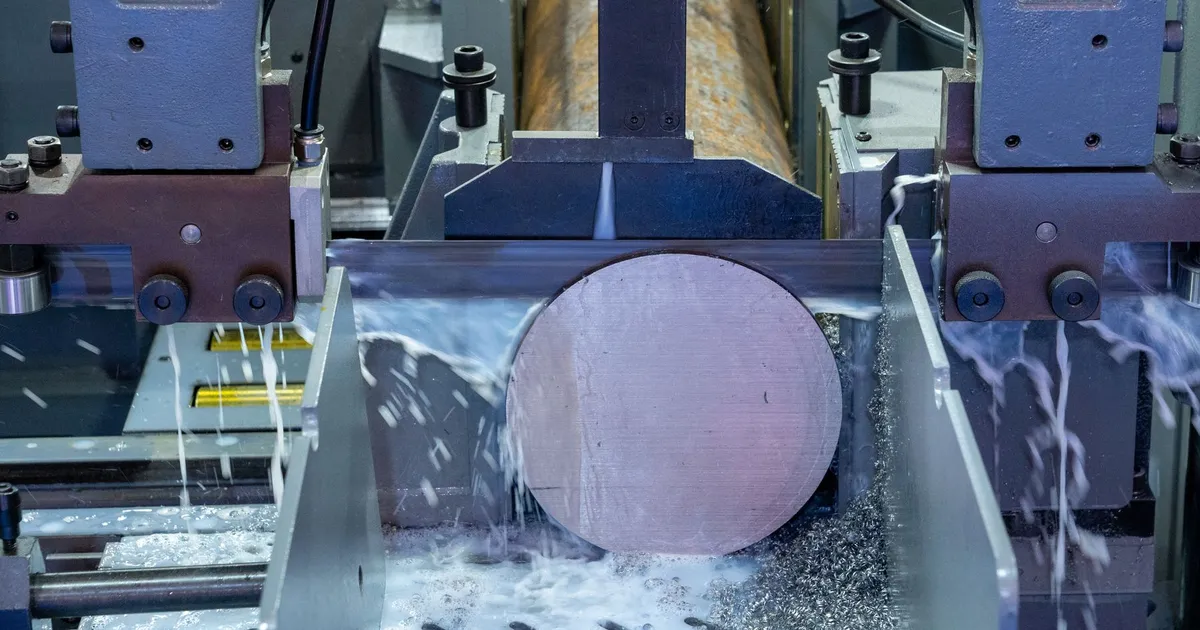
4140 and 4340 are the two alloy steels buyers meet most often on forging drawings for shafts, gears, crankshafts and heavy fittings. They look alike on paper, and many buyers ask whether the dearer 4340 is worth the extra. The answer depends on the section thickness and the load, not on a general ranking. This guide compares the two on chemistry, hardenability, toughness, typical properties and cost, and says how to choose.
What the two steels are
Both are medium carbon, low alloy steels that are hardened by quench and tempering. They share about 0.40 percent carbon, which is what allows them to harden to useful strength.
4140 is a chromium-molybdenum steel. Typical composition is about 0.38 to 0.43 percent carbon, 0.75 to 1.0 percent manganese, 0.80 to 1.10 percent chromium and 0.15 to 0.25 percent molybdenum. Chromium and molybdenum raise hardenability and strength and help resist softening on tempering.
4340 is a nickel-chromium-molybdenum steel. Typical composition is about 0.38 to 0.43 percent carbon, 0.60 to 0.80 percent manganese, 1.65 to 2.00 percent nickel, 0.70 to 0.90 percent chromium and 0.20 to 0.30 percent molybdenum. The nickel is the main difference. It adds hardenability and toughness and raises the cost.
Both are specified by AISI and SAE numbers and listed in standards such as ASTM A29 for bars. Forgings in these grades are often bought to ASTM A668 or to a customer or industry specification. Exact limits differ between standards, so use the one on your drawing.
Hardenability is the real difference
Hardenability is how deep into a section the steel can harden when it is quenched. A thin part cools quickly all the way through, so almost any alloy steel hardens fully. A thick part cools slowly in the centre, and a steel with low hardenability stays soft there. 4340 has higher hardenability than 4140, so it hardens through larger sections.
As a rough guide, 4140 through hardens in oil quench in sections up to about 50 to 75 mm thick, while 4340 through hardens in sections of 100 mm and more. These figures depend on the quench, the exact chemistry and the hardness target. If your part has a thick section that will be loaded in the centre, such as a large shaft or a heavy ring, 4340 is the safer choice. If your part is thin or small, 4140 can reach the same properties for less money.
Typical properties
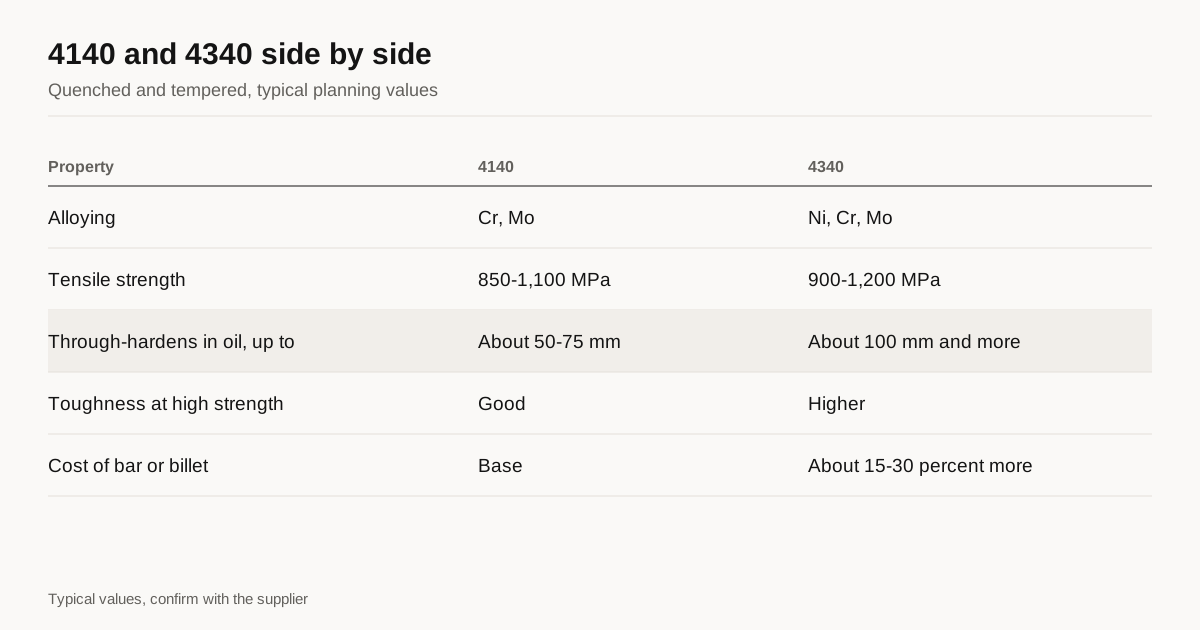
After quench and tempering to the same hardness, both steels have similar strength. The tempering temperature sets the strength, and both can be brought to a wide range of levels. The table shows typical ranges for each, but the actual values depend on the section and heat treatment.
| Property | 4140 Q&T | 4340 Q&T |
|---|---|---|
| Tensile strength | About 850 to 1,100 MPa | About 900 to 1,200 MPa |
| Yield strength | About 650 to 950 MPa | About 750 to 1,050 MPa |
| Hardness | About 26 to 34 HRC | About 28 to 38 HRC |
| Impact toughness at strength level | Good | Higher, especially at low temperature |
| Through-hardening section (oil) | Up to about 50 to 75 mm | About 100 mm and more |
| Relative cost | Base | About 15 to 30 percent more, depends on nickel price |
Treat these as planning figures. Specifications such as ASTM A668 or customer standards set the real minimums for each class and section size. Our guide to heat treatment of forgings explains how quench and temper sets them.
Toughness and fatigue
Nickel improves toughness, and especially toughness at low temperature. At the same strength, 4340 usually has higher impact energy than 4140, and the gap grows as strength increases. That is why 4340 is the traditional choice for highly loaded parts that see shock, such as aircraft landing gear, heavy rotor shafts, drivetrain parts and crankshafts for large engines. For parts that run at moderate strength levels, the toughness of 4140 is adequate, and it is used for gears, shafts, tool holders and oilfield parts.
Fatigue strength follows tensile strength closely at a given cleanliness. Steel cleanliness and surface finish matter as much as the grade. Vacuum arc remelted 4340 is used in aerospace for high cycle fatigue, but it costs far more than air melted 4340 and is not needed for most industrial parts.
Cost
4340 costs more mainly because of nickel. Nickel prices swing, so the gap between 4140 and 4340 changes over time and from region to region. A common range is about 15 to 30 percent more per kilogram for 4340 bar or billet. For a forged part the material is only part of the price. Forging cost, heat treatment and machining are similar for both, though 4340 can be a little harder to machine at the same hardness. For a part where the metal is a small share of the total, the difference may be only a few percent of the piece price.
Availability matters as well. 4140 is stocked widely in round bar and in forged form, so lead times are usually shorter. 4340 is stocked less widely, and a custom size may need a mill order. If your delivery is tight, ask suppliers what they hold.
Where each grade is used
| Part type | Usual choice | Reason |
|---|---|---|
| Shafts under 75 mm section | 4140 | Through hardens, lower cost |
| Heavy shafts and rotors | 4340 | Hardens through thick section |
| Gears and gear blanks | 4140 or 4320, 8620 for carburized gears | Depends on whether through hardened or case hardened |
| Oilfield flanges, drill parts | 4130 or 4140 | Standard in oil and gas specifications |
| Landing gear and heavy drivetrain | 4340 or higher alloy variants | Toughness at high strength |
| Crankshafts for large engines | 4340 or 42CrMo4 types | Section size, fatigue and toughness |
For the application side, our guides to forged crankshafts and camshafts and forged gear blanks show how each part type is specified.
Ruling section and mass effect
Strength figures in a specification are tied to a section size, usually called the ruling section. The reason is the mass effect: a large part cools more slowly in the quench than a small one, so the same steel gives lower strength in a bigger section. A specification might allow 4140 at one strength for sections up to 50 mm and a lower strength for sections of 100 mm. If your drawing gives one strength level for a part with both thin and thick sections, ask the supplier which section the test coupon will represent. A coupon taken from a thin prolongation can overstate the strength of the thick area of the part, and a coupon taken at the centre of the thickest section can understate the strength of the thin areas.
This is where 4340 earns its price. Because it keeps more strength in the centre of thick sections, a 4340 part can meet a given strength at the centre in a section where 4140 cannot. If the drawing calls for a strength level at mid-radius of a section over about 75 mm, the supplier will often propose 4340 or a similar steel without being asked, and it helps to know why.
Melt practice and cleanliness
Two parts made from 4140 can have very different fatigue life depending on how clean the steel is. Inclusions, which are small non-metal particles from steelmaking, are the starting points of fatigue cracks. Air melted steel from a good mill is clean enough for most industrial parts. Vacuum degassed steel has lower hydrogen and fewer inclusions and is common on heavy forgings. Vacuum arc remelted steel is cleaner again and is used where the application justifies the cost. If your part sees millions of load cycles, ask the supplier what melt practice they use and whether the specification sets a cleanliness limit. For many general parts the standard grade is enough, and paying for a cleaner melt adds cost without benefit.
Sulfur content also matters. Free machining grades have extra sulfur that helps chip breaking but lowers transverse toughness. Forgings that need good toughness are normally bought to a low sulfur limit. Check that the limit on your drawing suits the use.
Decarburization and allowance
Medium carbon steels lose carbon from the surface when they are heated in air, which leaves a soft skin after quench and tempering. The depth depends on temperature, time and furnace atmosphere. If the skin stays on a part that will see fatigue loading, it lowers fatigue strength at the surface, where cracks start. Machining allowance must be enough to remove the decarburized layer after the final heat treatment, which is a reason that parts for fatigue service are often finished by grinding or machining all over. Ask the supplier what allowance they plan, and check that it is more than the depth they expect. Our guide to forging tolerances and draft angles gives typical allowance values.
Machining and welding
In the quenched and tempered state, both steels machine fairly well at medium hardness, with 4340 a little harder to cut at the same hardness. Many parts are rough machined after normalizing, then quenched and tempered and finish machined. Both steels are hard to weld because they harden in the heat-affected zone and can crack, so welding needs preheat, controlled heat input and a post-weld heat treatment. If your design needs welding, ask the supplier whether a lower carbon steel would do the job.
Other grades to know
Sometimes neither grade is the best answer. 4130 is a lower carbon relative of 4140 used in oil and gas and aerospace where welding or sour service limits apply. 4330V and 300M are higher strength variants of 4340 used in aerospace. 8620 is a carburizing steel used where a hard case over a tough core is needed. For quench and temper in large sections, 34CrNiMo6 in Europe and 4340 in the US are close matches. If you are comparing offers with different grades, ask the supplier to explain the reason for the choice.
What to put in the RFQ
State the grade and the specification with edition, the required condition, such as quenched and tempered to a tensile range, and the section size where properties must be met. Say where test coupons are taken and what tests you need, including impact tests with temperature. If you will accept either grade, say so and ask for both prices. Include the finished weight and the yearly quantity.
Next step
Send an RFQ with the drawing and the load case if you have one. We match you with up to 3 forging suppliers that work with alloy steel in your size range, and we reply within 24 business hours. For the wider checklist, read how to choose a forging supplier.
See also the reference pages on alloy steel forgings and forged shafts and axles.
Frequently asked questions
Is 4340 always stronger than 4140?
No. At the same hardness the two have similar strength. The difference is that 4340 holds that strength deeper into thick sections and has better toughness at high strength levels. For a small part, 4140 can match 4340. For a large section, 4340 pulls ahead.
What are the European equivalents?
4140 is close to 42CrMo4, material number 1.7225, and 4340 is close to 34CrNiMo6, material number 1.6582, both in EN 10083-3. Equivalent does not mean identical, so check the composition limits on your drawing.
Can 4140 and 4340 be welded?
Both are hard to weld because they harden in the heat-affected zone and can crack. Welding needs preheat, controlled interpass temperature and post-weld heat treatment. If the design needs welding, ask the supplier about a lower carbon alloy instead.
Need a quote for this part?
Send the drawing. We match you with up to 3 forging suppliers and reply within 24 business hours.
Send my RFQ