Guides / Process
Forged Gear Blanks: Near-Net Shape, Machining Stock and Heat Treatment
October 19, 2026
A gear starts as a forged blank, and the quality of that blank decides how well the gear machines, heat treats and runs. Buyers of gears and gearboxes see blank forgings as a cost line, but small mistakes in steel, structure or machining stock show up later as scrap in the gear shop or as noise and wear in the field. This guide covers the steels, shapes, machining stock and heat treatment of forged gear blanks, and what to ask for in an RFQ.
What a gear blank is
A gear blank is a forging that has the outline of the gear but not the teeth. The common forms are:
- A disc with a hub and a web, for spur, helical and bevel gears.
- A ring, for ring gears, internal gears and large wheels.
- A shaft with an integral gear section, for pinions and gear shafts.
- A hollow disc with a recess, for planetary carriers and clutch gears.
After forging, the blank is heat treated for machinability, rough machined, cut with teeth, hardened and finished by grinding or honing. The forging sits at the start of that chain, so anything wrong with its structure carries through every step.
Steels for gears
Steel choice follows the way the gear will be hardened.
| Gear hardening | Typical steels | Why |
|---|---|---|
| Case hardened by carburizing | 8620, 4320, 20MnCr5, 16MnCr5, 18CrNiMo7-6 | Low carbon core stays tough, surface hardens to about 58 to 62 HRC |
| Through hardened | 4140, 4340, 42CrMo4, 34CrNiMo6 | Even hardness through the section, moderate loads |
| Induction hardened | 4140, 1045, 4340 | Surface hardened on the tooth, for larger and shaft gears |
| Nitrided | 4140, 4340, nitriding steels | Low distortion, hard surface layer |
Carburizing grades are the most common for automotive and industrial gears. They are forged, normalized, machined, carburized at about 900 to 950 degrees Celsius, quenched and tempered. Through hardened grades are used for lower speed gears and large ring gears that cannot be carburized easily. Our guide to 4140 against 4340 explains how the through hardening grades differ.
Cleanliness and hardenability bands matter as much as the grade name. Gear steels are normally bought to a narrow hardenability band, checked by an end quench test, so that distortion in carburizing stays consistent from heat to heat. Fine austenite grain size, usually ASTM 5 or finer, helps keep distortion and noise low. Ask for a steel certificate that shows both.
Near-net shape forging
Near-net means the forging is close to the final blank shape, with only a small allowance to machine. It matters for gears because gear steels are expensive to machine and because every extra millimetre of stock is cut away on the lathe at a slow rate. A closed die forging with a good web and hub shape can reduce the metal removed by half or more compared with turning from a bar.
Small blanks up to a few kilograms are typically closed die forged from bar, in a press or hammer. Many are upset first and then formed in a finishing die, similar to the process we describe in upset forging. Medium and large rings are made by ring rolling, which gives a ring with grain flow around the circumference, as in seamless rolled ring forging. The largest blanks, for gearboxes in wind turbines, rolling mills and ships, are open die forged discs with a bore pierced out.
Some gears are forged with teeth. Small straight bevel gears for automotive differentials are made as precision forgings, with teeth formed in the die and little or no cutting. That route needs very accurate tooling and high volume. For the cost and volume logic of forging the teeth too, see precision forging.
Machining stock
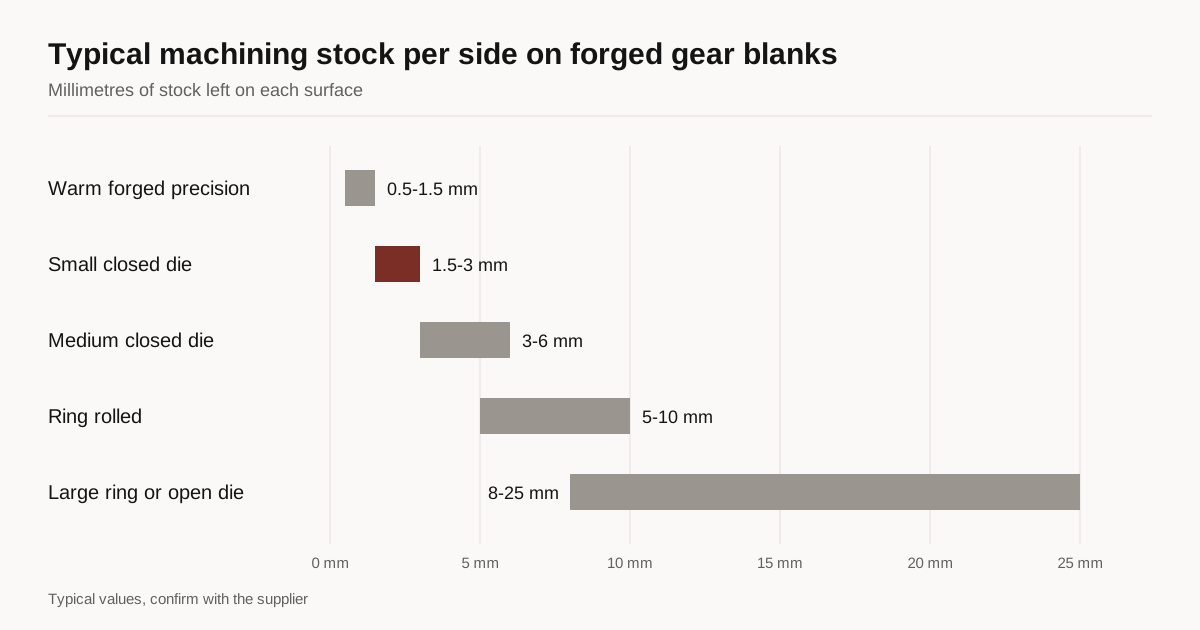
Machining stock is the extra metal left on each surface for the gear shop to remove. It has to clean up scale, decarburization, mismatch and distortion without leaving so much that the shop pays to cut it. Typical stock per side:
| Blank type | Typical stock per side |
|---|---|
| Small closed die blank, up to 5 kg | 1.5 to 3 mm |
| Medium closed die blank, 5 to 50 kg | 3 to 6 mm |
| Ring rolled blank, up to 1,000 mm OD | 5 to 10 mm |
| Large ring rolled or open die blank | 8 to 25 mm |
| Warm forged precision blank | 0.5 to 1.5 mm |
These are typical numbers, and the actual stock comes from the supplier’s process. More stock is safer for the gear shop but costs more metal and more cutting. Less stock saves cost but risks scrap if the blank is out of round or has scale in a corner. A common approach is to agree stock on the first articles and tighten it once the process shows stable results. Our guide to forging tolerances and draft angles shows how stock and tolerance interact.
Heat treatment for machinability
The forged blank has a mixed structure and uneven hardness from the forging cooldown. If it is cut as forged, the hob wears unevenly and the teeth come out with variable size. So blanks are heat treated before machining. The common treatments are normalizing and isothermal normalizing.
Plain normalizing heats the blank above its transformation temperature and cools it in air. The cooling rate varies with section size and loading, so the structure can differ between parts. Isothermal normalizing heats the blank, then cools it quickly to a temperature just below the transformation and holds it there until the structure transforms fully, usually at around 550 to 650 degrees Celsius. The result is a uniform structure of ferrite and pearlite and a narrow hardness range, typically about 150 to 200 HB for carburizing grades. Gear shops often specify the hardness range and the microstructure on the blank drawing. Our guide to heat treatment of forgings explains the basics.
Uniform structure also reduces distortion later. During carburizing and quenching, a blank with mixed structure moves unevenly and the gear goes out of tolerance. That is a main reason gear buyers ask for isothermal normalizing instead of plain air cooling.
A worked comparison: bar against forged blank
Take a spur gear blank with a 160 mm outside diameter, a 45 mm face width and a hub that stands out on one side. Turned from solid bar of 165 mm diameter, the part starts as a cylinder of roughly 8 kg of steel once the hub length is included. The finished blank weighs about 3.5 kg, so half of the bar becomes chips. A closed die forging of the same blank, with 3 mm of stock per side and a web that is forged thin, weighs about 4.3 kg, so only a fifth of the metal is machined away. The saving is about 3.7 kg of steel per part, and the turning time falls by more than half.
The forging has a die cost and a unit price premium for forging itself, so the saving only counts at volume. As a rule, a gear blank that you will buy in the thousands a year is a forging candidate, while a blank that you need in tens is turned from bar or cut from a ring slice. The break-even moves with steel price and with how hard the steel is to machine. Our guide to forging die cost explains how to compute it for your numbers.
Defects that reach the gear shop
Four defects cause most of the complaints from gear shops. Decarburization is the loss of carbon from the surface during heating, and if stock is too thin it stays on the finished tooth flank and weakens the case. Banding is a layered structure from steel segregation that makes hardness uneven and distorts the gear in heat treatment. Mismatch between the die halves leaves a step on the rim that is not cleaned up if stock is small. Out of round or warped blanks result from uneven cooling and make it hard to hold a gear in a chuck.
Gear shops can reduce these by tightening the blank drawing on hardness, structure and runout, and by checking the first articles of each lot. Suppliers can prevent them with good steel, controlled heating and cooling and die maintenance. A blank drawing that says only “forged steel” leaves each of these to chance, so write the specification down.
Large gear blanks
At the top of the size range, gear blanks become heavy rings and discs for wind turbine gearboxes, rolling mill drives, cement mills and marine reduction gears. These are open die forged or ring rolled from alloy steel such as 34CrNiMo6 or 18CrNiMo7-6, often weighing from a few hundred kilograms to several tonnes. They are heat treated in large furnaces, tested over their whole volume by ultrasonic testing and delivered with full certificates. The supplier list for these is short, and lead time is long, so plan for it early. Machining stock is larger, often 10 to 25 mm per side, and the blank is roughed by the supplier or by the gear maker before the final heat treatment to improve hardening in the centre.
The gear maker may ask for test coupons from a prolongation that is forged with the blank, so that the properties of the actual part can be measured. If your gear needs that, say so in the RFQ, since it affects the forging size.
Packing and delivery
Gear blanks are finished near the surface level the gear shop expects, so protection in transit matters. Blanks are shot blasted, oiled against rust and packed in boxes or on pallets with separators so they do not rub. For small blanks in volume, the packing has to be quantity controlled so that the gear shop can count the lot. Lot traceability, from steel heat to forging lot to heat treatment lot, should be kept on the packing label as well as in the paperwork, because a problem found at hobbing must be traced back to the lot.
Testing
Gear blanks are tested for chemistry, hardness, grain size, microstructure and, on larger parts, internal soundness by ultrasonic testing. Magnetic particle inspection finds surface cracks. Buyers sometimes require a check of banding, which is a pattern of alternate layers in the steel that makes hardness uneven. Hardenability is checked by an end quench test. Test reports should link to the steel heat number. For heavy gear blanks, ultrasonic testing is common, as set out in ultrasonic testing of forgings.
What to put in the RFQ
Give the blank drawing with the finished gear outline, the steel grade and standard with the hardenability band if used, and the grain size requirement. State the heat treatment and the hardness and structure range, the machining stock or the forging allowance and the tolerances on the forging. Add the weight, the yearly quantity and the batch size, and the tests and documents. Say whether you will accept a ring rolled or a closed die blank for the same part, because that choice changes cost.
Next step
Send an RFQ with the blank drawing and the steel specification. We match you with up to 3 forging suppliers who make gear blanks in your size and grade, and we reply within 24 business hours. For the wider checklist, read how to choose a forging supplier.
Frequently asked questions
What is a gear blank?
It is the forged or rolled disc, ring or shaft form from which a gear is cut. The gear teeth are machined later by hobbing, shaping or milling. A good blank has the right steel, a uniform structure and enough but not too much machining stock.
How much machining stock should a forged gear blank have?
On small closed die blanks about 1.5 to 3 mm per side is typical. On medium blanks, 3 to 6 mm, and on large open die or ring-rolled blanks 8 mm or more. The right figure depends on size, flatness and how the blank is heat treated.
Why are gear blanks normalized before machining?
Normalizing, or isothermal normalizing, gives a uniform structure and hardness. That keeps the cutting tool steady during hobbing and reduces distortion in later carburizing and quenching. A blank with a mixed structure cuts unevenly and moves in heat treatment.
Need a quote for this part?
Send the drawing. We match you with up to 3 forging suppliers and reply within 24 business hours.
Send my RFQ