Guides / Process
Forged Crankshafts and Camshafts: How They Are Made and How to Source Them
October 17, 2026
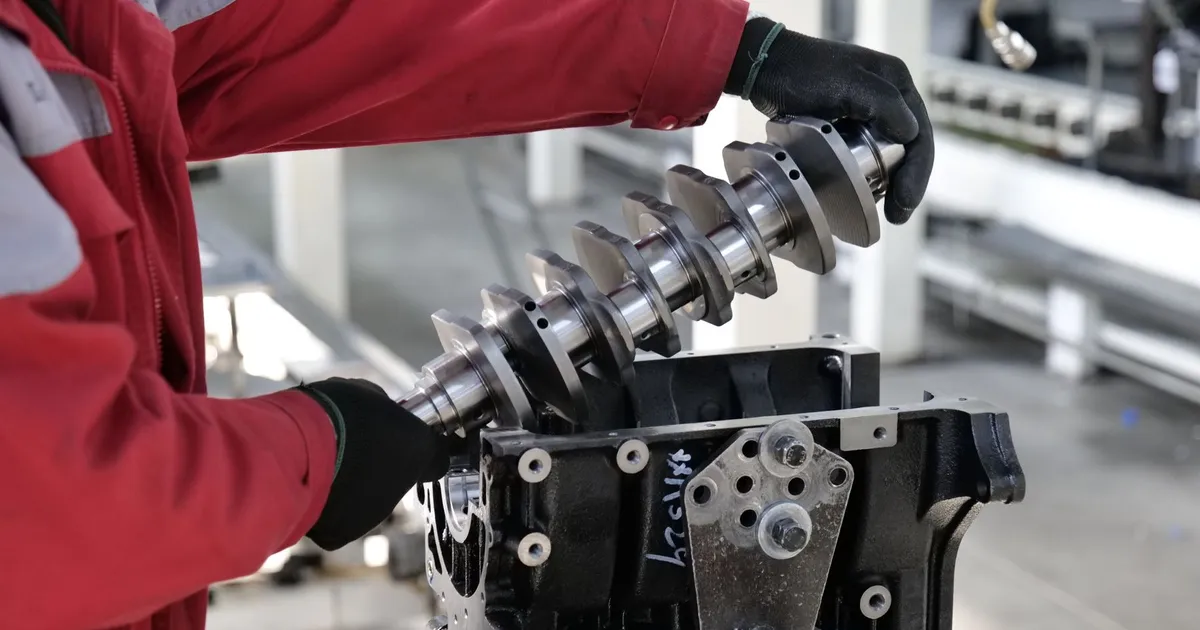
The crankshaft turns the up-and-down push of the pistons into rotation, and it carries the heaviest repeating loads in an engine. The camshaft opens the valves in time with it. Both are long, slender, loaded parts that must resist fatigue for hundreds of millions of cycles, which is why most high duty versions are forged. Sourcing them is harder than sourcing a flange, because the dies are large, the machining is long and the spec is tight. This guide covers how they are forged, which steels are used and what to include in an RFQ.
Why forge a crankshaft
A crankshaft fails by fatigue, usually in a fillet where a journal meets a web. A forged crank has flow lines that follow the shape of the throws and webs, so metal fibres run around the fillets instead of being cut by them. Forging also closes internal porosity, so there are fewer starting points for cracks. For these reasons forged steel cranks are the standard in diesel engines, high output petrol engines, marine engines and heavy equipment. Cast ductile iron cranks cost less and are common in passenger cars where loads are moderate. Billet cranks machined from solid bar are used in racing and in one-off builds, where tooling cost cannot be spread. Our guide to grain flow in forgings explains why the flow lines matter.
How a crankshaft is forged
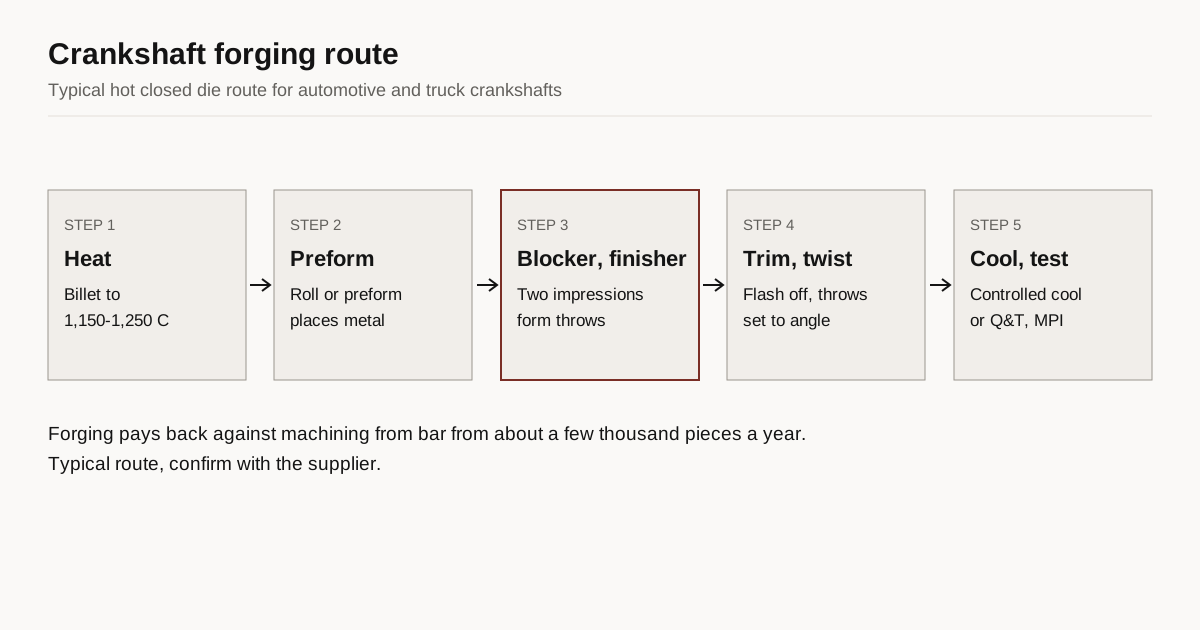
For automotive and truck cranks the route is a hot closed die forging line, usually with a large hammer or a mechanical press.
- Billet. A round or square billet is cut to the weight of the crank plus flash.
- Heating. Induction heating brings the billet to about 1,150 to 1,250 degrees Celsius.
- Preform. Roll forging or a preform die distributes metal along the length, so that more is placed where the throws and counterweights will be.
- Blocker and finisher. The billet is struck in two impressions, which form the journals, webs and counterweights. Flash flows out between the dies.
- Trim. The flash is trimmed off in a press.
- Twist. For cranks with throws in different planes, such as three cylinder or V engines, the forged part is twisted in a hot or warm fixture to set the angles between throws. Many four cylinder cranks have all throws in one plane and need no twist.
- Cooling or heat treatment. The crank is either cooled in a controlled way, for microalloyed steel, or heat treated, for quenched and tempered steel.
- Cleaning and straightening. Shot blasting removes scale and the crank is straightened to the runout allowed.
- Testing. Magnetic particle inspection looks for cracks, and hardness and dimensions are checked.
Large cranks for ships and power plants are made differently. Open die forging makes the crank in pieces or as a single throw forging that is machined, or the crank is semi-built from forged webs and shrink fitted journals. These cranks weigh from a few hundred kilograms to tens of tonnes.
Steels
| Steel | Type | Typical use |
|---|---|---|
| 4140, 42CrMo4 | Quenched and tempered alloy steel | Diesel and heavy duty cranks |
| 4340, 34CrNiMo6 | Nickel alloy, deeper hardening | Large and highly loaded cranks |
| 38MnVS6, 30MnVS6 | Microalloyed, no quench and temper | High volume automotive cranks |
| Ductile iron | Cast, not forged | Lower cost passenger car cranks |
Microalloyed steels get their strength from vanadium that forms fine precipitates during controlled cooling after forging. That lets the supplier skip the separate quench and temper, which saves cost. Quenched and tempered steel gives the highest strength and toughness, and is used where loads need it. Our guide to 4140 against 4340 compares the two common alloy steels.
Surface hardening and fatigue treatment
A forged crank is machined and then treated to improve fatigue life at the journals and fillets. Induction hardening makes the journal surfaces hard to resist wear. Nitriding gives a hard surface layer at lower temperatures with less distortion. Fillet rolling presses the fillets with a hardened roller to leave compressive stress, which raises fatigue strength. These steps are done after machining, so they are in the machine shop quote rather than the forging quote, but the buyer should know that the forging is only the start.
Camshafts
Camshafts open and close the valves, and they carry high contact stress on the lobes. Most are made from cast iron with chilled lobes, or from forged steel with induction hardened lobes. Forged steel camshafts are used in diesel engines, high performance engines and heavy duty applications. They are also made as assembled units, with separate steel lobes fitted to a steel tube, which saves weight. Forged camshaft blanks are usually in low alloy steels such as 4140, 5140 and 8620 or in microalloyed steel. The lobes are ground and hardened after machining. Camshafts are long and slender, so straightness is a main concern, and forging and heat treatment must hold runout to a few tenths of a millimetre.
Tolerances and machining stock
A forged crankshaft is rough. The webs and journals leave the die with draft, and the journals need heavy machining to reach finished size and surface. Typical machining stock on journals is about 2 to 4 mm per side on automotive cranks and more on large ones. Tolerance on forged dimensions is about ±0.8 to ±1.5 mm for common sizes, with mismatch limits of around 0.5 to 1.0 mm. Weight tolerance is often set at about ±2 to ±3 percent. Straightness of the finished forging is limited to a few millimetres over the length. Our guide to forging tolerances and draft angles shows how to read these numbers on a drawing.
Balance is also part of the design. The counterweights on a crank are forged in shape and later drilled or ground to balance the rotating mass. If the forging weight varies, the balance correction varies, which is one reason weight tolerance matters.
Tooling and volume
A crankshaft die set is large and costly, and the line that runs it is capital intensive. Die cost depends on size, number of throws and the preform tooling, and is spread over the run. As a rough guide, forging a crank pays back against machining from bar from a few thousand pieces a year, since forging saves metal and machining time and gives better strength. For one-offs and short runs, billet machining or open die forging with machining is cheaper. Our guide to forging die cost explains how to calculate payback.
| Quantity | Typical route |
|---|---|
| 1 to 20 | Machine from bar, or open die forging |
| 20 to 2,000 | Open die or small closed die, depends on size |
| 2,000 and above | Closed die forging with preform |
| Very large or marine | Open die forging, semi-built |
Where crank forgings go wrong
Several defects are specific to crankshafts, and a buyer who knows them can ask the right questions. Laps in the fillets form when the metal folds over itself in the die and are hidden under scale until magnetic particle inspection shows them. Because the fillet is the highest stress point, a lap there can start a fatigue crack early, so inspection of the fillets is the first test on any crank. Twist cracks appear in the webs when the part is twisted too cold, and are prevented by controlling the temperature during the twist. Bending and warping come from uneven cooling or quenching, and are corrected by straightening, which has its own limit, since too much straightening leaves stress in the part. Underfill at the edges of the counterweights leaves a rounded corner and a low weight, and is a sign of poor billet weight control or a cold billet.
Good suppliers prevent these by controlling billet weight and temperature, maintaining dies and checking the first pieces of each run. Ask how the supplier checks fillets and what percentage of parts are inspected by magnetic particle. For crankshafts, the answer should be all of them.
Connecting rods and other engine forgings
A crankshaft supplier usually makes other engine forgings too. Connecting rods are closed die forged from alloy or microalloyed steel, then often cracked at the big end to make a matched cap. Flywheels, gear blanks and bearing caps follow similar routes. If you buy a family of engine parts, ask whether one supplier can make the set, because the purchasing and quality workload falls with fewer suppliers. Our guide to forged gear blanks covers the gear end of the drivetrain.
Forged against cast: a worked comparison
Imagine a four cylinder crank for a truck engine that needs a fatigue rating higher than a cast iron crank can give. The forged crank costs more to buy, with the premium split between steel price, die cost and the longer machining of a harder material. In exchange, it carries a higher load for the same size, which allows a smaller or lighter crank or a higher engine rating. For a turbocharged diesel, the extra strength often decides the matter. For a naturally aspirated petrol engine with moderate loads, a cast crank is usually enough and the cost is lower.
When you compare quotes, compare the same condition. A forged crank quoted as a rough forging has no machining. A cast crank quoted rough has none either, but a finished crank price includes machining, hardening and balancing that differs between materials. Ask for a quote at the same stage of completion, and check what balance and straightness are guaranteed. Our guide to forging against casting and machining sets out a general method.
Testing and documents
Cranks are tested more closely than most forgings because of the load they carry. Standard tests include magnetic particle inspection on the full surface, hardness tests, tensile tests on sample sections, microstructure checks for grain size and inclusions and, for large cranks, ultrasonic testing. Sample cranks may be cut for macro-etch to show flow lines, or run in fatigue tests. Automotive buyers often require a controlled production process and statistical records. Ask each supplier what quality system standard it works to and request the certificate, and check its scope and date, since we do not verify claims.
What to put in the RFQ
Give the forging drawing or the finished crank drawing with the forging outline, the steel grade and condition, the weight, the yearly quantity and the batch size. State the tests, such as magnetic particle inspection of the full surface, the hardness range and the flow line check. Say if you need twisting, which journals are machined by you and which by the supplier, and the packing and delivery terms. For camshafts, add the lobe hardness and the straightness requirement.
Next step
Send an RFQ with the crank or cam drawing. We match you with up to 3 forging suppliers who make shafts in your size and volume range, and we reply within 24 business hours. For the wider checklist, read how to choose a forging supplier.
Frequently asked questions
Why are crankshafts forged instead of cast?
A forged crankshaft has dense metal and flow lines that follow the crank throws, which gives higher fatigue strength than a cast one. Forged steel cranks are used in diesel, high power and heavy duty engines. Cast iron cranks cost less and are used where loads are moderate.
What steel is used for forged crankshafts?
Common choices are quenched and tempered alloy steels such as 4140 or 42CrMo4 and 4340, and microalloyed steels such as 38MnVS6 that gain strength from controlled cooling after forging without a separate heat treatment. The choice depends on size, load and cost.
How many crankshafts do I need to order for forging to make sense?
Closed die tooling for a crankshaft is costly, so forging usually pays back from a few thousand pieces. Below that, many buyers machine from bar or use open die forging. A supplier can run the numbers if you give the drawing and yearly quantity.
Need a quote for this part?
Send the drawing. We match you with up to 3 forging suppliers and reply within 24 business hours.
Send my RFQ