Guides / Materials
Brass Hot Forging Alloys: CW617N, C37700 and Lead-Free Options Compared
October 15, 2026
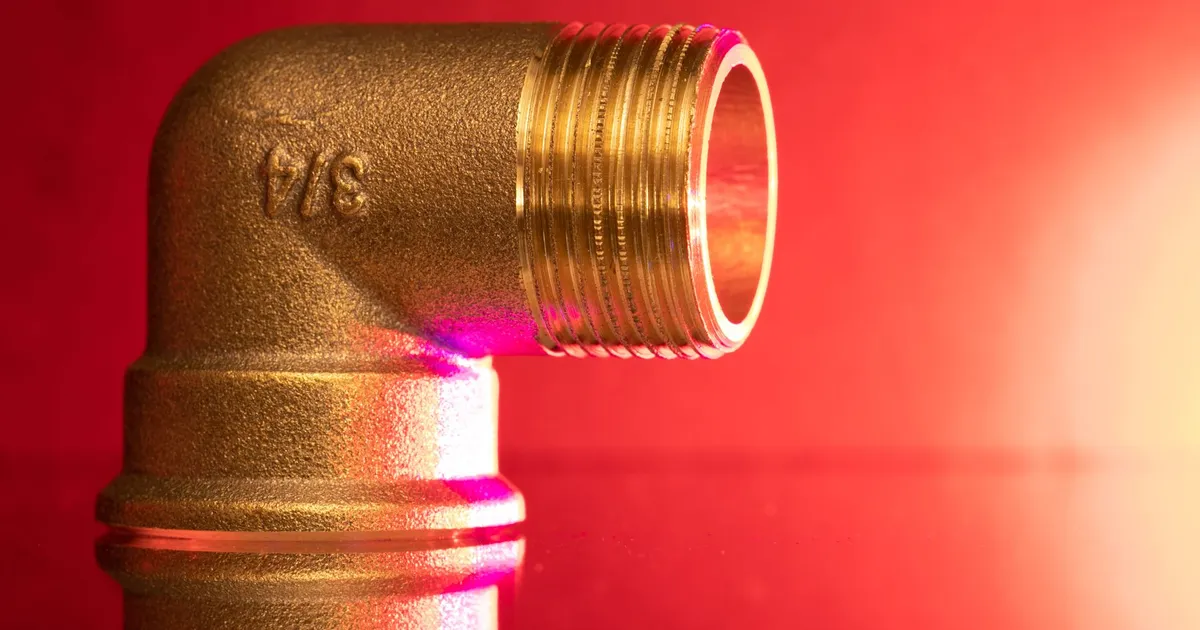
Brass is the most forgeable of the common engineering alloys. It flows easily, fills detailed dies, leaves little scale and gives parts that machine cleanly. That is why valve bodies, plumbing fittings, gas connectors and electrical hardware are so often hot forged from brass. The choice of alloy is trickier than it looks, because lead rules, corrosion in water and machining cost all push in different directions. This guide covers the standard forging brasses, the lead-free alternatives and what to put on an RFQ.
Why brass forges so well
Brass is an alloy of copper and zinc. Grades with about 40 percent zinc have a two-phase structure, alpha and beta, and the beta phase becomes very soft at forging temperature. That softness lets the metal flow into thin sections and sharp corners under low force. Forging temperatures are about 650 to 800 degrees Celsius, far lower than for steel, so dies last longer, heating costs less and there is little scale. Parts can be forged to close tolerances, often a few tenths of a millimetre, with a good surface that needs little machining. Material yield is high, and the flash that is trimmed off is clean scrap that can be remelted. Our guide to cold, warm and hot forging explains how brass compares with other metals.
The standard forging brasses
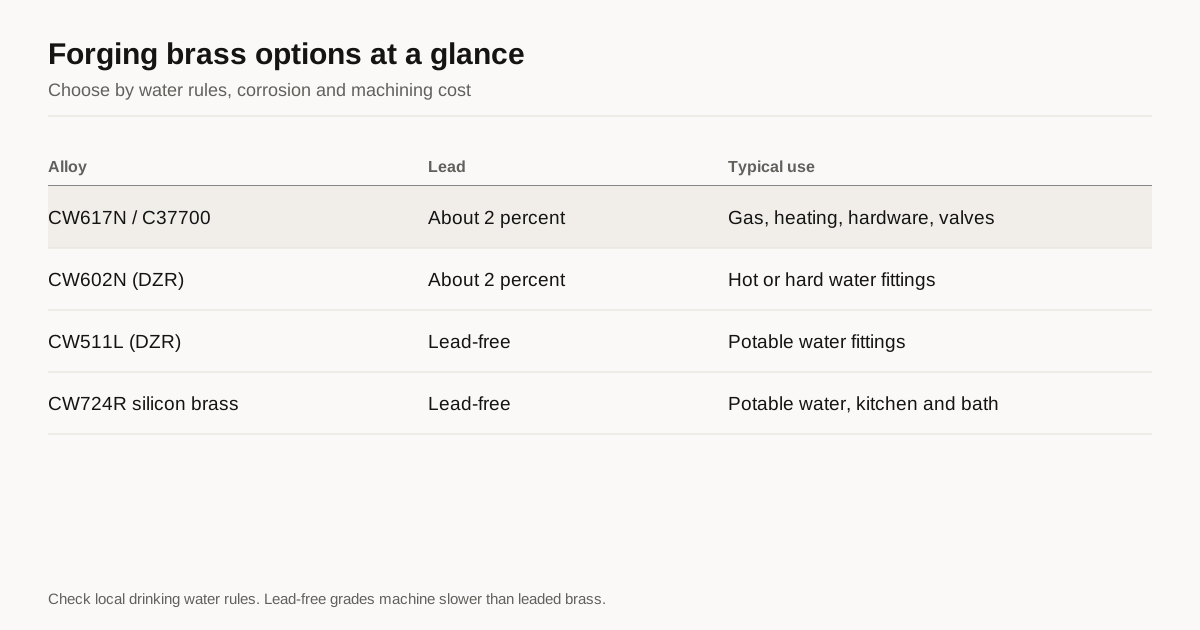
CW617N is the European forging brass, CuZn40Pb2 in EN 12165, the standard for copper and copper alloy forging stock. It contains about 57 to 59 percent copper, 1.6 to 2.5 percent lead and the rest zinc. The lead acts as a chip breaker and helps machining after forging.
C37700 is the North American counterpart, called forging brass, in ASTM B124, which covers copper and copper alloy forging rod, bar and shapes. It has about 58 to 61 percent copper, 1.5 to 2.5 percent lead and the rest zinc, with only small differences from CW617N. Parts forged from either alloy are interchangeable for most uses, but the specifications differ, so buyers should name the one on the drawing.
Forged parts from these alloys have typical tensile strength of about 350 to 450 MPa, yield strength about 140 to 200 MPa and elongation of 20 to 40 percent. The alloys are rated well for machinability, with C37700 near 80 percent of the free-cutting brass benchmark.
Lead and the move to lead-free
Lead in brass is a regulatory issue, mainly for products that touch drinking water. In the United States, the Safe Drinking Water Act limits the weighted average lead content of wetted surfaces of plumbing products to 0.25 percent, which standard forging brass exceeds. Other countries and states have similar rules for potable water, and several European countries run an approval scheme that limits what can be used in contact with drinking water. In electrical and general hardware, EU RoHS has exemptions for lead in copper alloys up to about 4 percent, but those exemptions are reviewed regularly and some customers ask for lead-free anyway.
The result is that buyers of potable water fittings, kitchen and bath hardware and similar parts often need lead-free brass. Standard leaded forging brass still dominates for gas, heating, industrial and hardware parts where the rules allow it.
Lead-free alternatives
| Alloy type | Examples | Typical features |
|---|---|---|
| Silicon brass | CW724R (CuZn21Si3P), C69300 | Lead-free, good strength, machinability lower than leaded brass |
| Bismuth brass | Bismuth-bearing brasses from several mills | Bismuth replaces lead as chip breaker, can be less forgeable |
| Low-lead or lead-free CuZn42 | CW510L | Low or no lead, needs careful forging |
| DZR brass | CW602N (CuZn36Pb2As), CW511L (CuZn38As) | Dezincification resistant, arsenic added, CW511L lead-free |
Machining is the main trade-off. Without lead, chips do not break as easily, so cutting speeds drop and tool wear rises. Silicon brasses can run at roughly half the machining rate of leaded forging brass, which raises the machining cost per part even if the forging cost is the same. Some lead-free alloys also need tighter temperature control in the forge, and a supplier may need a different furnace setup. A good supplier will say which alloy it recommends and why, and will quote both leaded and lead-free options when the rules allow.
Dezincification
Dezincification is a form of corrosion in which zinc leaches out of brass and leaves a weak porous copper structure. It shows in water that is hot, soft or high in chloride. Standard alpha-beta forging brass such as CW617N is vulnerable, and in water systems it can lead to leaks. Dezincification resistant, or DZR, brass is made with small amounts of arsenic and given a heat treatment to turn the beta phase into a form that resists attack. CW602N is the usual DZR forging brass in Europe, and CW511L is a lead-free DZR alloy. A part for potable or hot water should be specified as DZR and tested according to a standard such as ISO 6509, and the certificate should show it.
Typical properties and uses
| Alloy | Typical use | Key note |
|---|---|---|
| CW617N or C37700 | Gas fittings, valve bodies, hardware, heating | Best forgeability and machinability |
| CW602N | Water fittings in hard or hot water | DZR, still contains lead |
| CW511L | Potable water fittings | DZR and lead-free |
| CW724R or C69300 | Potable water, kitchen and bath fittings | Lead-free, harder to machine |
Forged brass parts include valve bodies and bonnets, pipe fittings, unions, gas connectors, electrical terminals, door hardware and musical instrument parts. Our guide to forged valve bodies covers the valve end of the market. For higher temperature or corrosion service, valve makers move to bronze, steel or stainless steel instead.
Forging details
Brass is usually forged from extruded round bar cut into slugs. Slugs are heated by induction or in a furnace to about 700 to 780 degrees Celsius. They are formed in a press or hammer in one or two hits, trimmed of flash, and often tumbled or pickled to clean the surface. Brass forgings are made in huge numbers, so dies are built for long runs, and tooling cost is spread across many parts. Our note on forging die cost explains how to compare tooling and piece price.
Tolerances are close, typically about ±0.1 to ±0.4 mm for small parts. Draft can be small, often 1 to 3 degrees, since brass flows easily. The quality of the surface is good, which lets many parts go straight to machining of threads and seats.
Cost and metal price
Brass price follows the copper and zinc markets, so quotes are often tied to a metal index and to a stated date. A piece price for a forged brass part has three parts: the metal in the part plus the metal lost as scale and unrecoverable trim, the forging and trimming cost, and the finishing cost. Because the flash is clean and goes back to the mill, the metal cost is often quoted on net weight with a conversion charge, and the supplier may offer to buy the flash at a scrap rate. Ask how the quote treats metal price changes, such as a fixed price for a stated time or a price that moves with the index. A price that floats with the market looks cheaper in a falling market and dearer in a rising one, and neither is wrong, but you should know which you are getting.
Lead-free brass usually costs more than leaded brass per kilogram, and the machining adds to it. For a part with heavy machining, the machining cost difference can be larger than the metal difference. If the part needs only light machining, the lead-free premium is smaller.
Plating and surface finish
Brass parts are often plated for appearance or wear: nickel, chrome, tin or electroless nickel are common. A forged surface takes plating well when it is clean, which is one reason brass is popular for visible hardware. Tell the supplier early about plating, because the forged surface and any parting line mark can show through a bright finish. A parting line placed on a non-visible edge, or a light polish before plating, can fix this. For potable water parts, check that plating processes and chemicals meet the same rules as the base alloy, since a coating can also leach.
Design tips for brass forgings
A few design habits lower the cost of forged brass parts. Keep wall thickness even, since thick and thin sections next to each other cool at different rates and can lead to shrinkage or distortion. Use generous radii on corners and where walls meet, so the metal flows easily and the die lasts. Avoid sharp internal corners, which are expensive to fill and a stress point in pressure parts. Keep the parting line on a flat plane where possible, because a flat parting line makes the die simpler. Allow draft of at least one to three degrees on walls. Our guide to forging tolerances and draft angles shows how draft and allowance work together.
If the part holds pressure, such as a valve body, think about the test pressure and the wall at the thinnest point, and ask the supplier whether the forging will hold wall thickness at the bore. Porosity is rare in forged brass compared to cast brass, which is a reason valve makers choose forging for pressure parts.
Forging against casting
Many brass parts could be cast or forged, and the choice is a common cost question. Casting suits complex internal passages and low volumes with cheap tooling. Forging suits higher volumes and parts where density and strength matter, since it produces no porosity and gives a finer structure. A forged part can also be lighter, because the stronger structure allows thinner walls. For a thorough comparison see our guide to forging against casting and machining.
Testing
Standard tests for forged brass parts include chemistry, hardness, tensile strength for critical parts and dimension checks. Parts for water service often need a dezincification test and a pressure test, and some need a test of lead release. A material certificate should show the alloy designation, and the chemistry should be checked against the standard. If lead-free matters, ask for the lead result on the test report rather than relying on the alloy name.
What to put in the RFQ
Name the alloy with its standard, such as CW617N to EN 12165 or C37700 to ASTM B124. State if the part needs to be DZR or lead-free and which water regulation applies. Give the drawing, yearly quantity, the machined features, the surface finish and plating, if any. Ask suppliers to quote the lead-free option next to the standard one if there is a chance you need it, so you can see the real difference in price.
Next step
Send an RFQ with the drawing and the target market. We match you with up to 3 forging suppliers who forge brass in your size range, and we reply within 24 business hours. For the wider checklist, read how to choose a forging supplier.
Frequently asked questions
What is the difference between CW617N and C37700?
They are close equivalents. CW617N is the European designation, CuZn40Pb2 under EN 12165, and C37700 is the North American forging brass under ASTM B124. Both are about 58 to 60 percent copper with around 2 percent lead and the rest zinc. Limits differ slightly between the two.
Can brass fittings for drinking water use CW617N?
Rules differ by country. Many drinking water markets limit lead in wetted parts, so standard leaded forging brass may not be allowed. Dezincification resistant or lead-free grades are common for potable water. Check the rules for your destination market.
Is lead-free brass harder to forge?
Somewhat. Silicon and bismuth-based lead-free brasses forge well but need tighter temperature control and give worse machinability than leaded brass. Tooling life and cycle time can differ. A supplier should quote against your actual part.
Need a quote for this part?
Send the drawing. We match you with up to 3 forging suppliers and reply within 24 business hours.
Send my RFQ