Guides / Specifications
Forging Test Coupons and Prolongations for Mechanical Tests
November 6, 2026
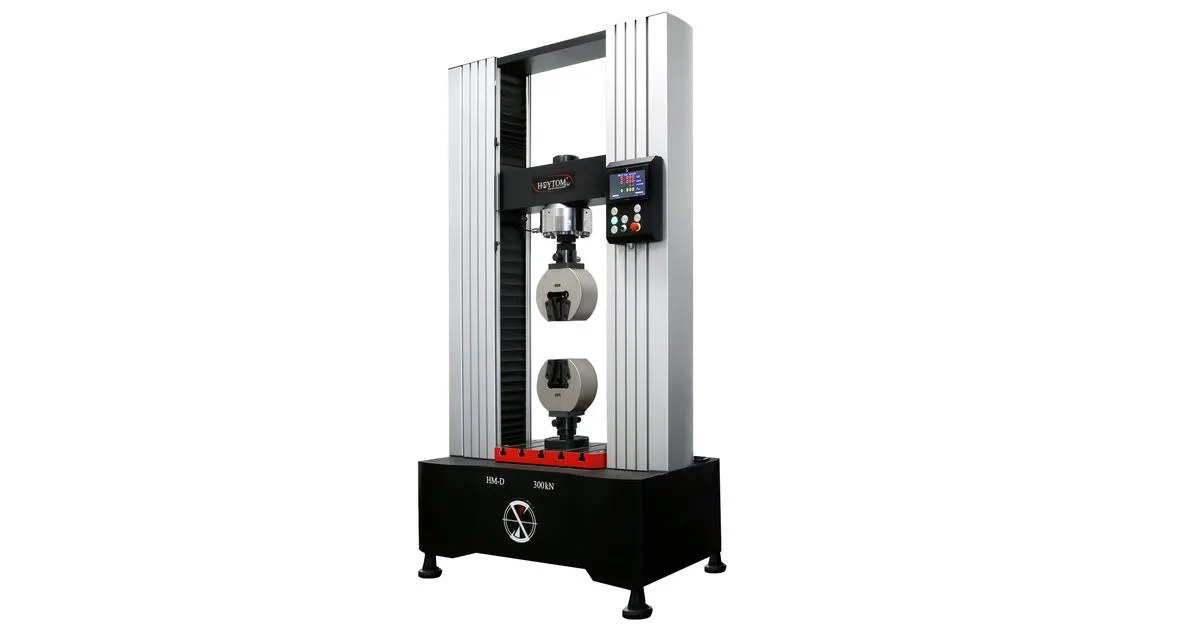
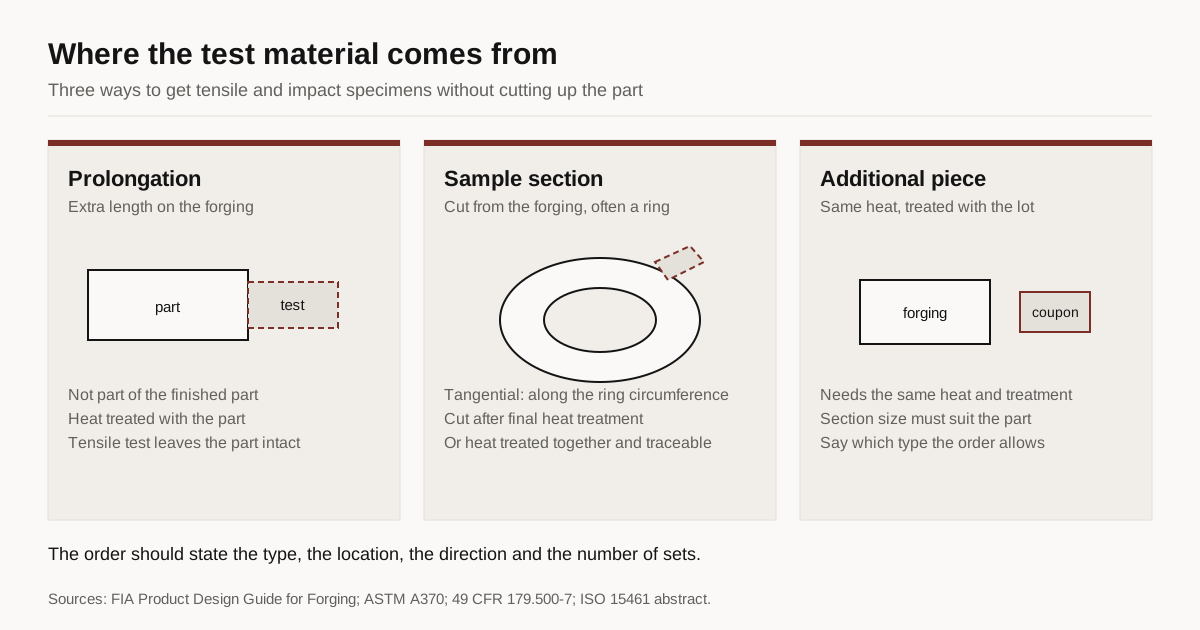
A test coupon is the piece of forged material that stands in for the part when the shop proves tensile strength, yield, elongation and impact toughness. It can be a prolongation, which is extra length forged on the part, a section cut from the part or a separate piece from the same heat that is treated with the lot. The product specification or your purchase order decides which one is used, where it is taken and in which direction the specimens are cut. When the order says nothing, the shop decides, and the certificate then shows results that may not match the section you care about. This guide explains the choices and what to write.
The terms buyers meet
Standards and shops use different words for the same thing. These meanings come from the Forging Industry Association guide and from one buyer’s published sampling standard, so treat them as working definitions and confirm them in your own specification.
| Term | Working meaning |
|---|---|
| Prolongation | An area of the forging at an agreed location, used for test and not part of the finished part |
| Sample section | Material taken from the test piece, enough to make one or more sets of specimens |
| Test piece | The product chosen for testing, such as a bar, a disc or a forging blank |
| Set of specimens | The specimens needed for the required tests, for example one tensile and three impact tests |
| Test batch or lot | Forgings of similar size from the same melt with a common heat treatment |
| Separate or additional piece | Test material from the same heat, forged apart from the part and treated with the lot |
The Forging Industry Association describes tensile tests as taken from the forging at a location and in an orientation agreed between forger and purchaser, which usually makes them destructive. In some cases, particularly open die forging and ring rolling, specimens come from a prolongation, and then the tensile test leaves the part intact. Its checklist for open die forgings says to spell out where any prolongations for testing should be located.
Who sets the rule
Three layers decide how coupons are taken, and the order must name the ones that apply.
- Test method. ASTM A370 covers the test methods for tension, bend, hardness and impact. It does not fix the location. It states that location and orientation are given in the product specification or in the general requirements specification for the product form, and that the product specification controls where the two differ.
- General requirements. ASTM A788 holds the common requirements for steel forgings under the listed product specifications, and ASTM A961 does the same for flanges, forged fittings, valves and piping parts under A105, A182, A350 and other specifications. In both, the product specification prevails if there is a conflict, and the purchaser may add requirements that are written into the order and agreed by the supplier.
- Sampling rules. ISO 15461:2018 is a guideline that harmonizes mechanical testing for open die and closed die steel forgings. It offers a set of options for testing frequency and sampling conditions and a designation system for the options. It also covers test methods for tensile, impact and hardness tests. Naming one designation in the order is a cleaner way to fix how many tests are done and where than a loose note.
Product specifications add their own limits. ASTM A105 covers forgings up to 10,000 lb (4540 kg) and calls for tension and hardness tests. ASTM A350 is written for low-temperature service and requires impact tests, so a coupon for LF2 has to supply Charpy specimens as well as tensile ones. Our comparison of A105 and A350 LF2 forgings shows how the toughness requirement changes the heat treatment and the paperwork.
Direction: longitudinal, transverse and tangential
Forging develops grain flow, and the Forging Industry Association says that flow gives directional properties in strength, ductility, impact toughness and fatigue. It advises that where properties are critical the required properties be specified in all directions, including tensile strength, yield strength, ductility and impact toughness. A coupon taken along the grain flow can look better than the same material tested across it, so the direction on the certificate matters. Our note on forging grain flow and how to verify it explains why.
A buyer standard shows how direction is usually fixed by shape. The gear maker Reintjes publishes RN 1550 for the steel it buys, edition of 24 April 2026. It is one company’s rule, not an industry standard, but it is a clear example:
- A ring or gear bandage under 2500 mm outside diameter takes a tangential sample, or a longitudinal one from an additionally made ring if needed. At 2500 mm or more, two opposite sections give two tangential sets.
- Forged round material of 500 mm or less takes longitudinal samples. Above 500 mm it takes transverse samples.
- Parts under 3000 kg are sampled at one end face and parts of 3000 kg or more at both end faces.
- For die-forged flanged shafts, tangential samples come from an additionally made die shaft.
The standard also refers to DIN EN ISO 3785, which designates specimen axes in relation to product texture. If your drawing uses letters or terms such as L, T or tangential, say which standard defines them.
Heat treatment and traceability
A coupon only proves the part if it saw the same treatment. A US federal rule for necked-down tanks (49 CFR 179.500-7) requires that the ring sections or prolongations be heat treated with the tank they represent, and it names a 0.505 inch round specimen with a 2 inch gauge length, taken 180 degrees apart. RN 1550 says sample sections should not be separated from the forging until after final heat treatment. If that is not possible, forging and sample section are heat treated together and the shop must be able to tell at all times which section belongs to which part.
Section size also matters. A small separate coupon cools faster in a quench than a thick forging, so it can show better properties than the part. Our guide to 4140 and 4340 forgings covers the ruling section and the mass effect, and our note on heat treatment of forgings shows where coupons are used to check the result.
Lots, retests and extra material
How many parts one set of tests covers is a cost lever. RN 1550 allows a test batch of forgings with similar dimensions from one melt and one heat treatment, with a limit of 3000 kg and two sets of specimens per batch for quenched and tempered parts. Its specimen blanks measure 30 mm by 30 mm by 130 mm, and a set means one tensile test and three notched-bar impact tests. It also requires extra sample material, in the form of extensions, additional parts or sample sections, when a part may be tested again after final heat treatment or for acceptance. It does not accept finished test specimens, because the original sample position must stay recognizable.
None of these figures is a general rule. They show what a careful buyer writes down. Extra material means extra billet weight, and a prolongation is length that is cut off, so it affects the numbers in our guide to forging material yield and the price per kilogram.
What to write in the RFQ
- Test type and standard. Tensile, impact and hardness, with the method standard and edition.
- Coupon type. Prolongation, sample section or separate piece, and which are acceptable.
- Location. A drawing note or sketch, including the depth below the surface if it matters.
- Direction. Longitudinal, transverse or tangential, and the standard that defines the term.
- Frequency. Per heat, per heat treatment lot, per piece or by weight. Name an ISO 15461 designation if you use that system.
- Heat treatment of the coupon. With the part, and the furnace record on file.
- Retest rule. How many extra sets are kept, and whether a failed lot may be heat treated again and retested.
- Report. Results by specimen, the heat number, the lot and the location and direction.
When you are ready, send an RFQ with the drawing, the specification and these lines. We match the request with up to 3 forging suppliers that fit the process, alloy and weight, and we reply within 24 business hours. For more on which checks to expect from a shop, read our guide on how to choose a forging supplier.
See also: Charpy impact tests on forgings, on how to write the impact line these test pieces serve.
Sources
- Forging Industry Association, Product Design Guide for Forging: prolongation, test location, directional properties, checklist.
- ASTM A370, mechanical testing of steel products: test methods, location set by the product specification.
- ASTM A788/A788M, general requirements for steel forgings.
- ASTM A961/A961M, common requirements for steel flanges, forged fittings, valves and parts.
- ASTM A105/A105M, carbon steel forgings for piping applications and ASTM A350/A350M, forgings requiring notch toughness testing.
- BS ISO 15461:2018, steel forgings, testing frequency, sampling conditions and test methods.
- 49 CFR 179.500-7, physical tests: prolongations heat treated with the part they represent.
- Reintjes RN 1550, material samples: one buyer’s sampling standard, used as an example.
Frequently asked questions
What is the difference between a test coupon and a prolongation?
A prolongation is an extra length on the forging itself, at an agreed location, that is not part of the finished part. A test coupon is a wider term for any piece of test material, so it can be a prolongation, a section cut from the forging or a separate piece from the same heat. Check which one your specification means.
Who decides where the specimens are taken?
The product specification or the purchase order. ASTM A370 states that specimen location and orientation are given in the pertinent material specification or the general requirements specification for the product form. The Forging Industry Association advises that buyer and forger agree location and orientation.
Does the coupon need the same heat treatment as the forging?
Yes. The material tested must stand for the part, so it is heat treated with the part or with the lot it represents. A US federal rule for necked-down tanks says prolongations are heat treated with the tank they represent. One gear maker's standard says sample sections stay on the forging until after final heat treatment.
Can I ask for a test on the forging itself instead?
You can, but it is destructive unless the test is taken from a prolongation or from material that is cut off anyway. The Forging Industry Association notes that tests on a prolongation leave the part intact. If a test on the part is required, expect extra parts and cost on the quote.
Need a quote for this part?
Send the drawing. We match you with up to 3 forging suppliers and reply within 24 business hours.
Send my RFQ