Guides / Cost
Forging Material Yield: From Billet Weight to Net Part
November 2, 2026
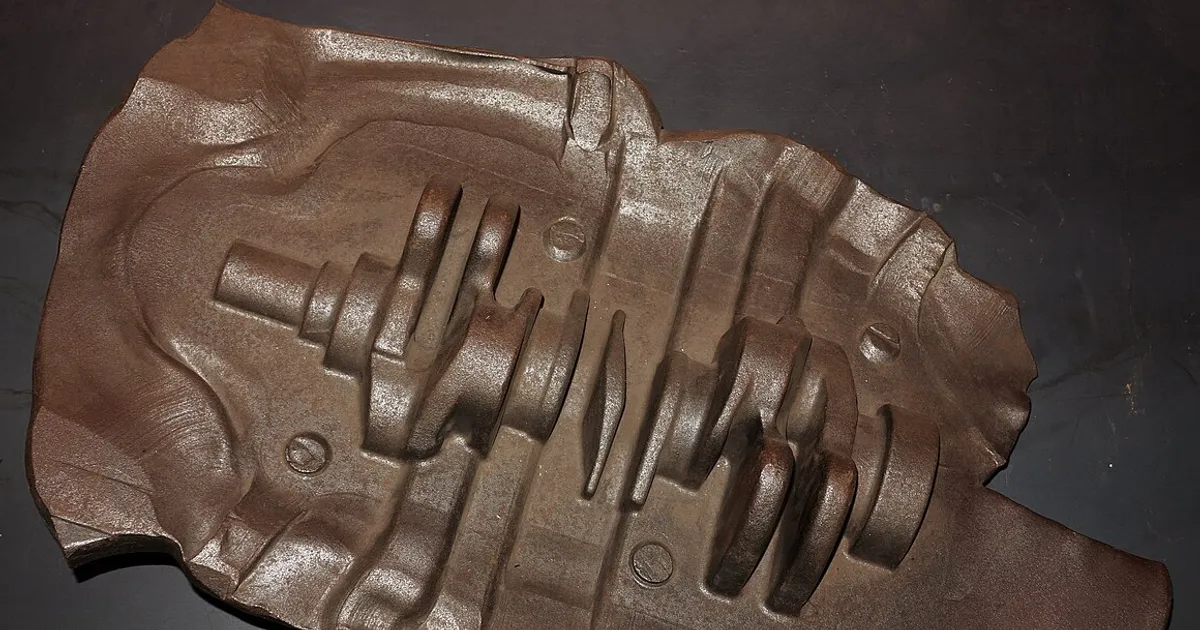
Forging material yield is the net part weight divided by the weight of the billet that went into the furnace. Everything between the two numbers is paid for in the quote: flash trimmed off at the parting line, scale lost to oxidation in the furnace and any end discards, with the machining stock on top if you buy a finished part. This guide shows where each loss comes from, what ranges published sources give, how to run the arithmetic on your own drawing and what to ask a supplier.
Where the material goes
The Forging Industry Association lists five primary sources of engineered scrap in forging: punch-outs, flash, other discards, material lost in furnace heating and machining allowance. Raw material for forging is bought as bars, billets, blooms or ingots, and the amount bought has to cover all five. The association also notes that forging usually produces a higher yield than casting, and a much higher one than machining a part out of plate or bar, but lower than powder metallurgy.
Each process loses material in a different place:
| Process | Where material is lost | Machining stock |
|---|---|---|
| Open die forging | Discards from one or both ends | Greatest of the forging processes |
| Impression (closed) die forging | Flash trimmed off, scale, sometimes a punched web | Moderate, less for near-net parts |
| Flashless (enclosed die) forging | Thin fin only, scale | Low, but billet weight must be tightly controlled |
| Ring rolling | Pierced center of the preform, scale on medium to large rings | Few if any operations |
| Cold forging | Almost none | Very little |
For ring rolling, the same guide says the preform typically uses up to 95 percent of the starting billet. That is why seamless rolled rings are often the material-efficient choice for round, hollow parts.
Flash: the largest and most variable loss
In impression die forging the metal is squeezed slightly beyond the cavity. The excess is the flash, a thin plate at the parting line that is trimmed off afterwards. It is not only waste. According to the FIA, flash cools quickly, restricts metal flow at the die edges and so helps the cavity fill, at the cost of high die pressure in the flash area. A gutter in the die lets the dies close at lower pressure.
Published figures vary widely, which is the honest answer to “how much?”:
- A vendor cost-estimating guide gives flash as 10 to 30 percent of billet weight for impression die forging.
- Wikipedia’s forging article says flash can account for 20 to 45 percent of the starting material.
- The same article says automatic hot forging, which makes no flash, saves 20 to 30 percent of material over conventional forging.
The spread comes from part shape. A compact, round part with simple geometry needs little flash. A part with long thin ribs or a deep boss needs more metal pushed to the edges to fill, and loses more.
Scale and furnace loss
Steel heated to forging temperature oxidizes at the surface. The scale falls off or is cleaned away, and its weight is lost. A steel industry reference gives the yield loss in reheating as 1.0 to 3 percent of the steel, depending on furnace conditions. Time at temperature, surface temperature and excess oxygen in the furnace atmosphere all raise it. The same source reports that cutting excess air from 70 to 20 percent can reduce the steel lost to scale by up to 35 percent.
Buyers do not control the furnace, but the figure explains two things. Scale loss is small next to flash. And long heating cycles, such as a heavy section waiting for a press, cost material as well as energy.
A worked example with assumed weights
The weights below are illustrative, not from any supplier. Take a steel part with these numbers:
| Item | Weight | Share of billet |
|---|---|---|
| Billet | 3.63 kg | 100.0 percent |
| Flash and trim loss | 0.55 kg | 15.2 percent |
| Scale | 0.08 kg | 2.2 percent |
| As-forged part | 3.00 kg | 82.6 percent |
| Machining stock removed | 0.60 kg | 16.5 percent |
| Finished part | 2.40 kg | 66.1 percent |
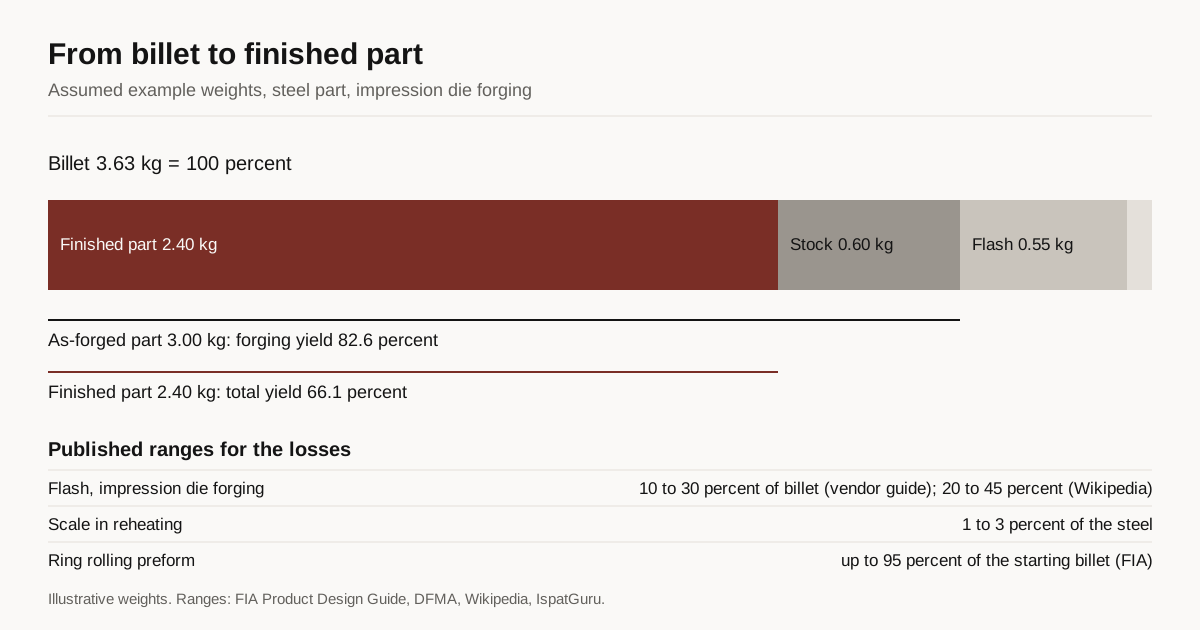
Forging yield is 3.00 divided by 3.63, or 82.6 percent. Total yield to the finished part is 2.40 divided by 3.63, or 66.1 percent. A supplier who quotes “83 percent yield” and a buyer who hears “83 percent of what I pay for ends up in the part I receive” are talking about different things whenever the part is machined afterwards.
Adding up the ranges above gives a rough check. Flash of 10 to 30 percent plus scale of 1 to 3 percent puts the forging yield of a flash-forged part at about 67 to 89 percent before machining stock. A claim far above that range deserves a question: is the part flashless, is a preform used or is the weight measured differently?
What drives yield, and what you can change
Some of it is in the drawing, and some in the supplier’s process:
- Radii and draft. The FIA notes that large radii make metal flow easier, and that near-net forgings with lower draft angles carry less material in the end product. Our guide to forging tolerances and draft angles shows how to read these on a drawing.
- Finish allowance. The FIA gives a rule of thumb of at least 5 mm of machining envelope per 300 mm of dimension for blocker type steel forgings, and typical finish allowances of 1.25 to 2.5 mm plus draft for finished forgings. Ask for the lowest allowance the supplier can hold, then check your machining process can clean up the surface.
- Preforming. A rolling, bending or blocker step puts metal where the finisher needs it, so less escapes as flash. It adds tooling.
- Flashless dies. They remove the trim operation and most of the flash, but the FIA warns that the volume of metal must be controlled within very narrow limits. That favors high volumes and stable processes.
- Alloy. Yield matters most with expensive material. A few points of flash on a titanium forging cost far more than on carbon steel.
What to ask the supplier
- Three weights. Billet weight, as-forged weight and net finished weight, with the drawing revision they refer to.
- Flash and scale allowance. The percentage assumed in the quote, and whether it changed with the last tooling revision.
- Scrap handling. Whether the quote credits any scrap value. Do not assume it does.
- Yield on repeat orders. Whether yield is expected to improve after die tryout and what happens to price when it does.
- Alternative processes. Whether ring rolling, a preform or a flashless die would change the yield at your volume.
Material is only one layer of the price. Our guide to forging cost per kg puts yield next to tooling, forging line and heat treatment, and forging vs casting vs machining compares material loss across the three routes.
Put it in the RFQ
Send the drawing, the alloy and specification, the yearly quantity and the finished state, and ask each supplier to state billet weight, as-forged weight and net part weight on the quote. Send an RFQ and we match you with up to 3 forging suppliers that fit the process, alloy and weight. We reply within 24 business hours.
To see where the material line sits in the whole price from billet to landed cost, read forging cost.
Sources
- Forging Industry Association, Product Design Guide for Forging: material cost, engineered scrap, flash, ring rolling, finish allowances.
- Wikipedia, Forging: flash as a share of starting material, flashless forging.
- DFMA, forging cost estimating: flash allowance range (vendor estimating page, directional).
- IspatGuru, reheating furnace scale loss: yield loss of 1.0 to 3 percent and the effect of excess air.
Frequently asked questions
What is a normal forging material yield?
It depends on process and part shape. Impression die parts lose material as flash, with sources giving 10 to 30 percent of billet weight for flash alone and 20 to 45 percent in some conventional work. Scale adds roughly 1 to 3 percent. Ring rolling is the high end, using up to 95 percent of the starting billet.
Does the buyer pay for the flash?
In practice yes, because the billet is bought and heated at full weight and the flash is cut off after forging. How the scrap value is credited differs by supplier. Ask whether the quote assumes any scrap credit and use the billet weight to compare quotes.
What is the difference between forging yield and total yield?
Forging yield compares the as-forged part with the billet. Total yield compares the finished machined part with the billet, so it also counts the machining stock. Both are useful, but a quote should say which one it uses.
How can I lower the material loss on my part?
Allow generous radii, keep draft and finish allowance no larger than the part needs and ask the supplier whether a preform step or a flashless die suits the volume. Each change trades lower material cost against tooling cost and process control.
Need a quote for this part?
Send the drawing. We match you with up to 3 forging suppliers and reply within 24 business hours.
Send my RFQ