Guides / Cost
Forging Cost per Kg: What Goes Into a Supplier's Price
November 1, 2026
Forging cost per kg is not a market price you can look up. It is the result of five separate cost layers, divided by the weight of the finished part. The same supplier will quote a different per-kg figure for a heavy, simple shaft than for a small, complex bracket in the same alloy. This guide shows what sits behind the number, a worked example with clearly assumed inputs and how to compare per-kg quotes without being misled.
Why there is no standard price per kg
No trade body or customs office publishes a price per kg for forgings. Steel bar prices move with the market, and the rest of the quote depends on the part. What does exist is a clear structure. The Forging Industry Association names five main cost drivers in its product design guide: material, tooling, manufacturing, secondary operations and quantities produced. Every quote you receive is built from those five, whether the supplier shows them or folds them into one line.
That is why a per-kg number taken from one forging supplier’s quote cannot be reused for a different part. It carries the yield, the die cost, the cycle time and the heat treatment of that one part.
The five cost layers
| Layer | What it contains | What moves it |
|---|---|---|
| Material | Billet or bar weight, which is the net part plus flash, scale and cut-off losses | Alloy, bar price at the time of quote, yield |
| Tooling | Die design and manufacture, trim dies, gauges and fixtures | Part size and complexity, number of impressions, expected die life |
| Manufacturing | Heating, the press or hammer, trimming, labor, plant overhead | Number of operations, cycle time, machine size |
| Secondary operations | Heat treatment, machining, straightening, testing, shot blasting, coating, packing | Finished state you order, inspection scope |
| Quantity | Setup cost and tooling spread over the order | Order size and yearly volume |
Two points from the FIA guide matter for buyers. Raw material for forging is bought as bars, billets, blooms or ingots, and the amount must cover punch-outs, flash, other discards and machining allowances. And manufacturing cost is charged cost center by cost center: each station has an hourly cost, divided by the pieces made per hour. A part with more operations costs more per piece, whatever its weight.
This is also why light parts cost more per kg. A press hour does not get cheaper because the part is small, so a 0.5 kg part carries a larger share of line cost per kg than a 20 kg part forged on a comparable machine.
A worked example with assumed numbers
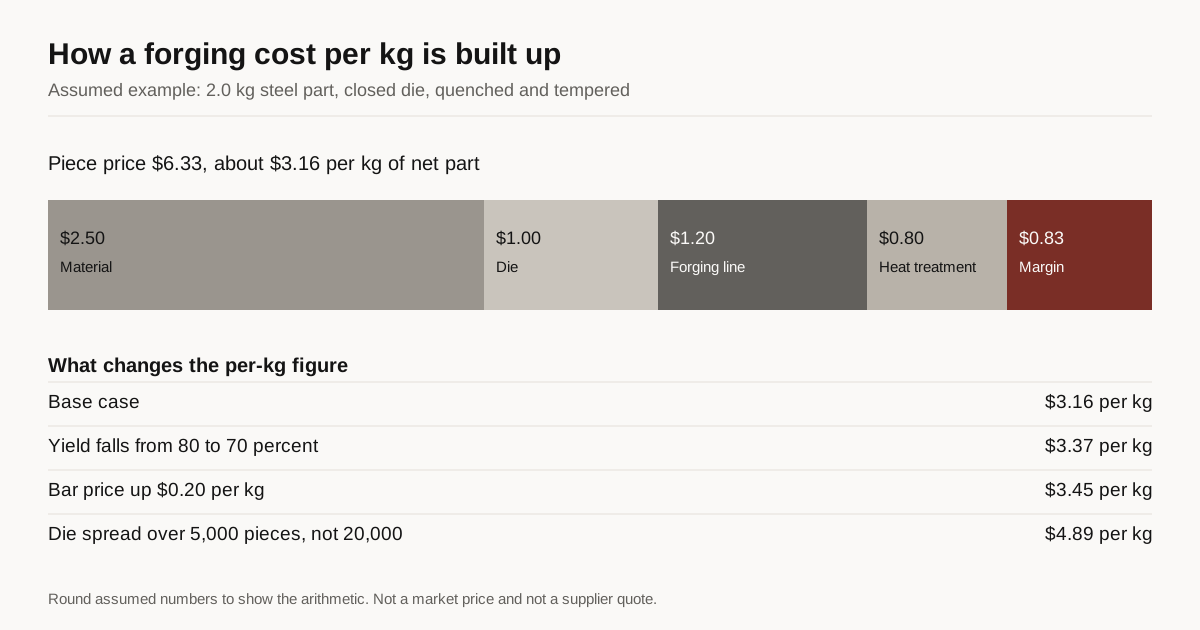
The numbers below are round figures chosen to show the arithmetic. They are not market prices and not a quote from any supplier. Take a 2.0 kg carbon steel part, closed die forged, quenched and tempered.
| Line | Assumption | Cost per piece |
|---|---|---|
| Material | 80 percent yield, so a 2.5 kg billet at an assumed $1.00 per kg | $2.50 |
| Die | $20,000 spread over 20,000 pieces of die life | $1.00 |
| Forging line | Heating, press, trim, labor (assumed) | $1.20 |
| Heat treatment | 2.0 kg at an assumed $0.40 per kg | $0.80 |
| Subtotal | $5.50 | |
| Margin | 15 percent (assumed) | $0.83 |
| Piece price | $6.33, about $3.16 per kg |
Now change one input at a time and watch the per-kg figure:
| Change | New piece price | Per kg of net part |
|---|---|---|
| Base case | $6.33 | $3.16 |
| Yield falls from 80 to 70 percent | $6.74 | $3.37 |
| Bar price rises by $0.20 per kg | $6.90 | $3.45 |
| Die spread over 5,000 pieces instead of 20,000 | $9.78 | $4.89 |
The last line is the one buyers miss. With the same part and the same supplier, a smaller order moves the per-kg price more than a steel price swing does, because the die has to be paid for by fewer pieces. Our guide to forging die cost covers how die price and payback are calculated, and the sibling note on forging material yield shows how to check the 80 percent figure.
Directional ranges, and how far to trust them
Some estimating pages from forging vendors publish ranges. They are useful as a sanity check and not as a price list, because they are broad, undated and written for marketing.
- One cost-estimating guide gives steel billet at $0.30 to $1.50 per lb (about $0.66 to $3.31 per kg), flash at 10 to 30 percent of billet weight and heat treatment at $0.10 to $0.50 per lb (about $0.22 to $1.10 per kg).
- The same guide puts impression die tooling at $10,000 to $100,000 or more and open die tooling at $500 to $5,000. A second supplier guide puts closed die tooling at $5,000 to $50,000, with simple single-cavity dies at the low end.
- Wikipedia’s forging article states that flash can account for 20 to 45 percent of the starting material in conventional impression die forging.
The spread between these ranges is itself the lesson. A buyer who plugs one of them into a spreadsheet gets a number that could be off by a factor of two. Ask for quotes on your drawing.
How to compare per-kg quotes fairly
A per-kg figure is a ratio, and a ratio changes when either side changes. Before you compare two suppliers, put these on the same footing:
- Weight basis. Net part weight, as-forged weight or billet weight. Ask for all three.
- Finished state. As-forged, normalized, quenched and tempered, rough machined or finish machined. Heat treatment alone adds a layer of cost, covered in heat treatment of forgings.
- Quantity. The same yearly volume and the same order size on both quotes.
- Tooling terms. One-time die charge or amortized into the piece price, who owns the die and what happens if volume falls short.
- Tests and documents. Chemistry, hardness, mechanical tests and any non-destructive testing. These are secondary operations and they cost money.
- Incoterm and packing. Ex works, FOB or delivered, and the packing method.
If one supplier quotes $2.80 per kg as forged and another $3.60 per kg quenched, tempered and shot blasted, you have not learned which shop is cheaper. You have two answers to two different questions.
When forging beats the alternatives per kg
Forging is not always the lowest cost per kg. It tends to win when the part is load-bearing, the volume pays back the die and machining from bar would remove a large share of the material. For low volumes or for parts that are mostly machined away, bar stock or casting can come out lower. Our forging vs casting vs machining comparison goes through that decision, and how to choose a forging supplier covers what to ask before you send the drawing.
Put it in the RFQ
To get a per-kg figure you can trust, send the drawing with the alloy and specification, the yearly quantity and first order size, and the finished state you need. Ask each supplier to break the quote into material, die, piece price, heat treatment, testing and packing, and to state the billet weight, the as-forged weight and the net part weight. Send an RFQ and we match you with up to 3 forging suppliers that fit the process, alloy and weight. We reply within 24 business hours.
For the lines around the per-kg figure (die ownership, steel clauses, Incoterms, duty), read our guide to forging cost.
Sources
- Forging Industry Association, Product Design Guide for Forging, section 3.3 on cost drivers.
- DFMA, forging cost estimating (vendor estimating page, ranges are directional).
- Closed die forging buyer’s guide, mfg-solution (supplier guide, tooling ranges are directional).
- Wikipedia, Forging, on flash as a share of starting material.
Frequently asked questions
What is a typical forging cost per kg?
There is no public price survey, and a per-kg figure only means something for one alloy, one weight, one finished state and one quantity. The same shop can quote very different per-kg prices for a simple 20 kg shaft and a complex 0.5 kg bracket. Compare quotes on the same drawing instead.
Is forging priced by the weight of the billet or the finished part?
Material is bought by billet weight, which includes flash and scale, but most suppliers quote the piece price per part or per kg of net part. Ask which weight the per-kg figure uses, because billet weight sits well above part weight: one estimating guide puts flash alone at 10 to 30 percent of billet weight.
Why does a forging quote have a separate tooling line?
Closed die forging needs a die set that is built once for the part. Suppliers either show it as a one-time charge or spread it over an agreed volume inside the piece price. Ask which method each quote uses before comparing prices.
Does heat treatment change the cost per kg?
Yes. Normalizing, quenching and tempering add furnace time and handling, and they are often priced per kg. A quote for an as-forged part and a quote for a quenched and tempered part are not comparable until you state the same condition on both.
Need a quote for this part?
Send the drawing. We match you with up to 3 forging suppliers and reply within 24 business hours.
Send my RFQ